Initial tests with tethered, unmanned balloons revealed their main difficulty: their relative inability to hover in strong winds. A new approach was needed, and Dragonfly Pictures Inc. (DPI) developed a new class of drone: a tethered drone that remained above its location without moving.
Unlike battery-powered multirotor drones, which require battery changes every 20 minutes, tethered drones are powered via an electrical cable connected to a base station. This allows them to remain airborne for hours or even days. DPI's tethered multirotor drones are designed to track and follow mobile motherships such as ships, boats, trucks, and other unmanned vehicles, both marine and land-based.
They offer several advantages over fixed-wing drones, such as their ability to take off and land vertically without the need for a runway, launcher, or recovery equipment. Unlike a balloon, they also offer the possibility of persistent and stationary positioning, even in adverse weather conditions or when wind speeds change rapidly.
DPI's tethered drones have undergone numerous tests under real operating conditions and are currently in the homologation phase by the U.S. Navy in marine/maritime environments for intelligence, surveillance, reconnaissance, communications and video applications.
How to overcome enormous design challenges:
DPI's military and industrial-grade UMAR (Unmanned Multirotor Aerial Relay) tethered drone withstands rain, snow, dust and heat, and is optimized for marine environments with salt water.
UMAR drones are particularly advantageous because they can operate continuously for over 400 hours at altitudes up to 500 feet (approximately 150 m) thanks to their continuous power supply. However, this design presents significant challenges. Power must be supplied from the mothership to the multirotor drone at a very high voltage and low current to allow the use of the thinnest and lightest cable possible, thus increasing the drone's mobility and payload capacity.
UMAR drones, with an operating power of 8 to 10 kW, are extremely powerful and robust, capable of persistently maintaining a stationary position under the adverse conditions of marine storms. This challenge is often compounded by turbulent waters and waves that affect the mothership's position. Therefore, the drones require the capacity and agility to accelerate rotor speed, tilt, and maneuver in short or extended bursts, depending on the conditions, to maintain altitude with an instantaneous response time.
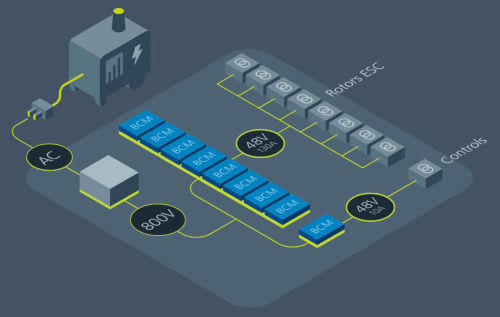
Inside the multirotor drone, high-voltage conversion must be carried out in minimal space and with minimal weight. The eight independent rotors on board the UMAR require sophisticated, interconnected circuitry on the printed circuit board so that any space saved on power components can be allocated to other value-added components.
“Vicor’s power modules have allowed us to reduce the weight of all drone components in order to increase altitude and speed, as well as carry the mission payload,” said Joe Pawelczyk, Vice President of Operations at DPI. “No one else offers Vicor’s power density, so we’ve achieved the highest levels of maneuverability, performance, and flight control with their components. This allows DPI’s tethered drones to carry more weight, fly higher, and be faster.”
Power density optimized architecture.
To meet these demanding power requirements, DPI utilizes Vicor's low-profile, high-voltage (HV) BCM® VIA™ modules in its UMAR to achieve high-efficiency conversion (98%) with only 2% losses and heat between 800V and 50V. The compact size and versatile mounting of the HV BCMs are especially valuable for achieving a system with extremely high power density and very low weight.
There are eight Vicor HV BCM4414 modules arranged in parallel to power the eight independent rotors of DPI's UMAR, with the option for the rotors to share power for increased redundancy. The inherently low EMI generation, with few high-frequency harmonics, along with the electromagnetic interference (EMI) filtering integrated into the Vicor HV BCMs, has helped minimize EMI noise while adding less size and weight than conventional DC/DC converters. Without filtering, noise can affect RF communications between the drone and the motherships and/or violate EMI regulations.
In addition to the tests currently being conducted by the U.S. Navy, DPI technology is being evaluated by various public agencies, contractors, and other entities, and has shown great promise for other applications, such as emergency services in disasters and monitoring of large areas (public events, stadium security, etc.).