

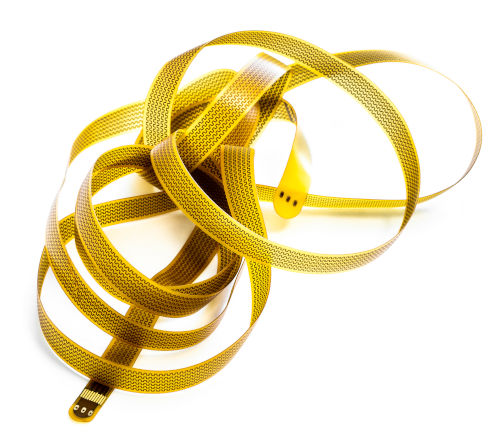
Trackwise's IHT process enables the fabrication of flexible, multilayer printed circuit boards of unlimited length, resulting in significant space and weight savings, increased reliability and repeatability, and reduced assembly time. IHT FPCs can withstand the harsh environments of aerospace, industrial, and automotive applications, but can also be made small enough to replace microwires in medical applications such as catheters.
"The diversity of applications using our IHT FPCs to drive product innovation is enormous," says Philip Johnston, Managing Director of Trackwise. "Design engineers have quickly recognized the significant advantages of IHT FPCs. It's inspiring to see their visions for future products become reality as they take advantage of replacing conventional interconnects and wire harnesses with our lighter, smaller, cheaper, more reliable, and repeatable alternatives."
Examples of customer innovations inspired by the company's FPC IHTs that are being evaluated or are in development include:
- AgriTech: Supply chain challenges and concerns about sustainability and food utilization are driving demand for agritech applications such as vertical farming in urban environments. Trackwise can manufacture flexible printed circuit boards of any length with sensors that enable the monitoring and control of lighting, climate, and irrigation needed to automate these types of indoor installations 24/7.
- Wearables: Flexible, printed electronics, along with ubiquitous connectivity, are enabling the use of smart technologies that can be worn or embedded in clothing for a wide range of uses:
o MedTech: The improved sensing, connectivity, and intelligence provided by IoT and wearable technologies offer new ways to effectively manage the healthcare needs of an aging population, helping to maintain independence while increasing comfort and safety. Sensors can be sewn into clothing or incorporated into wearable devices, enabling continuous remote monitoring of biomarkers such as temperature, blood sugar levels, and heart rate, as well as location and event-based tracking of accidents like falls. Alerts can be triggered with medical professionals or emergency services.
Smart fabrics: Whether for fashion or more functional uses, electroluminescent materials and fiber-based micro-LEDs can be woven into clothing fabrics to create wearable smart textiles, helping to improve safety and visibility while running, cycling, or walking the dog (or even when lost on a mountainside), or perhaps simply displaying the name of the latest headliner at a concert.
- Sports and fitness: Consumer wearables, such as smartwatches, contribute to the "quantified self" (QS) phenomenon, in which people track, collect, and record a wide range of behavioral, physiological, and environmental data to monitor and improve their overall health. Professional athletes, from tennis and soccer players to marathon runners and F1 drivers, can also use wearables to monitor vital signs, as well as for positional tracking via GPS and IMUs (inertial measurement units).
- Industrial sensing: Long FPCs with pressure sensor arrays, strain gauges, or linear measurement sensors can be used to monitor the position and speed of an elevator car in its shaft or to investigate the interior of industrial piping.
- Heating elements: FPCs can also power heating elements for applications such as de-icing aircraft wings, tails, or air intakes, or for innovative applications like infrared electric wallpaper.
Johnston concludes: "Design engineers are ingenious problem solvers who are applying these innovative flexible printed circuit board technologies to solve their design challenges and enable smarter, more advanced products across a wide range of industries and applications."