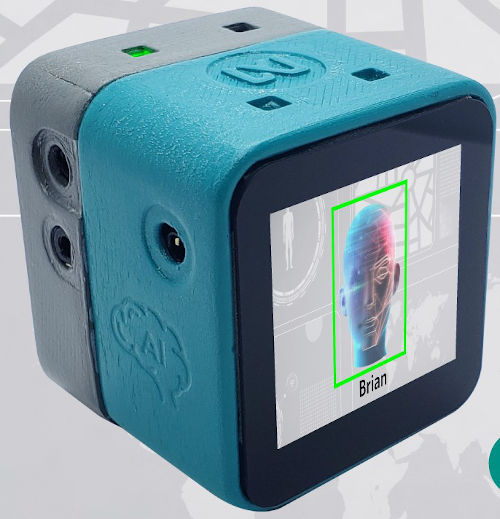
The MAXREFDES178# enables ultra-low-power Internet of Things (IoT) devices to implement hearing and vision capabilities and showcases the MAX78000 low-power microcontroller with a neural network accelerator for audio and video inference. The system also includes the ultra-low-power MAX32666 Bluetooth® microcontroller and two MAX9867 audio codecs . The entire system is presented in an ultra-compact form factor to demonstrate how AI applications, such as facial recognition and keyword recognition, can be integrated into low-power, cost-sensitive applications like wearables and IoT devices.
AI applications require computationally intensive processing, typically performed in the cloud or on expensive, power-hungry processors that are only suitable for applications with large energy budgets, such as self-driving cars. But the MAXREFDES178# camera cube demonstrates how AI can operate on a low power budget, enabling time- and safety-critical applications to run on even the smallest batteries. The MAX78000's AI accelerator reduces the power consumption of AI inferences by up to 1,000 times for vision and hearing applications, compared to other embedded solutions. AI inferences running on the MAXREFDES178# also show dramatic improvements in latency, running more than 100 times faster than on an embedded microcontroller.
The compact form factor of the camera cube, measuring 41 mm x 44 mm x 39 mm, demonstrates that artificial intelligence can be deployed in wearable devices and other space-constrained Internet of Things applications. The MAX78000 solution is up to 50% smaller than the next smallest GPU-based processor and does not require additional components such as complex memory or power supplies to implement cost-effective AI inference.