Society is reaching a tipping point where robots are bringing enormous advantages to our lives. Some robots take orders in restaurants, others handle security, and still others work on construction sites to increase the accuracy of blueprints. Robots are everywhere, and this proliferation is thanks to companies like OLogic.
OLogic, Inc., an electronics consulting firm based in Santa Clara, California, USA, has over 15 years of experience helping clients commercialize their robotic designs in both small and large quantities. They provide electrical, mechanical, and industrial engineering support, as well as software and firmware development. This requires advanced knowledge of power electronics integration, a critical design element that determines the autonomy, functionality, and payload capacity of mobile robots.
“I think the main reason they contact us is that they need help designing the electronics for the robot they’re going to build, and we understand that need better than anyone because we’ve built dozens and dozens of robots,” said Ted Larson, CEO of OLogic. “They can hire an engineer who has worked at a robotics company, or they can hire someone to manage their project with us, and it will be a success.”.
OLogic has designed numerous robots across diverse sectors, including agriculture, smart homes, and warehouse management, to name a few. OLogic began building its customer base in robotics as a startup, considered by many to be the progenitor of mobile robotics in Silicon Valley. Willow Garage was notable for its ability to integrate commercial and open-source software from universities and other organizations to help robots perform complex tasks.
When the company dissolved in 2014, it created a diaspora of robotics software experts who went on to found nearly all of the major robotics startups in the Bay Area. This generated new business opportunities for OLogic with companies such as Savioke, Knightscope, Fetch, and Dusty Robotics.
“The big stars of the robotics industry are those who develop high-level software for things like machine learning or algorithmic robot task navigation,” Larson noted. “Electronics kind of comes later. The problem is that these people think they can get ahead by buying everything off the market and then interconnecting it. But things soon get complicated.”.
Power supply emerges:
Mobile robots have unique power requirements. The sensors, servomotors, actuators, data servers, communication systems, and other devices that power the robot have varying power requirements and power densities. Some consume a lot of power, while others operate infrequently. This necessitates fast, clean, and cost-effective power supply from a battery.
Vicor Corporation has presented OLogic with a modular technique for developing power networks for robots. Vicor's high-density power modules have enabled highly efficient and easily scalable power conversion.
“The devices we’ve been using most lately are Vicor’s ZVS step-down regulators,” Larson said. “We’re now using them in robots for all sorts of applications. I no longer have to think, ‘I need 5 or 10 A at 12 V, so I’m going to build my own power supply.’ I don’t even think that way anymore.”.
Saving time and money by automating building layout.
One client that works closely with OLogic to optimize its consumption is Dusty Robotics (Dusty). This Mountain View, California-based company develops robot-based tools for modern construction.
For centuries, the construction industry has used two simple tools to mark out building plans on the ground: a tape measure and a chalk line. Even today, when architects design buildings using sophisticated 3D CAD models, the layout is still printed on paper, taken to the construction site, and then manually transferred to the ground. The tape measure and chalk process is slow and prone to human error, which impacts deadlines and budgets. These errors often require rework and typically account for 10% of a construction project's cost, according to Dusty.
“When plans are drawn by hand, many errors are made—far more than the construction industry realizes,” said Philipp Herget, co-founder and CTO of Dusty Robotics. “We’ve heard of cases where drafting errors have led to construction companies going bankrupt. We prevent these errors because everything is marked correctly: not by hand, but by a robot.”.
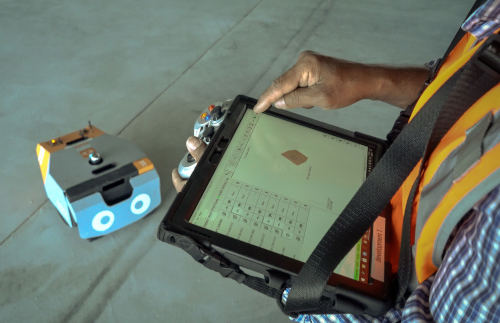 Dusty's FieldPrinter is five times faster and makes no mistakes.
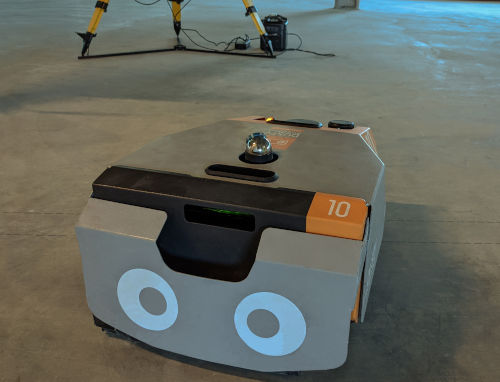
Dusty eliminates the laborious conventional process of physically transferring building plans to the ground with a robot programmed on-site to automate this task. Dusty's FieldPrinter robot loads a digital version of the plan and prints the layout onto the ground, including elements such as walls, doors, pipes, and electrical lines. And it does so at speeds approximately five times faster than a person with an accuracy of around 1.5 mm.
This innovation helps the construction sector operate more like a digitized manufacturer by increasing consistency, predictability, and reliability, while also improving working conditions for the skilled personnel involved in construction. Dusty also contributes to improved efficiency by joining the builder's prefabricated panels, an increasingly common option. Unlike hand-built walls, for example, which can be adjusted on the fly, prefabricated building materials are designed to be joined in only one way, which can lead to errors if not installed correctly.
Dusty FieldPrinter helps the construction industry function more like a digitized manufacturer by increasing consistency, predictability, and reliability, as well as improving working conditions for the skilled personnel who carry out construction work.
“If you can reduce the time spent, you can increase the speed at which the building is constructed,” Herget stated. “And the sooner the building is finished, the sooner you start billing. Time is money. Speed has enormous value in the construction industry.”.
Dusty's FieldPrinter Robot Power Supply:
Dusty's FieldPrinter is a battery-powered mobile robot that operates for extended periods under varying weather conditions. It incorporates numerous electronic devices, including sensors, control motors and motorized components, high-performance processors, and a printer, all with different voltage and current requirements. Therefore, a significant portion of Dusty's electronic design is dedicated to power conversion to supply power to these numerous components in an environment where the battery's output voltage is constantly fluctuating.
That's why Dusty collaborated with OLogic to develop the core electronics. OLogic initially used discrete power solutions. However, over time they discovered it was impossible to design something with the operational and thermal efficiency, as well as the wide operating range, of Vicor's power module. Furthermore, Vicor modules like the ZVS buck regulator are extremely cost-effective for the power they deliver.
“Vicor’s ZVS buck regulators deliver between 200 and 300 W of power in a tiny package and are 97% efficient,” Larson emphasized. “You couldn’t design something like this from scratch and get it to work well for the same price. There’s no reason not to use Vicor products as a result. It’s easier than designing it yourself. It’s faster, there’s no validation required, and the risk is lower.”.
Dusty's robots are complex and require 12V, 5V, and 3V rails that operate at significant power levels. Managing power conversion using a combination of Vicor modules helps accelerate the design process by ensuring reliable operation across different operating and temperature ranges, both indoors and outdoors.
Thanks to its long battery life and state-of-the-art power conversion technology, Dusty's robotic innovation is helping to digitize the construction industry by creating a single source of truth on the job site based on a digital model. Instead of the architect, contractor, and each supplier working from their own plans, they all rely on a single design printed on the ground. The ability to provide a digital layout improves coordination between all parties, thus enabling better planning and execution, as well as faster project completion.
“Construction automation increases people’s productivity,” Herget noted. “Before, they used screwdrivers, and now they use power tools. It simply makes their work much easier. Our robotic tools allow the construction sector to improve its results and the working environment for skilled personnel.”.