

However indispensable these systems may be, they face a number of unique and formidable challenges, most notably the dual threat of cyber vulnerabilities and space radiation.
The Growing Importance and Vulnerability of Satellite Communications
. Satellite communications are inherently exposed. Unlike terrestrial networks, which can be physically protected and monitored, satellites operate in the vastness of space, transmitting signals across thousands of kilometers. This makes them susceptible to a wide range of threats:
Espionage and interception: Adversaries may attempt to intercept satellite signals to gain unauthorized access to sensitive data.
Data manipulation and falsification: Malicious actors may attempt to alter or falsify data in transit, undermining the reliability of communication.
Denial-of-service attacks: Interference with or saturation of satellite channels can disrupt critical services, from navigation to emergency response.
These threats are not hypothetical. Incidents of satellite signal interference and spoofing have been documented in both civilian and military contexts. As geopolitical tensions rise and the commercial space sector expands, the attack surface for satellite communications continues to grow.
The Hidden Threat: Radiation-Induced Errors
While cybersecurity threats are well-known, there is a less visible but equally dangerous challenge in the physical environment of space itself. Satellites operate in a high-radiation environment, where they are constantly bombarded by cosmic rays, solar particles, and trapped radiation belts. These high-energy particles can cause single-event effects (SEEs), which are disruptions in electronic circuits caused by a single ionizing particle.
One of the most common SEEs is the single perturbing event (SEU), in which a charged particle strikes a semiconductor device and changes a bit in the memory or logic. In the context of satellite communications, this can lead to:
• Corrupted data packets: A single reversed bit can render a message unreadable or incorrect.
• Loss of encryption integrity: If a bit reversal occurs in an encryption key or authentication tag, it can invalidate the entire cryptographic process.
• System instability: Repeated SEUs can accumulate and cause wider system failures or outages.
These radiation-induced errors are particularly insidious because they are random, difficult to predict, and can mimic the effects of cyberattacks or hardware failures. Traditional error detection and correction methods, while useful, are not always sufficient, especially when data integrity and security are paramount.
The challenge of balancing security, performance, and reliability:
To address these threats, satellite systems must implement robust encryption and authentication mechanisms. The Advanced Encryption Standard (AES) is widely used for this purpose, as it offers strong protection against unauthorized access. However, not all encryption methods are created equal.
In high-performance, real-time communication systems, such as those used in satellites, encryption must be:
• Fast and efficient: Latency and throughput are critical in satellite links.
• Authenticated: Encryption alone is not enough; data integrity must also be verified.
• Radiation-resistant: Cryptographic operations must tolerate SEUs without compromising security.
This is where traditional encryption schemes often fall short. Many do not provide built-in authentication, requiring additional mechanisms to verify data integrity. Others are not optimized for the limited power and processing environments of space systems. And few are designed with radiation resistance in mind.
The hardware gap: limitations of conventional platforms.
Even the best cryptographic algorithms are only as effective as the hardware on which they run. In space applications, the hardware must meet stringent requirements:
• Radiation tolerance: Devices must withstand SEUs and other radiation effects without data loss or corruption.
• Low power consumption: Satellites have limited power budgets, especially on small platforms like CubeSats.
• Secure key storage: Cryptographic keys must be protected from both physical and logical attacks.
• High-speed I/O: To support modern data rates, the hardware must offer fast and reliable interfaces.
FPGAs and conventional processors often struggle to meet these demands. Volatile configuration memory is vulnerable to SEUs. External key storage can pose a security risk. And general-purpose processors may lack the performance required for real-time encryption and authentication.
The Need for an Integrated, Radiation-Resistant Security Solution
Faced with these challenges, the satellite industry needs a new approach—one that integrates robust cryptographic capabilities with radiation-resistant hardware and an efficient system design. The ideal solution should:
Combine encryption and authentication into a single, efficient algorithm;
detect and respond to SEUs in real time, ensuring data integrity even in the presence of radiation;
leverage secure, non-volatile memory for storing keys and initialization vectors;
offload cryptographic operations to dedicated hardware to reduce CPU load and power consumption;
and provide a scalable platform that can adapt to different mission profiles and performance requirements.
Microchip addressed this problem with a solution that integrates Advanced Encryption Standard - Galois/Counter Mode (AES-GCM) encryption with authentication, a radiation-tolerant FPGA fabric, and a dedicated cryptographic coprocessor, all within a secure, low-power platform.
Overview of the AES-GCM-256 Solution for Secure Satellite Communications:
To address the multiple challenges of secure and reliable satellite communications, Microchip presents a robust solution based on the AES-GCM-256 encryption algorithm, implemented on Microchip's PolarFire® and RT PolarFire FPGA and SoC platforms. This solution is designed to ensure both data confidentiality and integrity while withstanding the harsh radiation environment of space.
Key features include:
• AES-GCM-256 integration: The solution leverages AES-GCM, which combines encryption and authentication into a single, efficient algorithm. This dual capability is critical for detecting both malicious tampering and radiation-induced bit changes.
• Radiation-tolerant hardware: PolarFire FPGAs feature single-event disturbance-immune configuration logic (SEU), along with memory blocks protected by single-error correction and double-error detection (SECDED) and secure non-volatile memory (sNVM), making them ideal for space applications.
• Dedicated cryptographic coprocessor: The Athena TeraFire® EXP5200B cryptographic coprocessor offloads cryptographic operations from the main processor, improving performance and reducing power consumption. It also includes a true random number generator for secure IV generation.
• Secure key management: Encryption keys are stored in the on-chip integrated sNVM, protected by AES-SIV encryption, ensuring data security at rest. The system supports secure provisioning and runtime key management.
• End-to-end message protection: Messages are encrypted, authenticated, and buffered in SEU-immune buffers before transmission. At the receiving end, the same architecture verifies message integrity and authenticity, and failed authentications trigger retransmission requests.
• Demonstration design: A working demonstration on the PolarFire MPF300TS device shows the complete encryption and decryption cycle using proof vectors, with support for automated testing via TeraTerm macroscripts.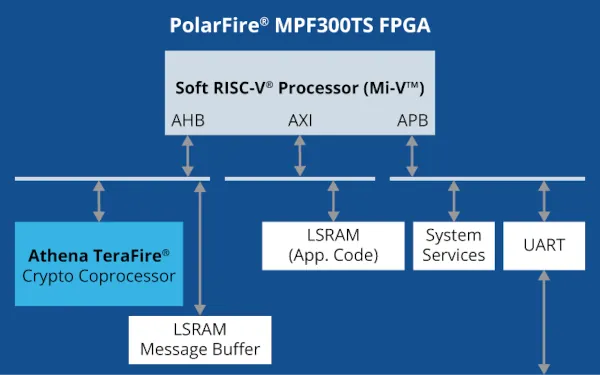
Figure 1: Block diagram of the AES-GCM-256 encryption algorithm, implemented on the Microchip PolarFire® FPGA
Microchip's PolarFire FPGA provides a robust and secure platform for implementing advanced cryptographic solutions, such as the AES-GCM-256 encryption algorithm. In this architecture, a soft RISC-V CPU (Mi-V™) coordinates system operations, with its application code stored and executed from high-speed LSRAM memory blocks within the FPGA fabric. The Mi-V processor interfaces with several key peripherals to deliver a complete encryption solution.
The Athena TeraFire cryptographic coprocessor is leveraged for hardware-accelerated AES-GCM encryption and random number generation, ensuring both performance and security. Encrypted messages are temporarily stored in a dedicated LSRAM message buffer, while system services provide a secure interface to the sNVM block for storing and accessing AES cryptographic keys. Additionally, a UART interface enables user interaction, allowing for the retrieval of payload data and parameters for demonstration purposes. This tightly integrated design highlights the flexibility and security of the PolarFire FPGA platform for modern cryptographic applications.
The integrated approach not only protects satellite communications against cyber threats but also provides robust defense against the unpredictable effects of space radiation. It exemplifies how modern cryptographic techniques, when combined with radiation-resistant hardware, can deliver reliable, high-performance communication systems for space missions.
Author: By: Tim Morin, Senior Technician, FPGA Business Unit, Microchip Solutions
https://www.microchip.com/en-us/products/fpgas-and-plds/radiation-tolerant-fpgas