
However, configuring these complex integrated circuits and evaluating the system's potential performance based solely on datasheets or simulations is challenging. The process can be lengthy and expensive, and may introduce uncertainties during implementation. The best approach is to conduct development in parallel with the system design, layout, and software development phases, using evaluation boards.
This article highlights some of the challenges designers face when using motion control integrated circuits and the role of evaluation boards in addressing them. It then presents exemplary integrated circuits and associated evaluation boards from Analog Devices that shorten time to market by enabling early, realistic evaluation, while reducing hardware and software uncertainties.
Summary of Motion Control Integrated Circuit Requirements:
Motion control integrated circuits provide the intelligence needed to control the motor and its internal power devices, such as the MOSFETs that drive the motor windings. Both the motor and the MOSFETs require careful management to achieve optimal performance, path, motion profile, and efficiency in static and dynamic operating modes and under various load conditions, as well as to handle disturbances, transients, and faults.
To help address these challenges, integrated circuit (IC) controller vendors offer evaluation boards. These simplify the configuration, optimization, and performance evaluation of hardware and software by enabling hardware-in-loop testing (HITL) with a real motor and load under varying conditions. They also ensure that the physical layout of the IC and surrounding circuitry is correctly established with regard to power distribution, parasitic effects, connectivity and input/output (I/O) formats, physical connectors, and more. Available as mid-range boards, basic patch boards (BOBs), or modular solutions, these boards allow designers to evaluate different settings, configurations, and options to determine the best fit for the application.
Motor Control ICs and Associated Boards
A good example of a motor control IC is the TMC5130A-TA-T from TMC5130 . This is a high-performance stepper motor driver and controller with serial communication interfaces that includes a flexible ramp generator for automatic target positioning.
Using a sophisticated StealthChop chopper algorithm, the driver ensures virtually silent operation, maximum efficiency, and optimal motor torque. The TMC5130 offers several unique improvements thanks to the integration of the driver and controller into a system-on-a-chip (SoC). For example, the TMC5130's SixPoint ramp generator uses the DcStep, CoolStep, and StallGuard2 functions to automatically optimize each motor movement.
To help designers get started with the TMC5130, the TMC5130-EVAL (Figure 1) provides a convenient hardware platform and easy-to-use software tool for evaluation. The board system consists of three parts: a motherboard-to-computer connection bridge (left), a connector board that includes several test points (center), and the TMC5130-EVAL board (right).
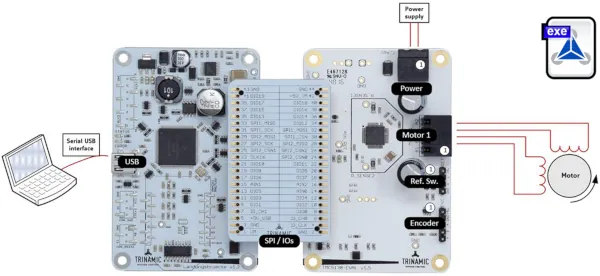
Figure 1: The TMC5130-EVAL evaluation board (right) and motor load (far right) are configured using a USB jumper to connect to a PC (left) and a connector board with test points (center). (Image source: Analog Devices)
For designers who prefer to develop more of their own circuitry around a TMC5130-based core, Analog Devices offers the TMC5130A-BOB (Figure 2, above). This board provides the basic interconnections necessary for operation and is controlled via an SPI interface. Its schematic diagram (Figure 2, below) shows the minimalist circuitry it provides to enable a functional TMC5130 IC.
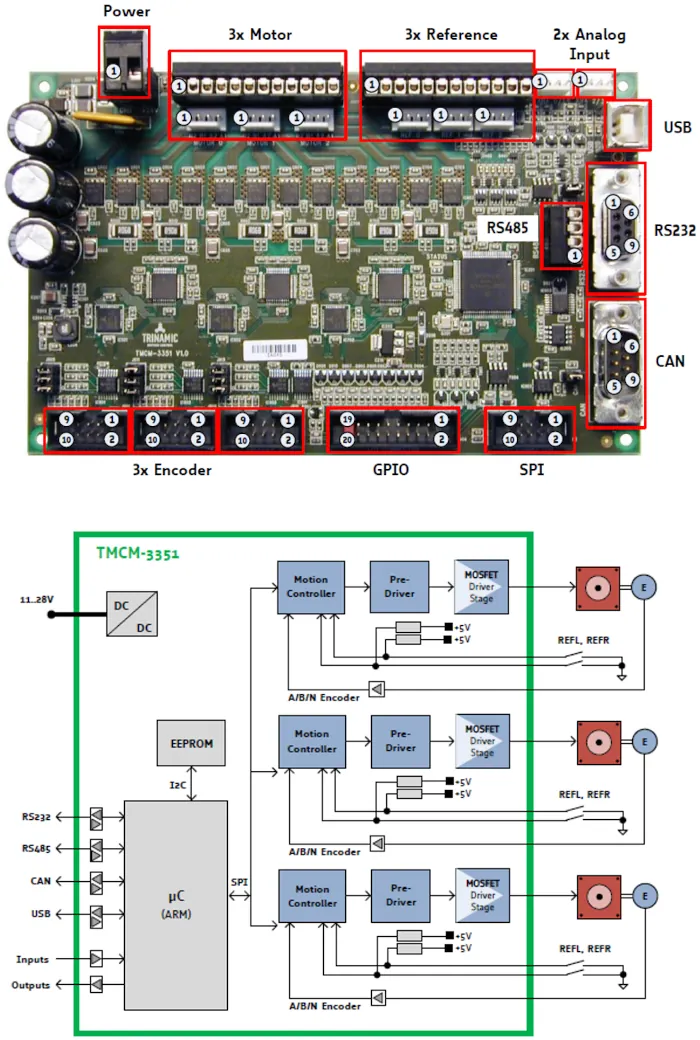
Figure 2: The TMC5130A-BOB (top) provides a basic evaluation approach, with connection points along its edges instead of discrete connectors; its schematic diagram (bottom) shows the minimum circuitry required to enable a functional TMC5130 IC. (Image source: Analog Devices)
The TMC5240-EVAL evaluation kit is based on the proven TMC5130-EVAL platform to optimize the evaluation of next-generation stepper motors, integrating 36V H-bridges, lossless current sensing, and advanced motion control with a jerk-optimized ramp generator and ultra-quiet StealthChop2™ operation, enabling faster commissioning, easier tuning, and more efficient validation of smooth, precise motor performance.
Advanced control eliminates the need for feedback sensors. Field-oriented control (FOC), also known as vector control, is an increasingly popular approach for controlling a wide range of motors because it eliminates, in many cases, the need for feedback sensors such as encoders or Hall effect sensors, along with their associated costs and size. The main difference between FOC and non-FOC techniques is that FOC requires high-precision calculations and matrix mathematics that must be performed in real time. The Analog Devices TMC4671 -LA motor driver IC is specifically designed for FOC, with its built-in algorithms and a dedicated motor for the complex calculations required to execute them. This servo controller for DC, brushless DC (BLDC), and stepper motors provides torque control via FOC, along with speed and position control via cascade control.
The TMC4671-A supports SPI and UART links for basic communication with a low-end supervisory microcontroller (MCU). All control functions are implemented in hardware, with integrated ADCs, position sensor interfaces for optional feedback, position interpolators, and more, providing a fully functional servo controller for a wide range of servo applications.
The TMC4671-EVAL board (Figure 3) for the TMC4671-A simplifies the configuration of the necessary FOC parameters and the evaluation of motor performance under this advanced control scheme. The designer connects the TMC4671-EVAL with the jumper, the associated baseboard, and a separate power stage. This configuration allows for easy setup of the proportional-integral (PI) controllers and feedback schemes, and supports motor operation in standard position, speed, and torque control modes.

Figure 3: The TMC4671-EVAL board has two rows of connectors for signal I/O and power. (Image source: Analog Devices, modified by the author)
The pin connectors on the top of the TMC4671-EVAL are for connecting digital encoders, digital Hall-effect sensor signals, and reference switches. The pin connectors on the bottom of the board are for analog Hall-effect sensor signals or a sine/cosine encoder. Designers who prefer to build their own evaluation circuit around a functional motor driver core can use the TMC4671-BOB breakout board (Figure 4, top). It provides SPI and UART interfaces for communication and configuration, along with a real-time monitoring interface (RTMI) for live debugging and tuning via the galvanically (ohmically) isolated USB-2-RTMI_V20 adapter (Figure 4, bottom)

Figure 4: The TMC4671-BOB (top) provides direct access to the TMC4671, as well as SPI and UART interfaces; the associated USB-2-RTMI_V20 adapter (bottom) is a galvanically isolated USB interface. (Image source: Analog Devices)
This adapter provides USB interface conversion for real-time monitoring of the FOC TMC4671-LA IC controller. The high-speed USB-to-SPI bridge interface converter is USB-powered and provides basic electrostatic discharge (ESD) protection, as well as galvanic isolation between the USB and RTMI connectors to prevent safety issues and ground loops.
All-in-One Evaluation Kit
Finally, in some cases, Analog Devices' complete evaluation board can serve as a drop-in product. For example, the TMCM-3351-TMCL (Figure 5, top) is a three-axis stepper motor driver/driver board for three two-phase bipolar stepper motors. It includes all the necessary active and passive components, including MOSFET power drivers and connectors (Figure 5, bottom).
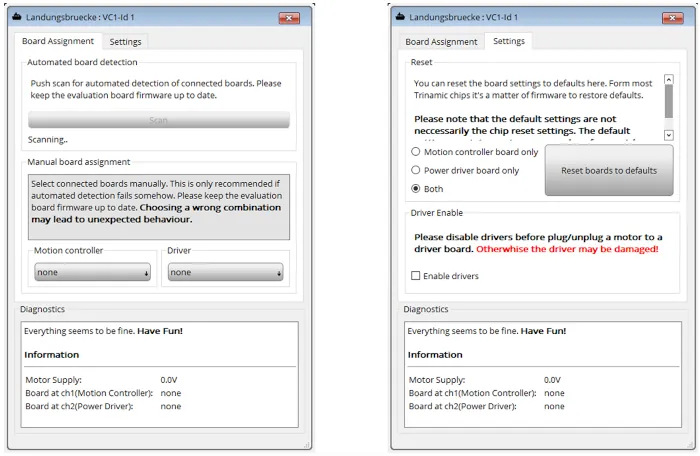
Figure 5: The TMCM-3351-TMCL module's standard signal, power, and I/O connectors (top) streamline setup and use; the IC and its module can drive three motors simultaneously (bottom) for three-axis motion control. (Image source: Analog Devices)
This fully functional module supports linear and S-shaped ramps for closed-loop operation with optional encoders for each of the three axes. The TMCM-3351-TMCL also offers numerous general-purpose digital and analog inputs and outputs. For communications, RS-485 serial, CAN bus, USB, and RS-232 interfaces are available.
Essential Software Tools for Evaluation Board Productivity:
Evaluation boards are compatible with the Trinamic Motion Control Language-Integrated Development Environment (TMCL-IDE). This graphical user interface (GUI) provides tools for easily configuring parameters, visualizing real-time data, and developing and debugging standalone applications.
Author: Bill Schweber. Contributed By DigiKey's North American Editors. Digikey
The TMCL-IDE displays several dialog boxes for diagnostic tasks (Figure 6) and includes an overview of the motion controller and connected driver chips. This overview window appears immediately after connecting the evaluation kit for the first time. The window displays the current status of the connections, while the second tab of the dialog box allows users to select basic settings or reset the module to factory defaults.
Figure 6: The TMCL-IDE GUI simplifies the installation, configuration, and performance analysis of various motor control integrated circuits under real loads when used with the associated evaluation boards. (Image source: Analog Devices).
Conclusion:
Modern motion control integrated circuits and their algorithms are highly sophisticated and must deliver exceptional performance across multiple motor criteria, including accuracy, reliability, and efficiency. By using evaluation boards and supporting software, designers can fine-tune these controllers in parallel with the rest of the design effort to deliver optimized motor performance despite load variations and transients.