UL is currently an organization with 64 testing and certification laboratories in 104 countries. When this mark appears on a product, it means that UL has tested representative samples of the product and determined that it complies with current regulations or other applicable requirements regarding its potential risk of fire, electrical shock, and/or mechanical hazards. The UL mark on a product represents the manufacturer's ongoing compliance with current regulations. Each year, UL awards its safety mark to more than 20 billion products worldwide.
The UL mark is applied to a PCB after it has been manufactured and tested. At this point, the factory includes both the UL mark and the manufacturer's own mark, which begins with the letter E followed by six digits, such as "Exxxxxx".
Important: Underwriters Laboratories is the only certification body authorized to grant the UL mark.
UL standards for PCBs.
One of the most recognized testing standards in PCB manufacturing is UL94, which is defined as:
- Flammability standard for plastic materials used in the manufacture of electronic devices.
Currently, UL94-rated adhesives are increasingly in demand by customers. Flame-retardant adhesives can help extinguish flames and slow the spread of a fire. These flame-retardant adhesives can be found in materials used in PCB manufacturing. UL94 is a material combustion test and can be either a horizontal burn test (UL94HB) or a vertical burn test (UL94V). In both tests, an open flame is applied to the sample for a specified period. The tests are performed to determine the material's behavior in extinguishing or propagating a flame. The material is classified according to HB, V0, V1, or V2, and the sample thickness is taken into account. There are also 5VB and 5VA classifications related to bonded paper rather than an adhesive. A material that meets the UL94 V0 classification is considered more flame-retardant than one that meets the UL94 V2 classification
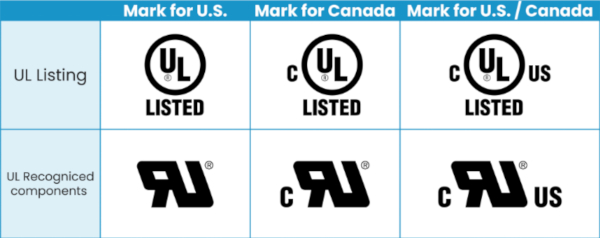
Within the UL certification, two main brands are distinguished:
- UL Listing: This is the most widely used mark. It focuses on finished products placed on the market (the complete assembly), guaranteeing safety and longevity during normal use and wear.
- UL Recognized Components: This focuses more on the components used to create a complete product. In our case, the PCB itself. This mark, combined with "C" and "US," indicates compliance with Canadian and US requirements
UL94 Ratings (from highest to lowest)
• HB – Slow combustion in a horizontal sample. Combustion rate <76mm/min for thicknesses <3mm or combustion stops before 100mm
• V-2 – Combustion (vertical) stops in 30 seconds and any dripping may be burning.
• V-1 – Combustion (vertical) stops in 30 seconds and dripping is allowed, but it must not be burned.
• V-0 – Combustion (vertical) stops in 10 seconds and dripping is allowed, but it must not be burned.
• 5VB – Combustion stops in 60 seconds, no dripping, plate sample may develop a hole.
• 5VA – Combustion stops in 60 seconds, no dripping, and the plate sample may not develop a hole.
NCAB works with factories equipped with printed circuit board recognition machinery, meaning that the PCBs have undergone rigorous reliability and safety compliance testing and certification according to the leading set of performance and reliability standards. The materials used by NCAB are UL recognized and listed during manufacturing, allowing our customers to identify the factory and materials used at every stage of the product lifecycle. Please feel free to contact NCAB Group Spain at +34 915 398 877 with any questions about PCBs; we will be happy to assist you.