




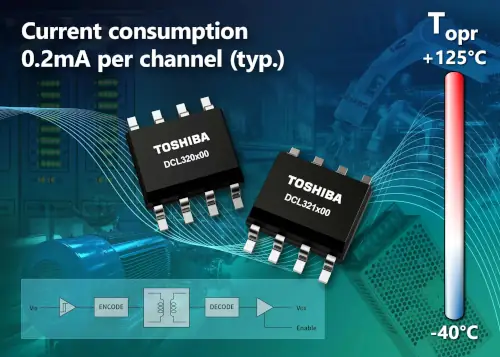
The DCL32xx00 series utilizes Toshiba's magnetically coupled isolation technology to transmit digital signals between circuits at different electrical potentials.
The company has combined this technology with a new circuit in the section responsible for transmitting signals across the isolation barrier.
The series supports data rates up to 25 Mbps, while the specified typical current draw of 0.2 mA per channel corresponds to a speed of 1 Mbps. Therefore, these figures describe different conditions and should not be interpreted as a current draw of 0.2 mA at the maximum transmission speed.
3,000 Vrms Isolation and 30 kV/µs CMTI.
Each device features a minimum isolation voltage of 3,000 Vrms for 60 seconds.
The specified common-mode transient immunity (CMTI) is a minimum of 30 kV/µs. This parameter determines the isolator's ability to maintain signal integrity against rapid common-mode voltage variations, a common condition in certain industrial and power electronics circuits.
The devices can operate between -40 and 125 °C and accept a supply voltage between 2.25 and 5.5 V.
All four models are supplied in SOIC8-N packages.
Two Signal Direction Configurations:
The family offers two configurations depending on the direction of the two channels.
The DCL320C00 and DCL320D00 have two channels in the same direction, allowing two digital signals to pass through the isolation barrier in one direction. The
DCL321C00 and DCL321D00, on the other hand, incorporate one channel in each direction. This configuration allows for separate transmit and receive paths for bidirectional interfaces such as UART.
Default High or Low Output:
The C00 and D00 versions differ in the logic state their outputs adopt when the input is undefined, for example, during certain power-up phases or when it is floating.
This feature allows selection between a default low or high output state, depending on the requirements of the circuit in which the isolator is integrated.
Thus, the series comprises four combinations that allow selection of both the channel direction and the output behavior in response to an undefined input.








