
The need to reduce brightness variations is increasing as more applications and devices, especially in the automotive and industrial sectors, demand greater consistency when configuring multiple LEDs in-line. However, until now, minimizing brightness variations during the manufacturing process has been difficult. Traditionally, users have only been able to reduce the number of rows from around four to two or three, which still requires sorting and using different resistors to match each range, increasing the number of man-hours required, along with inventory management.
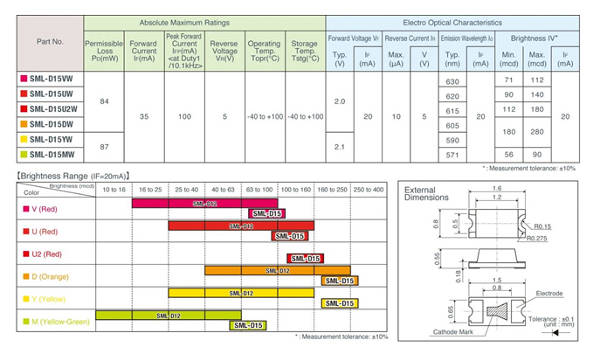
In response, the SML-D15 series has been developed using a comprehensive, highly integrated manufacturing system (from device fabrication onward), enabling ROHM to overcome the limitations of conventional LED production. As a result, high-precision brightness is achieved, and brightness variations are reduced by 75%. This makes it possible to provide a single brightness range (a rarity in the industry), significantly lightening the design burden.
Furthermore, by optimizing the LED element, ROHM has been able to improve brightness by up to three times compared to conventional products, providing class-leading brightness in the 1608 format (1.6 mm x 0.8 mm). The LEDs are also AEC-Q101 rated, making them suitable for demanding applications requiring high reliability, such as automotive systems.
 Main features
1. Single-range gloss eliminates gloss variations.
Conventionally, customers ordering a specific gloss level would receive four different gloss ranges due to limitations in production technology. In contrast, leveraging its integrated manufacturing process has enabled ROHM to achieve precision that reduces gloss variations by 75%, making it possible to provide single-range products that deliver unmatched consistency in end applications, significantly reducing the design burden.
2. Class-leading brightness in the 1608 format.
The complete redesign and optimization of the LED element have allowed brightness to increase up to 3 times compared to conventional LEDs, providing industry-leading brightness in the 1608 format (1.6 x 0.8mm).