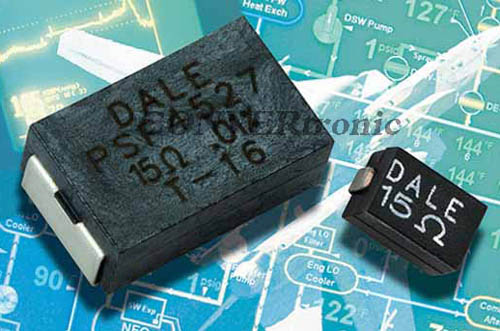
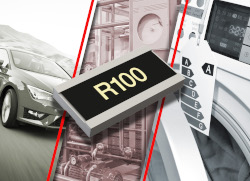
 ROHM has announced the availability of a new range of high-power (10-910mΩ) wide-lead thick-film SMD resistors ideal for current sensing in a number of applications, including inverters, AC and low-power household appliances.
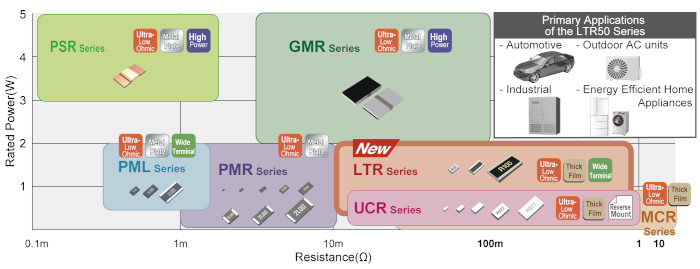 In various applications, the demand for current-sensing resistors for current control and management has been stimulated. This significant growth in embedded components requires compact, high-power resistors. ROHM continues to lead the industry in product development, starting with the world's first SMD resistors. For applications requiring reliability, ROHM offers resistors that provide features such as high power, surge resistance, and sulfurization resistance, which have been very well received in the industry. Adding this new line of low-ohm resistors allows for compatibility with a wider range of applications.
Key features
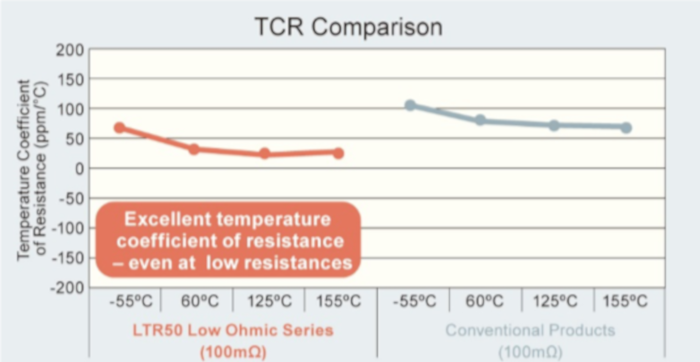
1. The superior temperature coefficient of resistance (TCR) ensures high-precision current sensing. Generally, the TCR increases as resistance decreases, but ROHM's optimization of the resistive element structure has enabled it to achieve class-leading TCR characteristics. For example, in the case of 100 mΩ, the LTR50 series provides a TCR of ±100 ppm/°C, ensuring stable resistance. (See Figure 3)
2. Four times the power rating of conventional products contributes to greater space savings. A 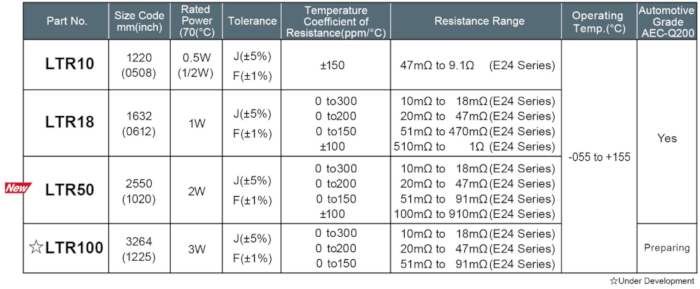 thorough review of the resistive material has made it possible to improve the power rating to 2W in the compact 2550 size (2.5 x 5.0 mm, t = 0.55 mm), four times higher than ROHM's conventional low-ohmic MCR50 series (0.5W). This allows customers to reduce the size of the assembly by using smaller resistors.
Terminology
Temperature coefficient of resistance (TCR): The internal resistance of many materials changes in response to temperature variations. This rate of change is called the temperature coefficient of resistance, or TCR. The lower this value, the smaller the change in resistance due to a change in ambient temperature, allowing variations to be suppressed during device operation.