


Features such as heated seats and steering wheels, high-end infotainment systems, and active suspension are increasing the electrical demands that the car's power system must meet. This is not limited to luxury brands but applies to all models.
For decades, a 12V alternator has been sufficient to meet the electrical demands of automobiles. However, the traditional 12V automotive electrical architecture, originally designed for internal combustion engine vehicles, is now proving inadequate to meet the growing demands of modern electric and hybrid vehicles. The need to increase fuel efficiency, improve energy recovery, and integrate advanced driver assistance systems (ADAS) and electrified components are the main drivers behind the development of power systems capable of efficiently delivering large amounts of energy to support the paradigm shift towards electric and hybrid platforms.
Migration to a 48V power supply system
Automakers are making steady progress toward transitioning to a 48V power grid. Using a 48V grid effectively minimizes power dissipation due to resistance, allowing for higher current transmission and improving overall power delivery. A 48V architecture, which uses thinner wiring, results in a lighter, more cost-effective, and easier-to-install distributed power system in the vehicle.
Adopting 48V provides the following advantages:
- It covers the vehicle's increased electrical demand — Electric vehicles (EVs) and hybrid vehicles (HVs) need more power for propulsion and auxiliary systems, thus exceeding the capabilities of conventional 12V systems.
- Energy recovery — Regenerative braking and other energy recovery technologies are more effective in a 48V system as they improve energy efficiency and increase the range of EVs and HVs.
- emissionsCO2 — The transition to 48V systems contributes to increased fuel efficiency and reduced carbon emissions in compliance with global environmental goals.
- Greater efficiency — A system with a higher voltage decreases current levels, minimizes resistive losses, and improves the efficiency of distributed power.
Evaluation of a 48V zonal power supply network
A 48V zonal architecture system represents a paradigm shift for the industry, leveraging Ohm's Law: DC/DC conversion takes place closer to the charging points rather than within a centralized control box. This allows for the safe distribution of 48V throughout the vehicle. The 48V to 12V conversion occurs at the charging point. By carrying a 48V current instead of 12V, the cables can be thinner, lighter, and less expensive (Figure 1). This smaller, more flexible cable is also easier to install in the vehicle. This method also evenly distributes the heat losses generated by the DC/DC converters throughout the vehicle, potentially enabling the use of chassis-mounted heat conduction and air convection cooling.
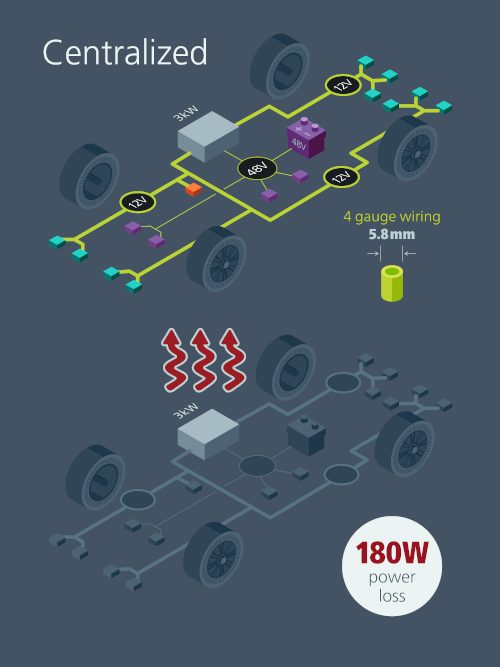

Figure 1. Modern cars use two types of electrical systems: the centralized 12V architecture (left) and the rapidly growing 48V zonal architecture (right). The former relies on thick 12V cables, while the latter can use thin 48V cables, which are much lighter, reduce heat losses, and carry four times less current.
Implementation of a 48V zonal power supply architecture
The implementation of the 48V zonal architecture can be carried out using various methods. For example, in mild hybrid systems, a 48V battery can be used in conjunction with the existing 12V battery. In the case of EVs that use one or more 800V or 400V batteries, it is possible to use power modules to transform this voltage to 48V and create a simulated or “virtual” 48V battery.
Tesla, like other major companies, is adopting this technology and plans to introduce 48V across its entire fleet. The first model to do so is the Cybertruck. Thanks to a 48V zonal architecture and advanced DC/DC converters, Tesla's increased conversion efficiency helps reduce the volume and weight of the wiring. A 48V zonal architecture distributes 48V throughout the vehicle and converts it to 12V at the ends.
Calculation of the savings offered by the 48V zonal architecture
The 48V zonal architecture better supports the increased demands of EVs and reduces vehicle weight in three main ways.
- Reducing cable weight by 85%:
Upgrading to a 48V zonal architecture means replacing traditional 12V cables (4 gauge, 273g/m) with 48V cables (10 gauge, 27g/m). This reduces cable weight by approximately 85%. - Eliminating the auxiliary battery:
Power modules in a zonal architecture provide a very fast response to transients, allowing for the creation of a virtual battery. These power modules replicate the characteristics of 12/48V low-voltage batteries, adding the option to eliminate the physical 12V battery, thus reducing weight by 13 kg or more.
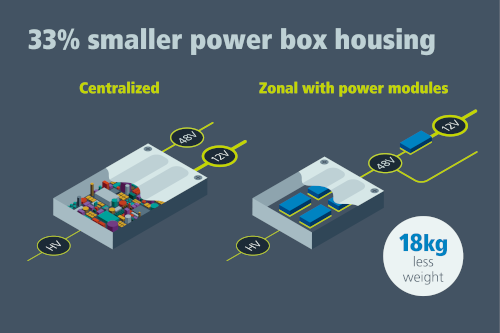
Figure 2. The centralized structure can be reduced with power modules and a zonal architecture because heat can be dissipated more efficiently at the ends when converting 48V to 12V loads.
3. Saving 33% by reducing the case size.
Replacing a centralized system with a zonal one moves the 48V to 12V conversion from the case to the charging points. The new power system case for high-density power modules supplying 48V can be up to 33% smaller. Therefore, its weight can be reduced by up to a third (33%).
In the traditional centralized 12V system, discrete components raise the ambient temperature inside the case. The power system case with high-density power modules generates less heat, and the modules at the charging point can efficiently cool the chassis with air. These improvements allow the weight of the liquid cooling system to decrease by approximately 7%.
48V to 12V DC/DC converters are essential for optimizing a 48V zonal power network. These high-density power modules are compact, lightweight, and highly efficient. Vicor's high-density power modules help automotive manufacturers take advantage of 48V while minimizing space and weight. Vicor's product range includes fixed-ratio and regulated converters for 48V and 12V loads, operating in buck or boost mode. These converters can be installed in a single housing or distributed throughout the vehicle to create a more compact and lightweight 48V power network.
These modules, when used in conjunction with a decentralized zonal architecture, optimize the vehicle's power supply network.
Power modules can reduce the vehicle's weight by up to 18 kg (Table 3). If this weight is replaced by 18 kg of battery cells, the EV's range can be increased by approximately 6,400 km per year without a net increase in weight.
This is important because, for example, the average American driver traveled 23,000 km in 2023, according to the Federal Highway Administration. Therefore, a 48V zonal architecture could increase annual driving distance by 28% and reduce annual charging time by up to 30% (Figure 4).
Weight reduction achieved with zonal architecture
|
|
|
Weight loss |
|
Cabling |
10 gauge cables (48V) |
2.5 kg |
|
Auxiliary battery |
Deleted |
13.0 kg |
|
Refrigeration system |
20.4 kg, 7% reduction |
1.5 kg |
|
Power supply box |
2.7 kg, 33% reduction |
1 kg |
|
|
|
18 kg |
Figure 3. The use of a 48V zonal architecture together with high-density power modules cuts up to 18 kg in the weight of a compact electric SUV.
Consumer desire for comfort and style is driving increased demand for electric vehicles. EVs require more efficient power consumption to meet the electrical demands throughout the vehicle. 48V is practically the only option currently available to satisfy this growing demand. While the conversion involves a cost, a 48V zoned architecture with power modules offers significantly more in the long run and delivers a higher return on investment.
30% less charging time per year
|
|
VE medium |
VE more efficient |
|
Autonomy per charge |
571 km |
805 km |
|
Autonomy per charge with zonal weight loss |
602 km |
848 km |
|
Increased autonomy with zonal weight loss |
31 km |
43 km |
|
Increased autonomy for 3 recharges/week |
93 km |
129 km |
|
Increased autonomy for 52 weeks/year |
4,836 km |
6,708 km |
|
Charging time saved |
21% |
30% |
Figure 4. Greater autonomy provides more distance per charge and reduces the number of charges per year.
The most efficient zonal architectures utilize small, lightweight converters at the point of charging. High-density, high-efficiency modules are the best choice for 48V to 12V conversion. Vicor, the leader in high-performance power modules, facilitates innovation and creativity. Vicor's compact power modules, architectures, and topologies offer automakers flexible and scalable power solutions for whole-vehicle high-voltage power conversion.
In the race to 48V, Tesla's Cybertruck is leading the way for other manufacturers. Tesla has successfully transitioned from 12V to 48V, and others will follow suit, introducing improvements along the way. Power modules are easy to install and offer an alternative to the traditional discrete designs used in centralized power systems. High-density power modules are small and compact, making them the obvious choice and a natural complement to a 48V zoned architecture, the power grid of the future for the automotive industry.
Author: