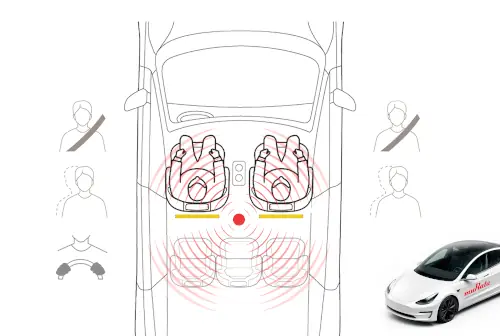
Modern vehicles already incorporate cameras, typically located in the overhead console or the rearview mirror. At the same time, 60 GHz radar is becoming increasingly common, especially in applications designed to detect the presence of children in the vehicle.
Both technologies offer different and complementary capabilities. Cameras provide detailed visual information about the position, posture, and behavior of occupants. Radar can detect people even in darkness and when they are partially obscured by clothing, blankets, or other items. It also provides depth information.
Combining data from both types of sensors allows for a more complete representation of the passenger compartment. This approach can reduce reliance on specific systems for detecting seat occupancy, such as weight-sensing floor mats or capacitive systems.
Reducing the number of independent detection technologies could simplify the integration of these systems into the vehicle, decrease their complexity, and help reduce the cost of certain components.
Greater accuracy for security systems
More precise detection of passenger position and posture can also be useful for adaptive restraint systems. Knowing more accurately where each occupant is located and their posture provides more information to systems responsible for managing airbag deployment or seatbelt operation.
Occupant classification is also relevant to reducing false alerts and improving child presence detection systems, especially in situations where cameras have difficulty obtaining sufficient visual information.
Radar can overcome these limitations by working independently of lighting conditions and detecting movement or presence even if certain body parts are not visible to a camera.
New features via software
The combination of cameras, radar, and artificial intelligence also allows for an architecture in which the same set of sensors can be used for different functions.
In addition to monitoring the driver and passengers, these platforms could progressively incorporate new capabilities through software updates. These include gesture recognition and the monitoring of certain vital signs.
This approach fits with the evolution towards software-defined vehicles, where a growing part of the functionalities can be added or improved without the need to modify all the physical components installed in the car.
Multimodal sensor fusion, therefore, seeks to go beyond the independent collection of information from cameras and radar. The goal is to combine the data to generate a coherent interpretation of what is happening inside the vehicle.
This information can be used both in current safety-related functions and in future applications related to restraint systems, vehicle automation, and new forms of interaction between occupants and the car.