


The sensor measures 3.5 × 2.6 × 1.0 mm, typically consumes 150 µA, and provides a voltage output similar to that of a conventional silicon microphone.
Microphones installed in headphones simultaneously capture the user's voice and ambient sounds. ENC systems can use two or three microphones and signal processing to separate the two sources.
The MEMSensing sensor takes a different approach: it detects the mechanical vibrations transmitted by the user's body when they speak.
The audio processor can combine this signal with the one from the conventional microphone to distinguish the user's voice from ambient noise or wind.
According to MEMSensing, this architecture can reduce reliance on additional microphones and certain beamforming algorithms. The press release, however, does not provide comparative tests of voice quality, noise suppression, or performance against two- or three-microphone ENC systems.
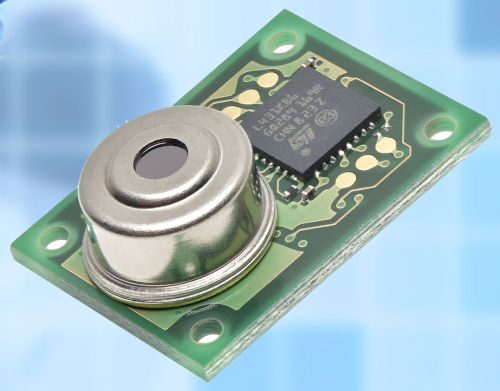
The component measures 3.5 × 2.6 × 1.0 mm and uses a Land Grid Array (LGA) package with a metal cover.
Soldered connections and the metal cover provide the electromagnetic shielding intended by the design.
According to the company, its dimensions are compatible with packages commonly used for microphones, facilitating its integration into compact headphone designs.
The sensor architecture is capacitive MEMS and incorporates an ASIC responsible for converting the detected vibrations into an electrical voltage signal.
MEMSensing specifies a typical sensitivity of −30 dBV/ga 1 kHz.
The indicated signal-to-noise ratio is 75 dB, while the resonant frequency is approximately 8 kHz.
The frequency response remains flat up to approximately 1.5 kHz, a feature designed to provide a reference signal that can then be processed by the audio system.
These parameters describe the behavior of the vibration sensor and should not be directly compared to the acoustic specifications of a conventional microphone without considering the differences between the two measurement principles.
The sensor operates on a supply voltage between 1.8 and 3.6 V and has a typical current consumption of 150 µA.
Its integrated ASIC generates a voltage output similar to that used by silicon microphones, in order to facilitate its connection to existing Bluetooth audio processing architectures.
The manufacturer presents the component as an alternative to incorporating another microphone channel or using a multifunction motion sensor solely to detect voice.
MEMSensing identifies TWS earbuds as the most direct initial application for the device, but also envisions potential uses in hearing aids, augmented and virtual reality (AR/VR) audio equipment, and headset-integrated communication systems.
The company also mentions possible future applications in healthcare, industrial monitoring, security systems, and robotics.