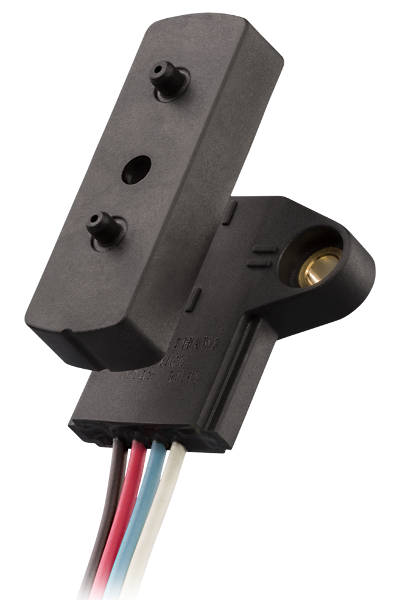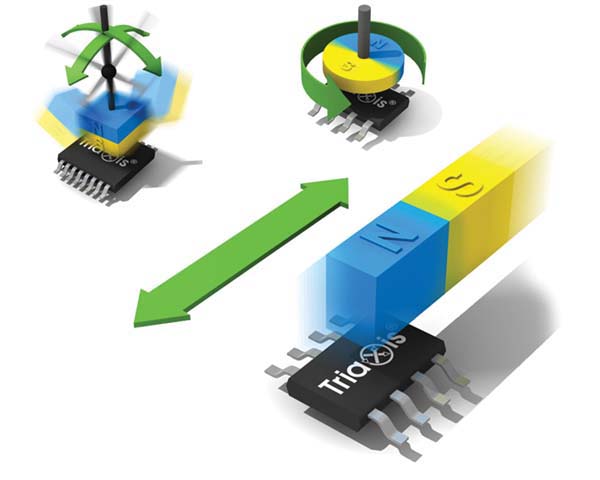


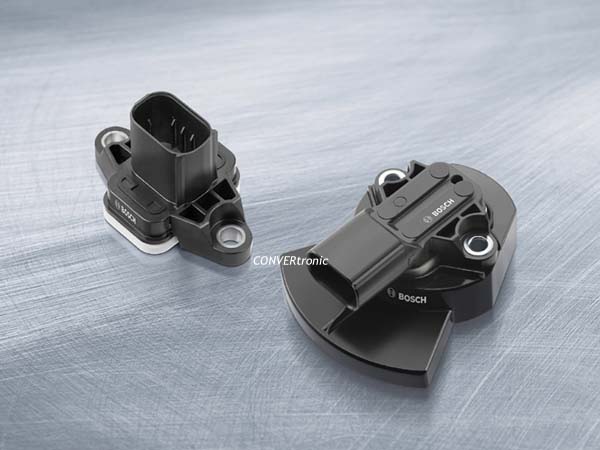
The Bosch pedal travel sensor's measurement principle is based on a Hall effect sensor that registers the vector of a magnetic field. This field is generated by a magnetic circuit that takes into account the design requirements of many brake systems and communicates linear and rotary movements to the Hall effect sensor. In this way, non-contact measurements of up to 45 mm of travel (PWG 12) or a 55-degree rotation (PWG 13) can be taken. Thanks to internal redundant signal recording and processing, the pedal travel sensor outputs the measured values to two separate outputs as modulated pulse path signals. A powered control unit receiving these signals can perform continuous logical checks of the measured values by comparing both signals, thus meeting the highest safety requirements of electronically controlled braking systems.
The nominal curve of the pedal travel sensor can be adapted to the characteristics of the pedals. Automakers can adapt it to the corresponding vehicle model by programming the sensor and configuring the control unit accordingly. This programming takes into account the different designs and mounting positions of the brake pedals.