This ensures that the correct amount is dispensed every time. This type of precision is essential for a wide range of applications: from logistics robots that distinguish between nearly identical packages to camera systems that maintain focus on moving objects in dynamic video scenes.
A new benchmark for dToF technology
. With dToF technology, the sensor emits pulses of light in the invisible infrared range. These pulses reflect off objects in the sensor's field of view and return to the sensor, which calculates the distance based on the time it takes for the light to travel back, similar to how the delay of an echo reveals distance: the longer it takes, the farther away the object is. Multi-zone sensors improve upon this by capturing reflected light from multiple viewing angles (zones), like a network of echo points. This enables the creation of detailed 3D depth maps.
The TMF8829 divides its field of view into up to 1536 zones, a significant improvement over the 64 zones of standard 8x8 sensors. This higher resolution enables more precise spatial detail. For example, it supports people counting and presence detection in smart lighting systems, object detection and collision avoidance in robotics applications, and intelligent occupancy monitoring in building automation. Detailed depth data also provides a foundation for machine learning models that interpret complex environments and enable intelligent interaction with the surroundings.
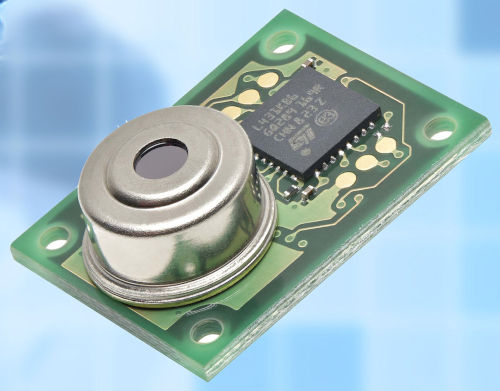
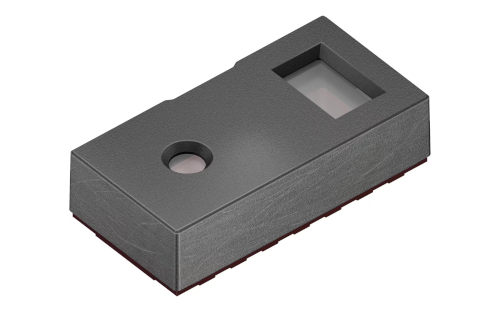
Measuring just 5.7 × 2.9 × 1.5 mm—thinner than a penny and more compact than typical lower-resolution sensors—the TMF8829 delivers high resolution in a form factor ideal for space-constrained devices. Because it operates without a camera, it is compatible with privacy-sensitive applications. When combined with a camera, the sensor enables hybrid vision systems such as RGB Depth Fusion, which combine depth and color data for AR applications, such as virtual object placement.
Classified as an eye-safe Class 1 device, the TMF8829 uses a dual VCSEL (Vertical Cavity Surface Emitting Laser) light source to measure distances up to 11 meters with an accuracy of 0.25 mm, sensitive enough to detect subtle movements like a finger swipe. With its 48×32 zones, the sensor covers an 80° field of view, providing depth information across an entire scene comparable to that of a wide-angle lens. On-chip processing reduces latency and simplifies integration. Instead of relying on a single signal, the sensor profiles the returning light pulses to identify the most accurate distance point, ensuring stable performance even with smudged cover glass. Full histogram output helps AI systems extract hidden patterns or additional information from the raw signal.