Challenges of Current Sensing in High-Power Integrated Traction Inverters:
The increased popularity of EVs naturally places greater demands on their reliability, especially their ability to travel longer distances between charges. To achieve this, components such as high-power integrated traction inverters, which are crucial for vehicle battery range and the overall driving experience, must be as compact and efficient as possible. A traction inverter converts DC current from the EV battery into AC current that powers the vehicle's propulsion system. Another function of the inverter is to capture energy from regenerative braking and return it to the battery.
The solution to the requirements of high-power integrated traction inverters has been to develop reliable power modules to reduce the space occupied by components such as capacitors, inductors, transformers, and filters, while leveraging the advantages of silicon carbide MOSFETs for faster switching and increased battery voltage.
Engineers working on the design of traction inverters for EVs know that the current sensor is a key component. To meet the demands of the electromobility market, it must offer high accuracy and a competitive price, as well as high integration and the ability to operate in a demanding and adverse environment. The integration of coreless current sensors in EVs is still in its early stages.
Coreless current sensors represent a promising solution for the future because they allow the use of smaller and lower-cost components, but many challenges remain before this technology can be widely adopted. These challenges are being addressed by LEM, a company specializing in electrical measurements.
For example, the large variation of the magnetic field in space requires coreless sensors to be mounted on the busbar with high precision and without the possibility of movement after assembly and calibration. A variation of just one-tenth of a millimeter can quickly lead to an unacceptable level of error in high-power traction inverters. Mounting tolerances, mechanical handling, vibrations, and thermal expansion are all potential causes of displacement. Along with the need to overcome the peculiar effect to achieve high bandwidth, these factors necessitate significant effort in mechanical design to reliably measure current. Furthermore, as traction inverters become increasingly compact, the conductors are getting closer together, and the magnetic field distribution is becoming more complex. Coreless sensors with their differential measurement capabilities are immune to homogeneous external fields but not to field gradients, which can introduce a greater degree of error into the measurements. In short, the significant limitations on mechanical design required to achieve the desired accuracy, coupled with the time needed for inverter calibration, make the coreless sensor solution less attractive… for the time being.
Overcoming Obstacles with Magnetic Core Current Sensors:
Until these technical barriers are overcome, fully calibrated magnetic core current sensors will remain the preferred method for obtaining highly accurate current measurements in EV traction inverters. This technology not only has a significant head start but also retains enormous potential for development and innovation.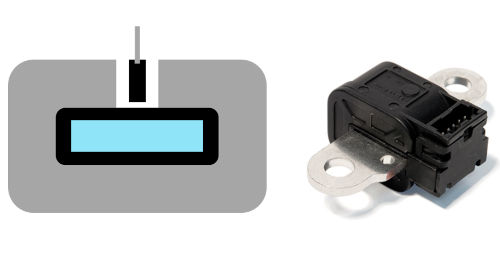 During operation, the magnetic core concentrates and amplifies the magnetic field for detection with reduced output noise, while also protecting the measurement from interference caused by external fields. This results in a high signal-to-noise ratio (SNR) across a wide bandwidth. Reliable and stable measurements are also possible even in environments with strong vibrations thanks to precise control of the magnetic core assembly and calibration, the Hall effect-based ASIC, and the busbar.
The challenge is that open-loop core-based sensors tend to be bulky and present integration difficulties at the inverter level. That's why LEM has focused its efforts on developing compact and cost-effective current sensors with magnetic cores that offer reliable current measurement across the widest possible range of applications. These sensors are part of the company's growing product portfolio specifically designed for use with EV traction inverters. This allows customers to select highly reliable products to meet their inverter requirements, enabling EV component manufacturers to accelerate their time to market.
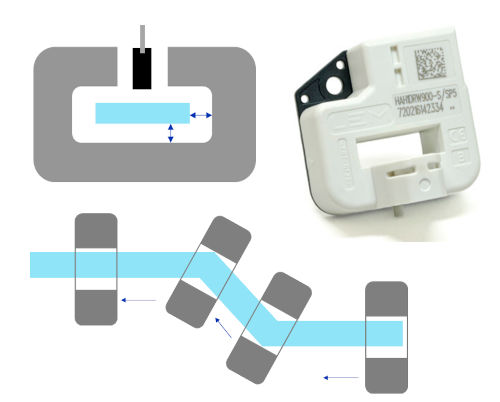
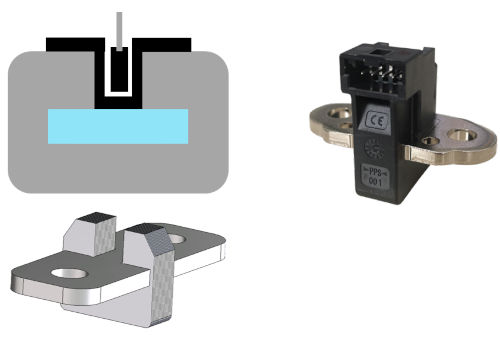 When it came to solving customer problems that existing current sensors couldn't address, LEM's R&D department delivered a solution in the form of the HSTDR single-phase current sensor with an integrated busbar. This sensor is significantly smaller than any traditional current sensor with an aperture. Designed to measure DC connection voltage and three-phase currents, as well as in DC/DC converters, the HSTDR's compact size offers superior flexibility for designers working within the limited space of a traction inverter enclosure. The HSTDR also provides protection against external fields and a high signal-to-noise ratio (SNR) thanks to its magnetic core with a small air gap.
Busbars are typically isolated from the magnetic core in traditional designs, but LEM's method of placing the core directly onto the busbar, which presents a constraint, allows for a much more compact core. Typical current sensors with an aperture usually require a large aperture to slide onto the busbars, which can be complex to design, resulting in a large sensor size. In contrast, there are no limitations on where to install the sensors with integrated busbars. This allows for minimizing the opening of the magnetic core, thus reducing the overall core size by up to 40%, while also increasing the current measurement range by 60% compared to the previous generation HSNDR. This again provides EV component designers with greater flexibility because the sensor can be positioned anywhere on the traction inverter.
A smaller magnetic core also naturally reduces the sensor's overall weight by around 50%. As a result, the sensor can tolerate vibrations of up to 10g, which is a common requirement in automotive environments. Another advantage of a smaller magnetic core is that it reduces the amount of raw materials needed to manufacture the sensor, thereby limiting costs. Significant time savings and productivity gains are also achieved thanks to a fully calibrated sensor that integrates the core, busbar, and sensing element into a single package.
 Design Considerations for the New Sensor:
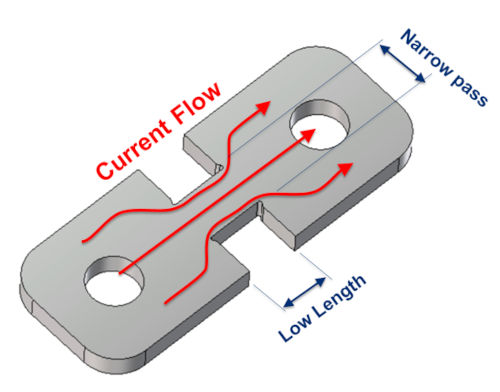
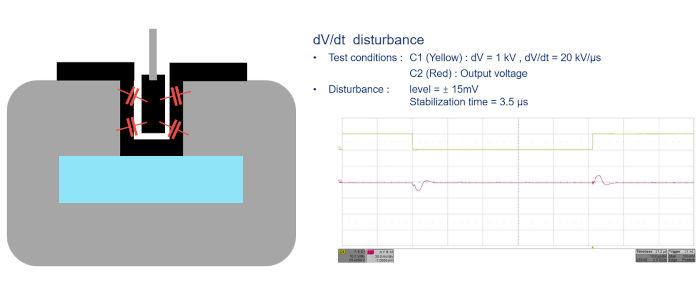
When LEM engineers designed the HSTDR single-phase current sensor with the EV traction inverter market in mind, they considered three key aspects. First, the aforementioned restriction on the integrated busbar needed to be large enough to ensure mechanical stability and prevent additional power losses and heat dissipation in an already extremely hot environment. As a result, the resistance introduced by the busbar restriction is negligible, falling below 20 µΩ. Second, with the magnetic core mounted directly on the busbar, it was important to design an isolation barrier between the electronics and the magnetic core to guarantee air clearances and creepage distances in systems with an 800V battery. Finally, it was important that, given the sensor would operate in harsh and noisy environments, its output would remain immune to high switching speeds (dV/dt).
 Another key feature is the HSTDR current sensor's accuracy. It boasts an overall error with respect to temperature and throughout its lifespan of less than 3.5% for a dynamic range of up to 1500A. Furthermore, because the device delivers consistent performance across a range of frequency levels with minimal phase variation between different units, it ensures precise torque control, a critical factor in EV motor drive applications.
LEM, which manufactured its first current sensor for battery monitoring systems over 20 years ago, is no newcomer to the automotive market and is continuously developing innovative new products for this demanding sector. LEM has built an extensive portfolio of such products, including sensors for traction inverters, DC/DC converters, and on-board chargers, aiming to make them increasingly smaller and smarter wherever possible. The company focuses on solving customer problems by exploring current technologies to take them further, as well as developing solutions for tomorrow by studying future challenges and working to overcome them.
Author: Sofiane Serbouh, Product Manager for Large Drives, LEM