This family of devices includes five sensors with shut-off temperature setpoints, designed so that they cannot be overridden by software or maliciously disabled.
This product family, which features up to five monitoring channels and various safety alert and shutdown options, can be used in systems monitoring more than one thermal element. The remote sensors also integrate resistance error correction and beta compensation, eliminating the need for additional configuration to improve accuracy. Monitoring temperatures at multiple points with a single integrated temperature sensor reduces board size and complexity, and simplifies design with a shorter bill of materials.
“This new family of remote temperature sensors provides customers with new possibilities in a product category that has historically offered few options,” said Fanie Duvenhage, vice president of Microchip’s mixed-signal and linear business unit. “The MCP998x family consists of 10 devices, each of which improves accuracy in very high-temperature applications. Five of them incorporate safety features, giving customers a broad range of multi-channel temperature sensors for automotive applications.”.
The MCP998x family of devices provides greater accuracy where it is needed most; specifically, they are designed to deliver an accuracy of 2.5°C at temperatures up to 125°C, so they can be used at the upper end of the traditional temperature range, where many competitors struggle.
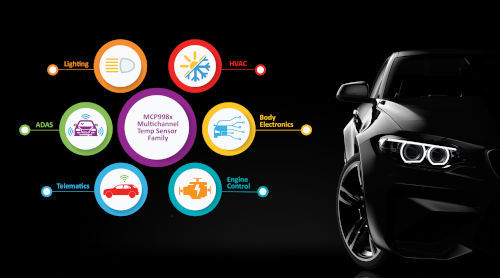
This high-temperature tolerance makes them ideal for automotive applications where operating temperatures for electronics are critical. MCP998x sensors are designed for vehicle functions such as HID lamps, advanced driver assistance systems (ADAS), automotive servers, video processing, infotainment systems, engine control, telematics, and automotive electronics such as seat controls, lighting systems, mirror controls, and power windows. Visit the website for more information on Microchip's complete catalog of temperature sensors.
Development Tools
The MCP998x family features support for the new EV23P16A evaluation to facilitate design and development.