
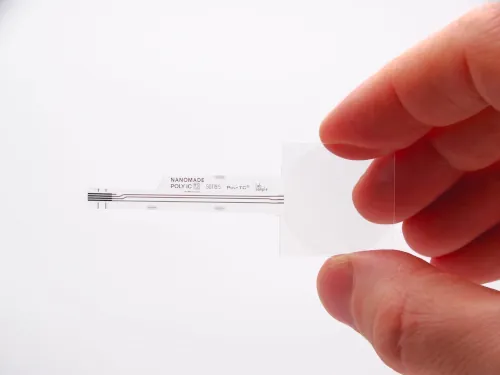
This innovation represents a milestone in Human-Machine Interface (HMI) technology, enabling transparent, flexible, and illuminated control surfaces without compromising performance, aesthetics, or industrial scalability.
In a market where minimalist designs with integrated lighting effects or borderless displays are evolving, conventional technologies often sacrifice transparency or design freedom. While transparent capacitive solutions exist, until now there hasn't been one that combines transparency with force and touch detection.
The innovation is based on a complementary approach to printed electronics: PolyIC manufactures a flexible, transparent capacitive film with printed conductive electrodes, while Nanomade adds its proprietary nanoparticle-based ink to integrate force sensing directly into the same substrate.
The result is the first ultra-thin, flexible, and fully transparent film that combines capacitive touch and force sensing without compromising optical clarity or light transmission.
The combination of capacitive touch and force detection overcomes the limitations of current solutions, offering:
Reliable operation with gloves,
high performance in wet or humid environments,
reduced accidental activations,
and improved detection of intentional interactions.
Force detection adds a new dimension to interaction, allowing differentiation between simple contact and deliberate pressure, improving safety, reliability, and user experience through progressive haptic feedback.
Beyond its technical performance, this transparent film greatly expands design possibilities and facilitates integration into existing systems. It can be laminated under current displays or interfaces without complex redesigns.
This allows for the creation of fully transparent or "invisible until illuminated" control surfaces, the integration of sensors into interactive displays, and the design of curved or three-dimensional interfaces with a seamless, continuous aesthetic.
Main applications
The technology is geared towards multiple sectors:
Consumer electronics: laptops, wearables and advanced displays
Automotive: backlit panels, consoles and decorative surfaces
Smart home: appliances and glass control panels
Medical devices: hygienic interfaces compatible with gloves
The concept has already been validated and the product is in the industrialization phase. Samples will be available in the third quarter of 2026, with an initial demonstration underway in partnership with a major OEM manufacturer.