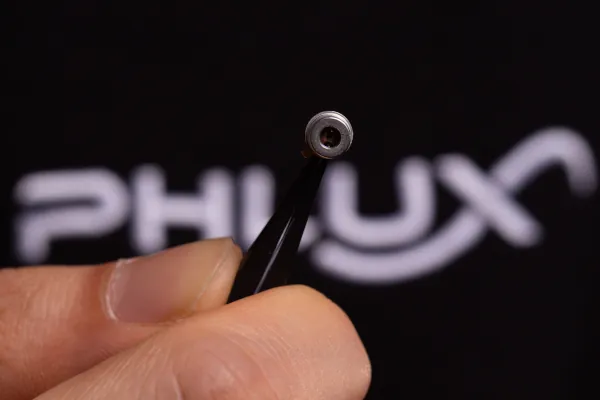
The Aura sensor family, available in 30 µm, 80 µm, and 200 µm versions, is 12 times more sensitive than traditional InGaAs APDs and extends the range and accuracy of IR systems by up to 50% for a given laser power. Alternatively, for the same range, significantly less laser power is required, reducing system costs by up to 40% and size and weight by up to 30%, partly due to simpler thermal management. The sensors are designed for professional laser rangefinders, optical time-domain detectors (OTDRs), long-range LiDAR, and free-space optical communications. In all these applications, the use of 1550 nm ensures eye-safe operation, eliminating one of the major drawbacks of 905 nm IR systems.
Aura APDs can operate at temperatures up to +85°C with minimal performance degradation, significantly outperforming traditional sensors. They offer high dynamic range and rapid recovery from strong reflected signals to minimize dead zones in OTDR applications, where faults near the instrument might otherwise go undetected. Their high sensitivity also enables higher resolution for detecting even small defects in fiber optic networks and tiny objects with low reflectivity in distance measurement and LiDAR applications. These advantages also apply to new hollow-core fiber (HCF) technologies, which promise up to 47% higher data rates and significantly lower latency than current networks.
Aura noiseless InGaAs APDs are designed to MIL-STD-883, qualified according to Telcordia GR-468, and are direct replacements for existing surface-mount or OT (total object) packaged components, enabling immediate upgrades to current systems. The noiseless InGaAs
APD technology was developed by incorporating an antimony alloy into the compound semiconductor manufacturing process. The resulting devices operate with an internal gain of up to 120, allowing them to detect even the smallest signals above the noise floor.