Above all, the negative impact on the soil is harming agriculture to the point that it is no longer possible to grow plants. This represents a blow to the stable food supply. It is also essential to take action as soon as possible on the negatively affected soil to achieve sustainable agriculture.
The tsunami resulting from the Great East Japan Earthquake in 2011 caused extensive damage to agricultural land in Japan. There were concerns about salt damage to crops due to seawater intrusion. Therefore, desalination work was carried out on the affected farmland across a wide area as part of the disaster recovery project. A demonstration test was also conducted to monitor salinity using soil sensors on the farmland after desalination. What is the potential of sensing technologies to contribute to agriculture? We spoke with Hitoshi Kanno, former associate professor at the Graduate School of Tohoku University, for an overview of the desalination work and the use of sensing technologies in smart agriculture.
What damage does global warming cause to soil and agricultural products?
-- It is said that salt damage severely harms agriculture. How important is soil to agriculture?
Some soils are suitable for crop production, while others are not. Even when we simply say "suitable for crop production," several factors must be considered. Regarding physical aspects, for example, it's important that the soil drains well and that there are no problems with root growth. Furthermore, in terms of chemical aspects, it's important that it can adequately supply the nutrients the crops need. Additionally, the diversity of microbes and other living organisms is crucial to avoid imbalances in soil properties, ensuring that only specific pathogens thrive.
In fact, categorizing soil in this way is not simple. The properties of soil suitable for agriculture change depending on its intended use.
-- Tell us what kind of research you specifically conduct in your specialty of soil science.
Soil science is a discipline that promotes research into how soil forms, its composition, its characteristics, and how to use it. Among these topics, my specialty is soil fertilization science. My research has primarily focused on how plant growth and nutrient uptake change through the interaction between soil and crops.
Climate change is spreading worldwide due to the impact of global warming. In this context, what problems does soil science face?
In Japan, damage caused by heavy rains and other weather events is often attributed to global warming. However, there are also regions around the world concerned about decreased rainfall due to the impact of climate change. Salt accumulation in the soil and the resulting damage to crops have become significant problems in these areas.
Why does salt damage occur when there is little rain?
In humid areas, where it rains year-round, the amount of rainfall is greater than the amount of water that evaporates from the soil surface. This means that salt is less likely to remain in the soil. However, in semi-arid areas, the amount of groundwater that rises to the surface and then evaporates is greater than the amount of rainfall. As a result, the salt contained in the groundwater remains near the soil surface (salt accumulation), and this becomes the cause of salt damage to crops. Improper irrigation can also cause salt accumulation in agricultural lands.
When salt damage occurs, the properties of the soil change. This also affects the growth of agricultural products.
The main effects of salt damage on agricultural products are that it inhibits moisture absorption and significantly disrupts the nutrient balance due to the impact of accumulated salinity in the soil. Consequently, crops are unable to adequately absorb the necessary nutrients.
The physical and biological properties of the soil can also be affected. Consequently, if salt accumulates, the soil becomes unsuitable for crop production.
Use of soil sensors to assess salt damage in tsunami-affected areas following the Great East Japan Earthquake
-- Agricultural lands located mainly along the Pacific Ocean coast in the Tohoku region were severely damaged by the tsunami resulting from the Great East Japan Earthquake in 2011. In addition to damage caused by the destruction of irrigation and drainage facilities, the influx of foreign debris such as rubble, and soil runoff, there were strong concerns that crop production would be affected by seawater intrusion (salt damage) (Photo 1).
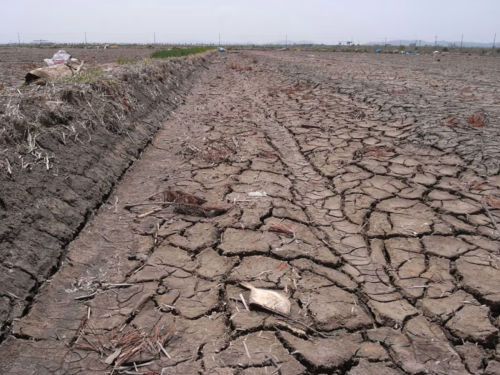
Photo 1: Soil of a rice paddy where erosion and salt accumulation have occurred due to the tsunami resulting from the Great East Japan Earthquake.
This is an extremely rare case in Japan of seawater intrusion damage across a wide area. The soil salinity temporarily increased, making it impossible to grow crops. Therefore, large-scale desalination work was undertaken as part of a disaster recovery project to allow freshwater to penetrate and leach the salt from the subsoil.
The basic procedure for rice paddies involved repeatedly waiting for the water level to drop a few days after filling them with fresh water and then measuring the soil salinity before adding more fresh water if the salinity was still too high. This procedure reduced the soil salinity to a level (standard value) that was not problematic for crop production.
The desalination work was carried out primarily over three years, beginning in 2011, through a disaster recovery project. The first year focused on inland regions experiencing seawater intrusion. The second and third years then shifted the focus to coastal regions severely damaged by the tsunami. Ultimately, desalination was completed in nearly 99% of the disaster recovery areas.
Soil sensors were used to measure salinity over time in agricultural lands after desalination, wasn't that right?
Tohoku University and Murata Manufacturing jointly conducted the Multimodal Sensor Demonstration Experiment in Tsunami-Affected Farmland in 2013, two years after the earthquake. In this experiment, farmers in three disaster-stricken areas of Miyagi Prefecture were asked to conduct monitoring by inserting soil sensors into some of their rice paddies where desalination work had been completed. The soil sensors were embedded at depths of 10 cm, 20 cm, and 30 cm, respectively, at multiple points in a rice paddy after planting. The demonstration experiment then proceeded using a wireless environmental monitoring system that continued to collect data via wireless communication throughout the growing season.
The soil sensors we used in the demonstration experiment are capable of simultaneously monitoring soil temperature and EC*1. This is a multimodal soil sensor*2. The higher the salt content in the soil, the easier it is for electricity to flow. Taking advantage of this knowledge, we used the EC values we measured as an indicator of soil salinity and then observed their changes.
*1: This refers to electrical conductivity. It indicates how easily electricity flows. The unit is S/m (siemens per meter). The current flow also changes due to variations in the concentration of ions in the soil moisture. Therefore, it becomes an indicator of salinity.
*2: This system allows for the simultaneous processing of multiple data points. In this demonstration experiment, multimodal sensors with temperature and EC sensor functions were used.
-- Please tell us specifically how you measured changes in salinity using soil sensors in the demonstration experiment.
Initially, soil temperature and EC data measured by soil sensors every 30 minutes were wirelessly transmitted to the base unit of the wireless environmental monitoring system we installed next to the rice paddies and then stored on a memory card. We went to the rice paddies to collect the memory cards once every two weeks. We imported the data to a computer and observed the changes in the numerical values. In addition, when collecting the memory cards, we measured the soil EC values using a conventional method with soil samples taken at each depth. We collected these samples by inserting augers around the areas where the soil sensors were embedded. We also compared these measurements with the EC values from the soil sensors (Photo 2).
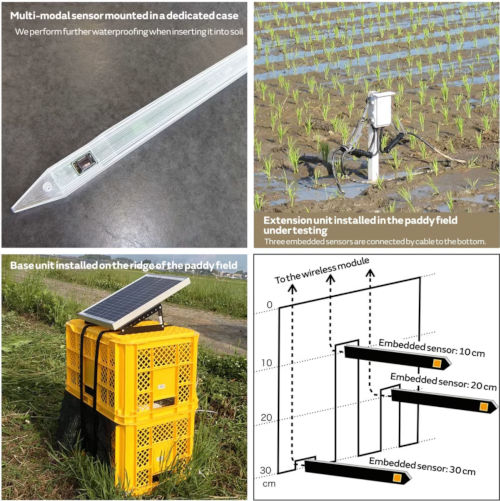 Photo 2: Wireless environmental monitoring system that wirelessly collects data from soil sensors [Top left: multimodal type soil sensor / Top right: wireless module of the extension unit installed in the rice paddy under test (three of these sensors are embedded in the soil and then connected by cable) / Bottom right: sensors embedded in the soil / Bottom left: base unit on the ridge of the rice paddy].
-- What kind of possibilities for using the sensors have you discovered with this demonstration experiment?
We can obtain diverse data simultaneously and continuously from multiple points using soil sensors and the wireless environmental monitoring system. This also allows us to analyze the environmental factors behind the fluctuations, as well as the changes in salinity at each location and depth. I believe, for example, that it will be possible to accurately observe the risks of salt damage due to the impact and other effects of changes in weather and agricultural work processes, such as after rainfall or when draining a rice paddy in preparation for harvest. Fortunately, we did not observe any problematic increases in salinity during the growing season in any of the rice paddies we used in this demonstration experiment.
The challenge of using sensors in smart agriculture: Linking data with past assets
-- What do you think about the importance of detection technologies in the smart agriculture of the future?
Being able to obtain data continuously every 30 minutes in the 2013 demonstration experiment was a new experience for me. The conventional method for measuring soil EC involved measuring the EC of the water suspension in the soil sample we collected. We had to go to the measurement site each time to collect the sample. The measurement frequency was once a week or once a month. It was impossible to continuously measure the soil without sensors. In other words, the use of sensors makes it easier to obtain large amounts of agricultural data. I believe this will be extremely important for smart agriculture in the future.
However, the method for measuring EC using soil sensors is, in fact, slightly different from the method used to measure soil EC when assessing salinity in agriculture. Typically, we measure the EC value (soil EC value) of the water suspension, which is a mixture of water and soil, and then use this as a guide to soil salinity. However, the EC value from soil sensors is derived from a complex function of pore water salinity and various soil characteristics. Consequently, the relationship between the soil EC value and the EC value obtained from a soil sensor can vary depending on the soil type and differences in water status. Therefore, I believe the challenge lies in understanding the relationship between the two in detail.
-- How will that gap in the data relationship be filled in the future?
In future research, we will need to connect the large amount of soil data measured in the past with the data recently measured by sensors. The Demonstration Experiment on Analyzing Factors Affecting Salt Tolerance of Shallow-Rooted Rice in Soil will be conducted from June 2022 to March 2023. I have heard that new data will be compiled and linked to past data using the new, advanced soil sensors jointly developed by Tohoku University and Murata Manufacturing.
Addressing challenges one by one will also lead to the realization of digital transformation (DX) and smart farming in the agricultural field, as well as other advancements.
Soil does not change rapidly. Therefore, soil analysis does not usually require real-time data collection to that extent. However, research on crop growth models requires diverse data (temperature, moisture content, solar radiation, wind direction, and fertilizer quantity and content) to see what differences arise in yield (the amount of crops harvested). Yield production models have long been built using average values of air temperature, soil temperature, and moisture content over a specific period.
The use of data observed through the environmental monitoring system, including soil sensors and other technologies, will greatly contribute to this research. If we can obtain a large amount of real-time data using multiple sensors, we will be able to make even more accurate yield predictions. It will also be possible to consider measures to correct past growth models, and I believe this will advance our research.
AUTHOR: Hitoshi Kanno, MURATA