Navigating such a wide assortment can seem complicated; however, the manufacturer has ensured a logical and clear organization of its portfolio. Below is an overview. Here are Autonics' most important product groups, their basic parameters, and unique competitive features.
Autonics photoelectric sensors
In this article, we address topics such as:
Applications and installation of slot sensors
Color detection and verification in automation systems
Accuracy and other advantages of laser measurement
Photoelectric sensors in building automation
Autonics universal solutions
Oil and cutting oil resistant components
Mechanical strength of cylindrical housings
Ultra-compact photoelectric sensors
SLOT SENSORS (BS3, BS4 AND BS5 SERIES)
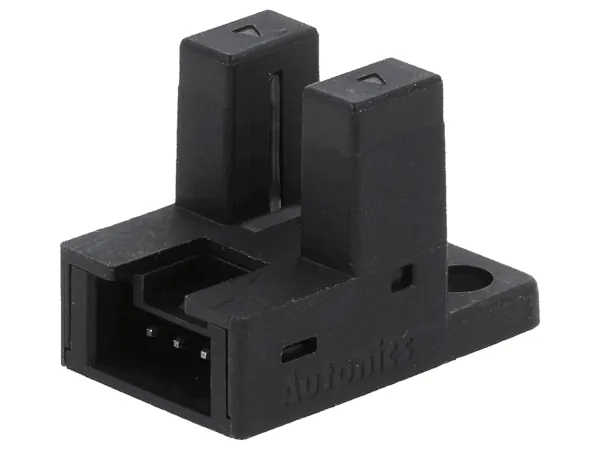
Model with mounting holes and cable connector.
The application fields for slot sensors include production control, robotic control, and the operation of precision mechanisms. These small components are commonly used in encoders, mounted directly onto electronic circuits, or connected via wires. Autonics offers slot sensors adapted for screw and mounting holes, equipped with solder connectors, IDC connectors, and factory-installed 1-meter cables. The sensors feature integrated signal amplifiers and transistorized outputs (NPN or PNP open collector). They are designed to operate at frequencies up to 2 kHz, in either DARK-ON or LIGHT-ON mode. The manufacturer offers over one hundred models of these sensors, available in various configurations.
COLOR SENSORS (BC SERIES)
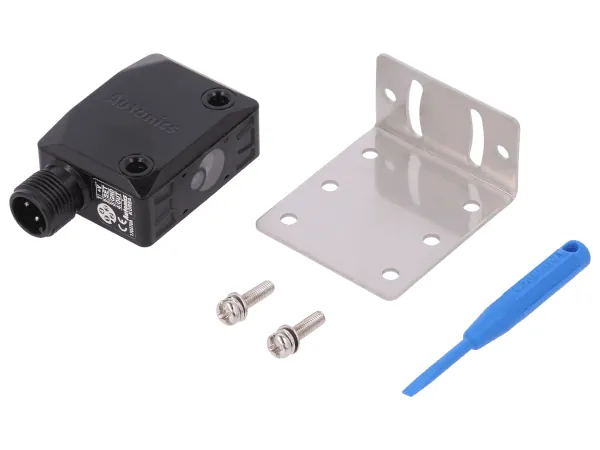
The BC sensors are supplied with a mounting bracket.
The BC series color sensors utilize RGB LEDs and 12-bit resolution detectors, delivering exceptionally accurate measurements. This is further stabilized by minimizing interference from external light. The sensors are programmed based on a pattern to precisely verify the color of objects, for example, as part of quality control on production lines. The detection area is very small, just 1.24 x 6.7 mm. A key feature of these sensors is their high degree of protection (IP67), enabling their use in demanding environments such as paint shops or printing plants.
LASER SENSORS (BD SERIES)
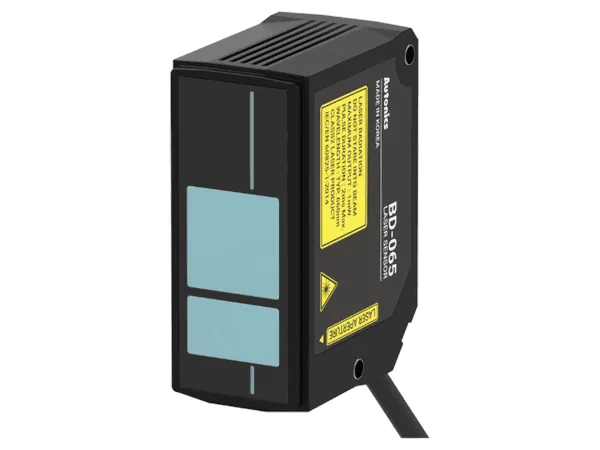
The sensor housing has IP67 sealing.
Autonics laser sensors are characterized by their extremely high precision and IP67 protection rating, with aluminum or polycarbonate housings. They are available in ranges from 27.3 mm to 600 mm. Designed to measure thickness, width, curvature, or detect surface irregularities, their maximum resolution is approximately 1 µm (depending on the model). These are reflective sensors, meaning they contain both a transmitter and receiver; the manufacturer has equipped them with an adjustment mechanism to adapt operation to the transparency level of the objects being observed. The measurement range can be automatically calibrated (single or dual point).
MOTION AND PRESENCE DETECTION (ADS-A AND ADS-SE SERIES)
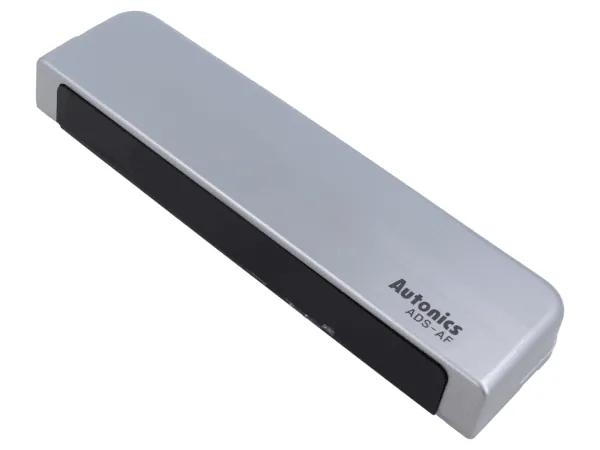
The ADS-A door sensors are housed in aesthetically pleasing casings.
The ADS-A and ADS-SE series sensors are designed for building security and automation applications (automatic door opening). They are adapted to operate in a variety of environmental conditions. The sensor circuits are based on microcontrollers that interpret the sensor data; this allows for easy adjustment of the sensor's sensitivity and viewing angle (from 7.5° to 28.5°), as well as signal extension ("hold") for control purposes. The ADS-SE sensors are notable for their wide operating range (0–10 m) and their ability to operate in sunlight.
UNIVERSAL SENSORS (BEN SERIES)
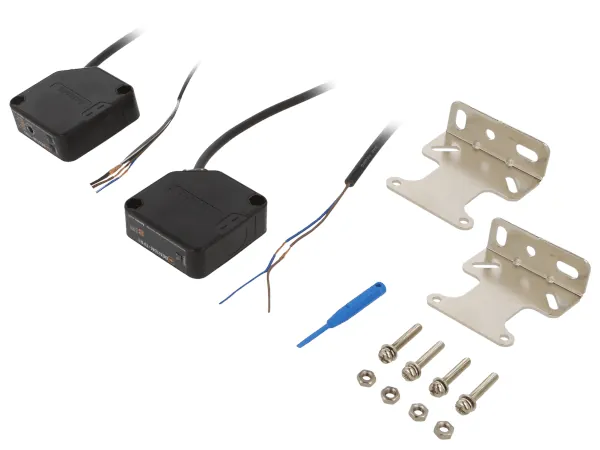
BEN sensors are available, among other options, as a transmitter-receiver set.
The BEN series includes the most versatile sensors offered by Autonics. They are available in transceiver, reflective, and reflective with reflector versions. The versatility of this product group refers to several aspects. They come in versions powered by direct current (12V to 240V DC) and alternating current (24V to 240V AC). Their outputs can be transistorized (PNP and NPN) or relay-type (SPDT contact configuration). They are equipped with pre-installed 2-meter cables. The sensors operate in LIGHT-ON and DARK-ON modes. Also noteworthy: the range includes sensors with varying ranges, from 0 to 0.3 m to 0 to 10 m. Regardless of the sensor housing variant, they have a compact, rectangular design with dimensions of 18 x 50 x 50 mm.
OIL-RESISTANT SENSORS: REFLECTIVE, TRANSMITTER-RECEIVER
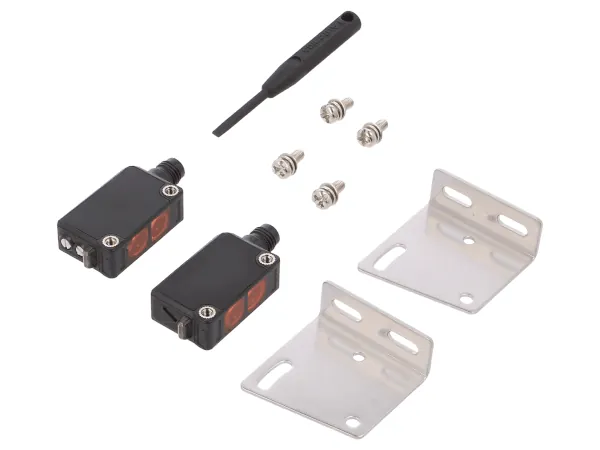
Factory-installed 2-meter connection cables.
Like the BEN sensors, the BJR series sensors come in various versions and with extended ranges (up to 15 m). The key distinguishing feature of these products is their high resistance to oils, including both machine oils and cutting oils. They are also designed to operate in the presence of electrical and optical interference. As a result, they can be used in industries where other solutions would be vulnerable to damage. The sensors feature adjustable sensitivity and transistorized outputs. They are designed to operate at voltages from 10V to 30V DC.
CYLINDRICAL SENSORS (BRQ AND BR SERIES)
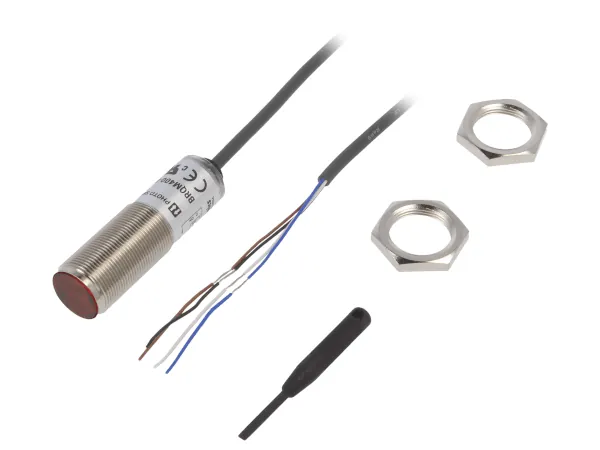
The sensor is supplied with a set of mounting nuts.
In terms of sealing and mechanical resistance, the sensors in cylindrical housings exhibit the best performance. The BRQ and BR series, for example, are enclosed in metal housings with M18 threading. They can operate at distances of up to 20 m (depending on the model). They connect via integrated cables or M12 industrial connectors, which receive IP66/67 protection thanks to the housing design. The BRQ and BR sensors also offer a wide thermal tolerance, for example, from -25 °C to 60 °C.
ULTRA-FLAT SENSORS (BTF SERIES)
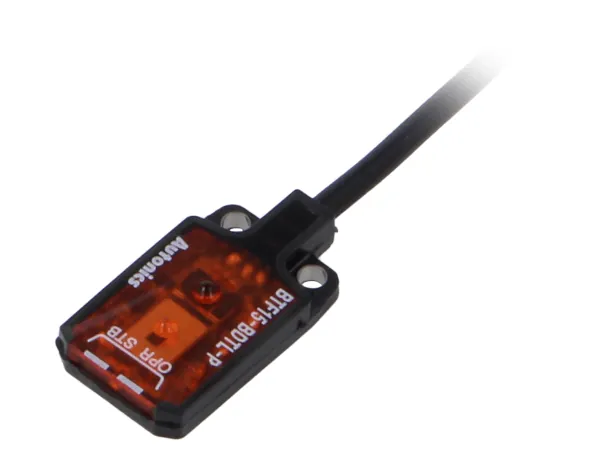
In addition to the small size of the base, the sensor stands out for its very low profile.
BTF is a series of reflective sensors (also available in transceiver versions) whose key feature is their compact size, designed for space-constrained environments in machines and automation systems. The module is only 3.7 mm thick (with a 13x19 mm base). These sensors can operate at distances of 1–15 mm, 5–30 mm, or up to 1 meter. They feature PNP and NPN outputs and are powered by voltages ranging from 12V to 24V DC. Importantly, these sensors can detect very small objects, down to 0.2 mm in diameter (under the manufacturer's specified mounting conditions). Even these highly accurate, low-profile Autonics sensors are manufactured with a high degree of sealing (IP67), making them resistant to moisture, flooding, and dust.
https://www.tme.eu/es/news/about-product/page/72520/resena-de-los-sensores-fotoelectricos-autonics/