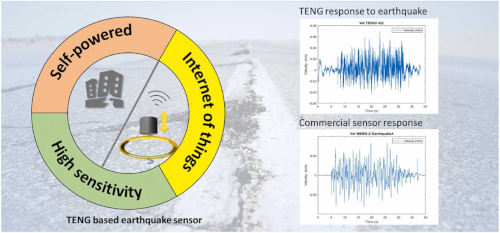
In addition to being resistant to extreme conditions, each sensor can transmit seismic activity information over long distances, up to 20 kilometers from its location in interurban areas, and this information can also be viewed on any internet-enabled device. In short, the new sensor—which has been patented—can be used to detect earthquakes and warn of danger using a very inexpensive, low-power, and weather-resistant system.
With the aim of improving earthquake monitoring systems and thus improving the information provided to the public and competent authorities regarding the seismic risk they face at any given time and place, researchers from UPM and IMDEA Materials, experts in sensor design, have manufactured and tested a novel seismic sensor based on the triboelectric effect.
Specifically, in collaboration with the IGN's Seismic Data Service, researchers—led by José Sánchez del Río of the Advanced Structural Materials and Nanomaterials Research Group at the UPM—tested at CEDEX the relationship between vibration measurements obtained with the new sensor placed on the surface of a triaxial vibration table and those obtained by the MEMS (microelectromechanical systems) sensors normally used in the IGN's national seismic sensor network. The results showed a high degree of similarity between the two signals, demonstrating the usefulness of the new sensor.
The new seismic sensor's main components are triboelectric transducers. These transducers are manufactured in the IMDEA Materials laboratory, led by researcher De-Yi Wang. They consist of two layers of polymeric material that, through various chemical treatments, have opposite electronegativity. When these layers come into contact, high-voltage electrical power is generated without the need for any external source. This characteristic has led to these sensors also being called triboelectric nanogenerators (TENGS).
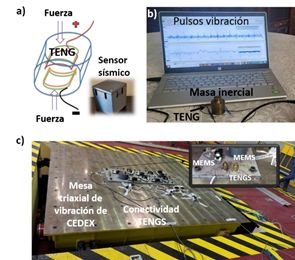 a) Operating principle of the TENG and seismic sensor. b) Signals generated by vibration. c) TENGS and MEMS on the CEDEX bench. Source: UPM.
The seismic sensor also includes an inertial mass positioned above the triboelectric transducer, enabling it to detect vibrations along the Z-axis. The Department of Industrial Mechanical Design at the School of Engineering and Industrial Design of the Polytechnic University of Madrid (ETSIDI-UPM), led by Francisco Santos Olalla and Rafael Cascón Porres, is currently responsible for the mechanical design for 3D detection, along with student Alba López Laguna. Furthermore, the new seismic sensors are capable of detecting vibrations of very low amplitude (5 mg) and high frequency (300 Hz). José Sánchez del Río, along with David Patrizi and Álvaro Merodio, also an ETSIDI student, verified that the vibration signals could be transmitted over long distances and visualized online via the Internet of Things (IoT).
In summary, and according to researcher José Sánchez del Río: “This new seismic sensor can be used to detect earthquakes and warn of danger using a very inexpensive, low-power system that is resistant to adverse conditions. Potential users range from large corporations, small and medium-sized enterprises, and interested individuals, to those responsible for national earthquake detection systems.”
J. Sánchez del Río, A. Yusuf, Xiang Ao, I. Astarloa Olaizola, L. Urbelz López-Puertas,, MY. Ballesteros, R. Giannetti, V. Martínez, JL Jiménez, JB Bravo Monge, Xiaosui Chen, De-Yi Wang. High-resolution TENGS for earthquakes ground motion detection, Nano Energy, 102, November 2022. https://doi.org/10.1016/j.nanoen.2022.107666
This result has been protected by a patent at the Spanish Patent and Trademark Office: A seismic detection system.
https://www.upm.es/recursosidi/offers-resources/patentes/un-sistema-de-deteccion-sismico/?_sf_s=sísmico&_sft_product_cat=patentes&sort_order=date desc
.