As the heart of the vehicle shifts from mechanical and hydraulic to electrical and electronic, a significant change is also occurring within sensing. Older linear and rotary sensors that relied on potentiometric and optical sensing are being replaced by modern magnetic sensors that do not suffer from inaccuracies or premature failures due to dirt, dust, and grease present in vehicles.
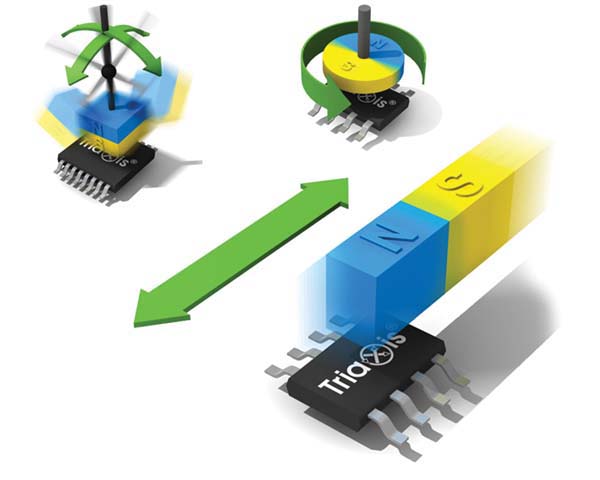
One of the technologies driving magnetic sensing in the automotive world is Melexis' Triaxis® sensors. This modern sensing approach is now in its third generation and is fundamentally insensitive to the many scattered magnetic fields found in modern vehicles.
However, a challenge remains. Every magnetic sensing arrangement has an element of nonlinearity caused by factors including the sensing mechanism itself and also the accumulation of mechanical tolerances within the mechanism being sensed.
To address this, devices in the Melexis MLX9037x series of Triaxis® position processors include built-in linearity compensation, which dramatically improves the performance of the sensing system, critical to meeting the accuracy required in today's demanding automotive applications.
The latest MLX90371 and MLX90372 devices offer a range of two to 32 calibration points, which can be selected to suit the application's nonlinearity and the desired output accuracy. A smaller number of calibration points may be suitable for applications with low initial nonlinearity, while a larger number of points is appropriate for long-stroke linear motion or where there is significant initial nonlinearity.
 Figure 1: Comparison of different calibration options for linear movement of +/- 8 mm
As can be seen in Figure 1, increasing the number of calibration points significantly improves nonlinearity. Given that the graph uses two different scales for 2 and 4 points and 16 and 32 points, it can be seen that while nonlinearity errors (NLE) of up to 28° can be expected with 2-point calibration, these are reduced to maximums of 1.25° and 0.8° for 16- and 32-point calibration, respectively.
To perform calibration, engineers use the PTC-04 programmer, which is specifically designed for efficient and accurate calibration of Melexis programmable integrated circuit families. The programmer is very similar to an EEPROM programmer and simply requires an available PC with an RS-232 or USB communication port. The PTC-04 contains its own programmable power supply and can measure both voltage and current at a 16-bit resolution. It also includes multiple configuration options, making it suitable for prototyping and large-scale production, and can be used to program all Melexis programmable Triaxis, Linear Hall, Latch, and Switch products.
To calibrate one of the MLX90371/MLX90372 sensors, users simply assemble the calibration system and connect the PTC-04 programmer to the device via the power, ground, and output pins. By moving the magnet to multiple positions (up to 32) and calibrating the sensor output, the initial NLE can be compensated for and thus reduced during operation.
The calibration process also allows the output to be tailored to the application requirements. For example, in addition to NLE calibration, the output can be programmed to cover the entire range at any angle for rotary detection, or the full length for linear detection, thus ensuring that the sensor delivers maximum resolution and accuracy in all applications.
By: Nick Czarnecki, Marketing Director - Position and Speed Sensors, Melexis BV.