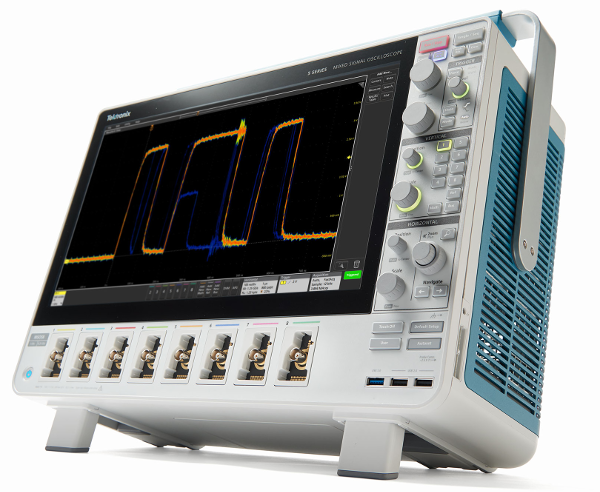
As embedded systems are used in everything from smartwatches to hybrid vehicles, they become more sophisticated, and the engineers developing these systems require more capabilities from their test and measurement tool: the oscilloscope. To effectively and efficiently characterize and debug these more complex systems, designers need to look at a much larger number of diverse signals than in the past. At the same time, ease of use and quick understanding are critical to meeting deadlines and budgets. Designed from the ground up, the Series 5 MSO is the world's first with the versatility and signal understanding needed to meet these challenges.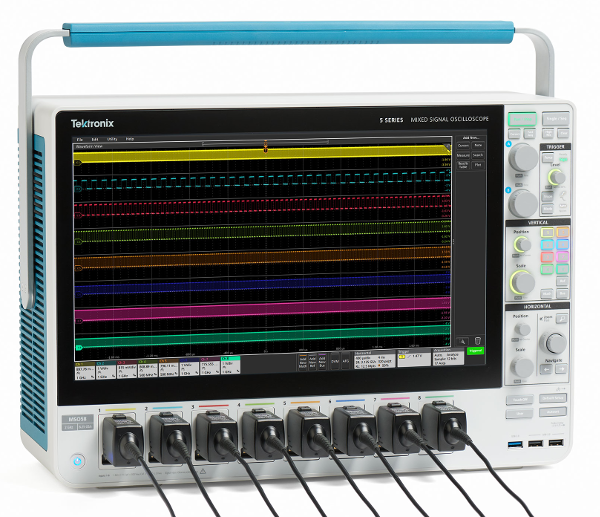 "The world of embedded electronics is expanding rapidly, driven by an insatiable demand for more electronic content in military, automotive, consumer, and industrial products and systems, as well as cutting-edge energy technologies," said Chris Witt, vice president and general manager of Tektronix's Time Domain Business. "A completely new oscilloscope platform that enables our customers to keep pace with demand. The MSO Series 5 is the culmination of the largest single-platform development effort in Tektronix history and offers significant innovations that will benefit our customers every day."
Tektronix has designed the MSO Series 5 to be the most flexible, capable, and user-friendly midrange oscilloscope family on the market. Just as the DOP70000SX oscilloscope offers a completely new and innovative approach to high-performance instruments, the MSO Series 5 continues Tektronix's history of breaking accepted rules for oscilloscope design and configuration to better meet user requirements.
FlexChannels - More Analog and Digital Channels When Needed²
As systems become more complex and debugging problems more difficult, engineers are finding they need more than four analog channels, which is the number available on most midrange oscilloscopes. To work around this problem, engineers sometimes try to make two oscilloscopes work together, adding time, expense, and immense frustration. More than four analog channels are also needed for motor control and inverter design, automotive electronics, power supply design, and power conversion analysis. Furthermore, the ability to correlate multiple analog and digital inputs is critical for obtaining a complete and synchronous view of what is happening in today's more complex embedded and IoT systems.
Until now, oscilloscopes have been defined by fixed configurations: the user had to decide in advance how many analog channels they wanted and whether they also wanted a fixed number of digital channels or none at all. Some oscilloscopes offer the option to add digital channels after purchase, but even then, it's a fixed number of digital channels that can't be changed as needs evolve. In many instruments, analog and digital channels are sampled at different rates, triggered using separate hardware, and stored in registers of different sizes, making accurate comparisons impossible.
Unlike ordinary oscilloscopes, the MSO Series 5 offers models with four, six, or eight FlexChannels—the first reconfigurable oscilloscopes on the market. By default, channel input is via a TekVPI+ connector that accepts all TekVPI analog probes, but when the new TLP058 logic probe is connected, the input becomes eight digital channels. The user can add as many logic probes as needed, allowing for anywhere from eight to 64 digital channels. Digital signals are sampled, triggered, and stored in the same way as analog signals, greatly simplifying comparisons.
Larger, Touchscreen Display and Advanced User Interface:
Engineers like big screens on oscilloscopes – and the MSO 5 Series offers the market’s first high-definition (1920 x 1080 pixel) 15.6-inch capacitive touchscreen. Included with the display is an advanced user interface that allows users to access controls directly through on-screen objects instead of navigating through menus. The result is faster, more intuitive operation, while also providing significantly more space for viewing waveforms and correlating signals. For added flexibility, users can also operate the oscilloscope with a mouse and conventional front-panel controls.
Along with the state-of-the-art display and user interface, the MSO 5 Series features an attractive, modern industrial design with bold new colors and many useful conveniences. The instrument is compact, less than 8 inches deep, and enhances the user experience with a robust handle, a simplified and intuitive front panel with LED light rings that indicate selected waveforms and trigger sources, and adjustable legs that allow for additional viewing angles.
Optional Windows Operating System:
Every oscilloscope on the market today is either a dedicated oscilloscope or based on a Windows PC platform that allows users to run other programs on the oscilloscope. Each approach has advantages and disadvantages, and many labs have both types, leading to problems when users need to switch test platforms.
The new 5 Series MSOs solve this problem by offering the industry's first oscilloscope that can function as a dedicated oscilloscope or based on an open Windows* setup. The user can switch between the two modes simply by adding or removing a solid-state drive (SSD) that has the Windows/OS license installed. When the SSD is installed, the instrument boots into Windows. When removed, the instrument boots up as a dedicated oscilloscope. Regardless of the configuration, the oscilloscope user interface is handled in exactly the same way.
Flexible options, field upgrades:
All Series 5 MSOs can be purchased or field-upgraded as needs change with an arbitrary function generator (AFG), digital probes, extended recording length up to 125 Mpoints, additional protocol support, and bandwidth up to 1 GHz. The 2 GHz upgrade is available through Tektronix Service Centers. The oscilloscopes are backed by a three-year warranty.
Price and availability:
The journey to unprecedented oscilloscope flexibility and greater visibility into complex embedded systems begins now. The Series 5 MSO is priced at €12,800.