
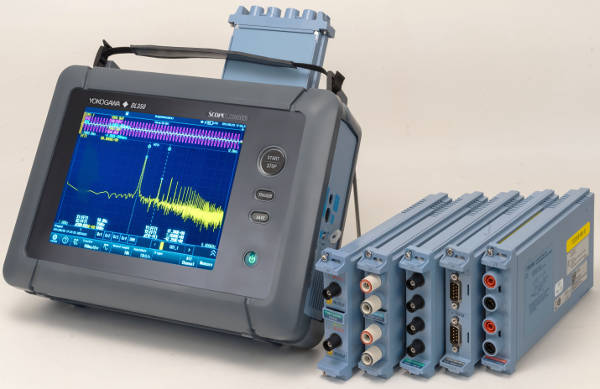
Like other models in Yokogawa's ScopeCorder family, the DL350 combines the features of a general-purpose oscilloscope with those of a high-speed data acquisition system in a single instrument. Unlike other portable measurement solutions, such as oscilloscopes and oscilloscope/multimeter combos, the DL350 adds high levels of accuracy in field measurements, isolated inputs for high-voltage measurements, and a large memory capacity that allows recording for several hours or even days.
Another feature of the ScopeCorder DL350 is its plug-and-play modularity, which allows it to be configured to suit a variety of user applications. Whether performing simple, high-precision voltage measurements or recording a mix of signals from current probes, temperature sensors, strain gauges, accelerometers, and serial buses, the DL350 can handle it all without additional enclosures or cables.
This flexible input capability is achieved by incorporating two slots compatible with any of 18 different types of user-swapped input modules. This means, for example, that four isolated voltage inputs can be measured at 16 bits of vertical resolution at speeds of 1 Megapoints per second (MS/s), along with 16 temperature readings or two CAN/LIN buses, each containing 60 signals. Changing just one module enables measurement at 100 MS/s with 12 bits and 1 kV isolation. Furthermore, 16 logic inputs are available simply by swapping out a module.
Among other modules are AC measurements that utilize a real-time RMS module and a math channel for signal processing and analysis after recording is complete.
The DL350 offers compatibility with many of the existing modules of the still-available ScopeCorder DL850E(V).
For users more familiar with chart recorders than large-memory oscilloscopes, the DL350 offers a selection of operating modes. The “Recorder” mode is suitable for continuous recording for a specified duration and sampling interval. In this mode, a setup wizard can be used to quickly guide the operator through the entire configuration process.
The “Scope” mode allows the DL350 to be used like an oscilloscope, including complex triggering and flexible memory usage. The use of historical memory allows up to 1000 independently triggered acquisitions to be recorded in internal memory so that the causes and effects of phenomena of interest can be analyzed later.
Up to 5 G-points of data per module can be recorded to an SD card. This means the DL350 can be used for continuous recording for up to 50 days. For high-speed signals, up to 100 M-points per module of internal memory is available to capture fast transients, allowing signals to be captured at higher sampling rates or for longer periods.
A unique, high-resolution, high-speed sampling module among portable measuring instruments provides individually isolated 12-bit, 100 MS/s inputs that can accurately measure and record transient waveforms (e.g., superimposed on inverter outputs) and control signals that cannot be measured by traditional portable recorders or oscilloscopes.
An 8.4-inch resistive touchscreen has been chosen for superior noise performance. In environments with the highest levels of electrical noise, such as motors and inverters, measurement accuracy is maintained while allowing the unit to be used with gloves or a stylus. Even when the backlight is off and the touchscreen is inactive, the user still has access to the START/STOP keys, manual trigger, and data save key. For users unfamiliar with this type of measuring instrument, assistance is also available through the instruction manual included with the device.
The user can choose between a simple or complex trigger level, considering aspects such as pulse width, waveform period, and even multiple channels. For example, the waveform window trigger is ideal for monitoring AC power lines and allows capturing voltage dips, surges, spikes, or phase and frequency changes (available for fundamental frequency waveforms from 40 to 1000 Hz).
A DL350 can be left to capture the waveform and automatically save it to a file when the trigger condition is met, or even send an email, if the user prefers.
The sampling clock, trigger, and start/stop controls are available as external signals, so a rotary angle encoder or degree wheel, for example, can be used as the instrument's sampling clock to analyze motor rotation and performance.
It allows power measurement in both single-phase and three-phase systems. Furthermore, for fundamental 50 or 60 Hz waveforms, up to the 40th harmonic can be analyzed. The FFT function set can also be used for comprehensive frequency analysis.
The DL350 is housed in a compact A4-sized chassis and weighs less than 2.6 kg without the battery and less than 4 kg including the battery and two 4-channel modules. The built-in rechargeable battery provides three hours of continuous operation, which, when combined with mains or 10-30 V DC power, gives the DL350 highly reliable power and worry-free recording for difficult or costly tests.