Internal impedance reflects battery quality and performance over its lifespan. A battery with higher internal impedance will be less efficient and more prone to premature failure. High internal impedance generates excess heat during operation, which can become a safety hazard if a battery goes into thermal runaway. Measuring internal impedance before use is a good way to identify cells that may be at risk of failure. There are several ways to characterize internal impedance, and each characterizes a slightly different aspect of performance.
One technique is electrochemical impedance spectroscopy (EIS). During this test, an AC signal is applied to the battery across a broad frequency spectrum, and the battery's response is measured. This test can be time-consuming, but it provides the most comprehensive picture of the impedance behavior within the battery.
The most widely used method is AC internal resistance (ACIR). Since it is an AC technique, it characterizes impedance, although typically only the real part, or resistance, is measured. ACIR is a subset of the EIS process, in which the measurement is performed at a single frequency, usually 1 kHz. This characterizes small-signal behavior, which is a good indicator of battery quality and is much faster than the full EIS process. This time saving makes it a popular test in production environments, where every battery must meet a specification.
The last method is DC internal resistance (DCIR), which can also be called pulsed characterization. In this method, only resistive components are measured, since the battery is assumed to be represented by an ideal open-circuit voltage and a series resistance, as shown in Figure 2:
Battery model with internal DC resistance
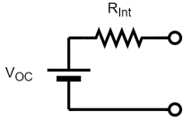
Figure 2: DCIR battery model
A direct current is applied to the battery for a specific time, the change in battery voltage is measured, and the resistance is calculated. Figure 3 shows a graph illustrating this operation.
DC voltage and current graphs of the battery's internal resistance

Figure 3: DCIR Measurement Routine
The currents used in the DCIR method are typically much higher than those used in the ACIR method, making it a more realistic test in terms of use cases, as batteries are often exposed to high, sudden currents. The battery's internal resistance is the biggest limiter of its ability to deliver large currents, so it's important to identify a battery that cannot function under high-current conditions. Ideally, you would have an instrument capable of delivering high-current pulses while simultaneously performing synchronized voltage measurements. Source measurement units (SMUs), such as the Keithley 2461, can accurately deliver 10 A pulses while measuring the resulting voltage with a 6.5-digit resolution. These SMUs feature a Test Script Processor (TSP®) that allows users to run a complete DCIR pulse sequence and receive calculated data from the front panel using the DCIR TSP application.
DCIR test setup and results on a Keithley 2461 graphic touchscreen SMU

Figure 4: DCIR test setup and results on a Keithley 2461 graphic touchscreen SMU
A battery's internal impedance is a key indicator of its quality and performance over its lifespan. Three methods can be used to measure a battery's impedance, or resistance, and each provides slightly different information. Understanding these methods can help ensure you're getting the information you need and expect.