
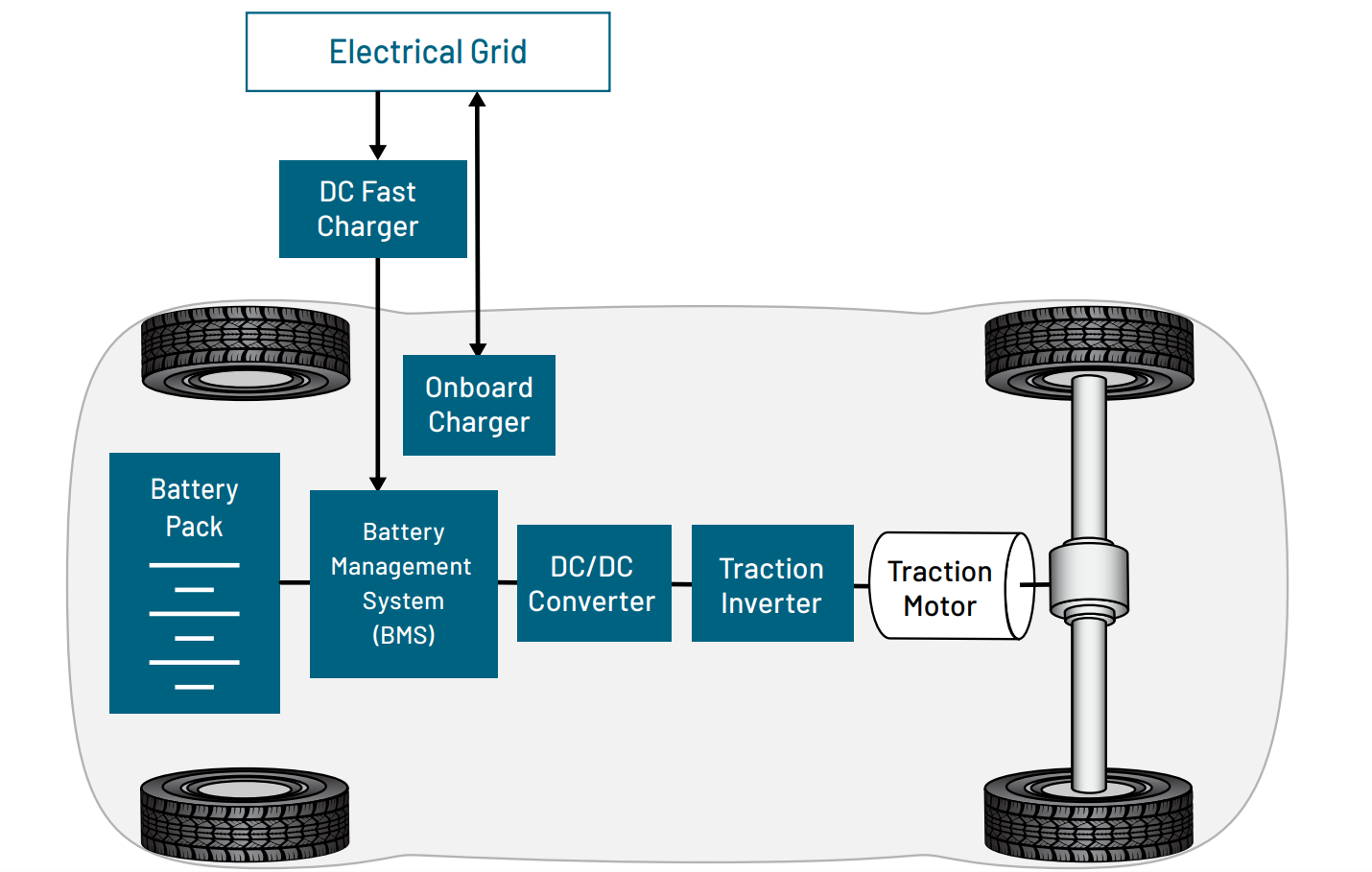
The introduction of the 800V powertrain architecture represents a major step forward. Let's take a look at the design and testing challenges associated with the 800V powertrain architecture for electric vehicles.
Unlocking the potential of 800V systems
The 800V powertrain architecture refers to the electrical system of an electric vehicle (typically electric trucks and construction vehicles) that operates at a nominal voltage of 800 volts. This is a significant increase over the 400V powertrain architecture currently used in battery electric vehicles (BEVs). These vehicles require charging times of between 40 and 120 minutes at a public DC fast charger (DCFC). These times are limited by the practical size of the cable needed to carry the required current to the battery pack. 800V BEVs are a promising alternative for achieving ultra-high charging speeds of 350 or 400 kilowatts.
The transition to 800-volt battery electric vehicles (BEVs) offers a solution to range anxiety. Doubling the voltage while maintaining the same current effectively doubles the vehicle's energy output. With the ability to recharge the vehicle 50% faster (in other words, a 50% reduction in charging times), this advancement significantly reduces concerns about battery drain during extended journeys.

Bar chart showing the growth in production share of 800V systems between 2020 and 2030. Source: Yole market research
Increased autonomy of BEVs
As a result, these vehicles have the potential to charge from 5% to 80%, equivalent to approximately 320 km of range, in under 23 minutes. This contrasts sharply with the 40 to 120 minutes typically required for currently available 400V battery systems.
Furthermore, the high voltage allows the same power to be delivered with a lower current, which allows the use of smaller diameter cables and connectors within the propulsion system, resulting in a lighter electric vehicle and, ultimately, greater range for a comparable battery pack.
Other advantages of the transition from 400 to 800 volts are improved overall efficiency and simpler thermal management throughout the powertrain subsystem.
According to market research firm Yole, the automotive industry is expected to begin adopting 800V systems as a mainstream solution by 2023. This shift is driven by the numerous advantages mentioned earlier, particularly in the premium vehicle segment, with automakers such as Audi, Porsche, Hyundai, and Kia leading the early commercialization efforts. While currently only a small number of public DCFC stations can fully utilize the 800V architecture, that number is increasing daily, and we are likely not far from the majority of public DCFC stations operating at 150 kW or more within the next five years.
Thermal advantages of broadband devices
Regarding hardware approaches, emphasis is placed on the use of widebandgap (WBG) semiconductors such as SiC and GaN switches. This choice is due to their fast switching capabilities and high temperature tolerance. These components operate effectively at elevated temperatures, improving efficiency and reducing total harmonic distortion (THD). The extended operating temperature range of widebandgap devices can also simplify inverter design and minimize the need for thermal management systems. In our collaboration with standards organizations such as JEDEC and IEC, we focus on standards related to switching analysis and diode reverse recovery measurements, which are fundamental for characterizing the performance of widebandgap devices.
Oscilloscopes play a crucial role in validation
Oscilloscopes play a crucial role in validating and diagnosing problems with electric vehicle traction motors and inverter designs. They enable designers to achieve ambitious efficiency targets. However, it is essential to recognize that an oscilloscope alone may not be sufficient for all these measurements.
Probing solutions and analysis software play a critical role. Optically isolated voltage probes help designers take measurements on high-voltage gate drive systems
Tektronix offers a wideband gap double pulse test (DPT) solution, or double pulse test, on the MSO 4 B Series, MSO 5 B Series, and MSO 6 B Series oscilloscopes, which helps engineers achieve accurate and repeatable measurements on state-of-the-art power converter designs.
Specially tailored software, such as Tektronix's IMDA (Inverter Motor Drive Analysis) offering, complements these capabilities by enabling three-phase measurements for PWM and mechanical data, enhancing the overall utility of the solution.
Dedicated current and voltage probes are essential for measuring the correct magnitudes and frequencies at critical points. The MSO 5 and 6 series oscilloscopes are an excellent solution for engineers designing electric vehicle powertrains, offering a high number of channels, inverter analysis software, and versatile probe options.
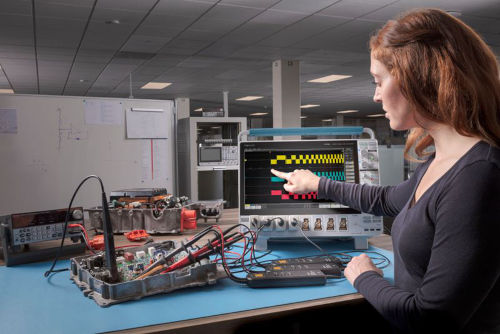
Engineer using the Tektronix Series 5 B mixed-signal oscilloscope to perform electric vehicle powertrain tests.
AUTHOR: Denis Solomon, Tektronix