Furthermore, a conventional four-channel oscilloscope is insufficient to meet the demands of a wide range of applications or for comprehensive monitoring. An alternative would be to use several four-channel oscilloscopes. However, these would then need to be laboriously synchronized with mostly proprietary software, which is not easy to do due to device limitations, such as excessive jitter. Moreover, time is a critical factor, especially for automated processes, because the more complex the product, the more analyses are required, which ideally should be performed simultaneously.
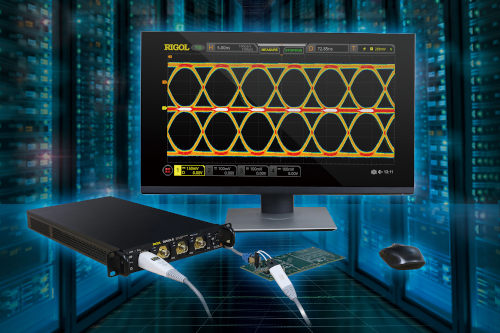
The new Rigol DS8000-R series of oscilloscopes is designed as a 1U rackmount (19" rack). Based on the MSO8000 series, the device features a sampling rate of 10 GSa/s and a memory depth of 500 Mpts. Like the MSO8000, the DS8204-R can utilize two channels up to 2 GHz or four channels up to 1 GHz, and its signal acquisition rate of up to 600,000 Wfms/s enables the acquisition of very fast error pulses. Real-time signal recording and playback are possible, with a capacity of up to 450,000 measurements.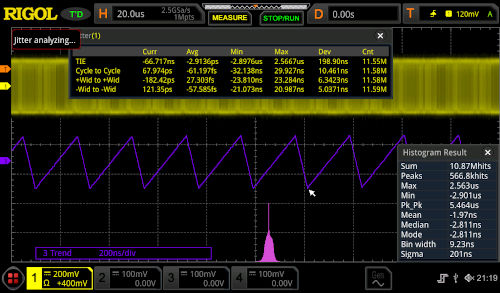
A DS8000-R series instrument has four analog inputs and a 25 MHz arbitrary function generator. An HDMI interface allows a single device to be connected to a monitor and operated with a mouse or keyboard via the USB inputs. As an alternative to the monitor, the device can also be operated from a web browser using the Web Control function (see Figure 1).
Like the MSO8000, this series is based on the UltraVision II architecture and uses Rigol's proprietary Phoenix chipset, with two ASICs forming the analog front end. This oscilloscope offers very easy rack integration thanks to its compact design and the included rack kit. A single four-channel rack-mount module can be synchronized with DS-SYNC64 sync modules and additional modules for up to 512 channels (see Figure 2 – a multi-channel configuration). This is possible because trigger jitter is effective. All options and functions, such as real-time eye charting and jitter analysis, can be performed in the same way as with the MSO8000 series. This means that different functions can be tested with different instruments.
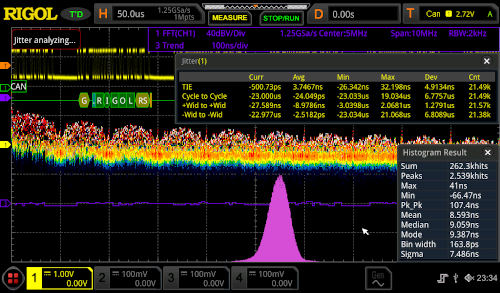
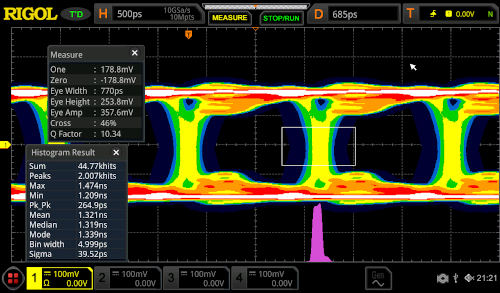 For example, an HDMI video stream was measured using an eight-channel setup consisting of two DS8204-Rs. The first DS8204-R was used to perform the measurement using a real-time eye chart, and the second device was used to measure the jitter behavior of the same signal (see Figure 3). With a single device, this measurement would have to be performed sequentially with different device settings, meaning that with an automated test sequence, the respective measurements only need to be initiated for each test object without changing the entire settings.
The histogram was used for both tests. With the jitter measurement, a trend graph of the jitter deviation can also be displayed. By measuring the frequency of the trend graph, the jitter frequency can be determined. Using the information on the histogram's symmetry and its values, as well as the trend graph and its frequency, a qualitative statement can be made about the type of fluctuation to help narrow down the cause. Simultaneously, the real-time eye diagram determines eye characteristics, such as the Q factor, which can be used to provide information about the bit error rate (BER).
Another example of multichannel measurement is the investigation of different bus systems within a single system. Most often, the same clock is used for different buses in a circuit, enabling clock triggering. This allows for the decoding of up to four different buses, such as CAN, LIN, SPI, and FlexRay. The process becomes more complex when different data and clock speeds are used with different bus systems.
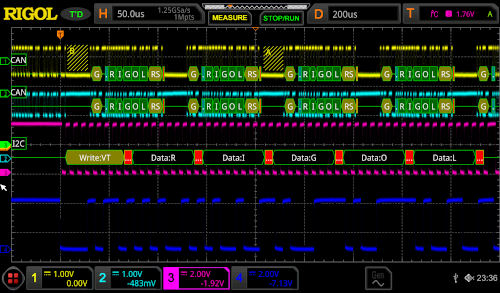
 In Figure 4, three bus systems with an eight-channel configuration were analyzed in detail. Different clock frequencies were used for the respective buses in this circuit. The first four channels were triggered by the SPI bus clock. Additionally, a zone trigger was used on channel 1 (CAN High), which simultaneously triggered channel 2 (CAN Low). All three bus signals could then be decoded in a single measurement. CAN High was measured simultaneously with the second DS8204-R and decoded again. The jitter behavior was also measured using a histogram. Furthermore, the frequency spectrum with a density representation is displayed using an FFT with one million samples for calculation. This means that several signals can be measured simultaneously in different ways with this configuration.
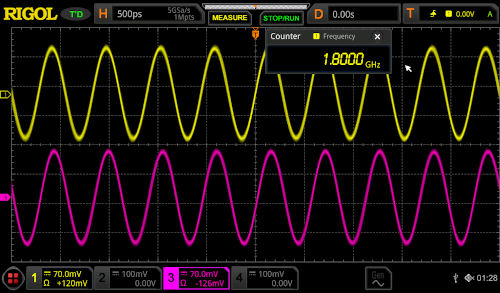
High-frequency signals can also be measured with the DS8204-R. For example, to make a qualitative statement about a 2 GHz signal, an oscilloscope would need to have about five times the bandwidth. Signals up to 2 GHz can be analyzed very well with the DS8204-R, as only small amplitude fluctuations are observed at the highest frequencies due to the RF aspect. Using two DS8204-R units, up to four 2 GHz signals can be measured. Figure 5 shows four 1.8 GHz signals.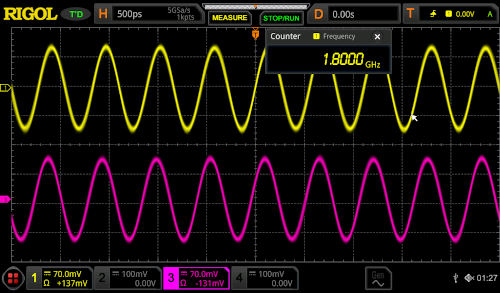
Another alternative is data analysis across a large number of channels over a specific period, which can be used to monitor automated processes, for example. In addition to USB and LAN interfaces, the DS8000-R series also offers a 10Gb 10GE SFP+ optical interface, which transmits the combined data at very high speed to a PC via a network router. With its ULTRADAQ software, RIGOL offers an optimal solution for this type of monitoring. In combination with the SFP+ interface, ULTRADAQ can be used as high-speed data acquisition software (see Figure 6). RIGOL offers an open-source Software Development Kit (SDK) on its website, which customers can modify to meet their specific requirements.
 The DS8000-R can solve a wide range of problems, including high-performance, multi-channel applications with highly accurate synchronization, compact installation, very high data transmission speed, and visualization within a single software application for monitoring and data acquisition. By cascading multiple DS8000-R units, multi-channel applications with very fast data transmission can be implemented. The oscilloscopes can operate between -40 and +50 °C and are also suitable for use in extreme environments. With the new DS8000-R, RIGOL offers a multifunctional solution for multi-channel applications, especially in automation or research and development.