
Furthermore, to test higher-capacity batteries, the channels can be connected in parallel to test 12 kW, 18 kW, and 30 kW battery packs. The EA-BT 20000 Triple series comprises eight models with voltage outputs from 10 V to 920 V and current outputs/channels from 40 A to 600 A. Unlike other battery test instruments on the market, an EA-BT 20000 can continuously supply three 600 A channels or a single channel supplying 1800 A.
The EA-BT 20000 triple-output battery testers cover the entire battery lifecycle, from materials research and development to manufacturing, incoming inspection, and second-life battery recycling. The EA-BT 20000 can test individual cells, battery modules, and large battery packs for basic research and industries, including automotive, aerospace/defense, and consumer renewable energy systems.
The EA-BT 20000 battery testers offer complete functionality in a single instrument for charging and discharging high-power battery packs for battery testing, battery simulation, and battery recycling. The testers measure parameters such as state of health (SOH) and end of life (EOL). They also include controls for external circuit breakers and other safety features to monitor and protect the battery under test.
The EA-Power Control and EA-Battery Simulator software packages allow for automated tester control and the configuration and sequencing of tests without requiring a programming language.
To enable software development for custom systems, EA offers driver compatibility, including IVI and NI LabVIEW drivers. The EA-BT 20000 can also connect to a PC via SCPI commands or to a programmable logic controller (PLC) via Modbus commands. All models in the family share an identical programming interface to save development time when a system requires multiple models. Standard interfaces include USB, Gigabit Ethernet, EtherCAT, and CAN FD. With CAN FD, the battery tester can be conveniently connected to automotive test benches.
For system integrators, EA provides 3D models as step-by-step files to facilitate the design of complete battery testing systems. Furthermore, the compact 4U enclosure helps minimize the size of the test rack. With the support of application experts, system integrators can cost-effectively incorporate the EA-BT 20000 into battery test systems of any capacity.
Featuring three channels, the EA-BT 20000 battery testers can simultaneously test three batteries. Therefore, these instruments maximize throughput compared to single-output instruments, enabling manufacturers to reduce testing costs and save on capital expenditures for instrumentation.
Furthermore, the EA-BT 20000 processes commands and performs readings at the fastest control speed of 1 ms. Combined with the latest interface versions—EtherCAT, CAN FD, and Ethernet Gb/s—the EA-BT 20000 further optimizes performance.
For large battery systems, up to 64 battery testers with a capacity of 30 kW can test a system with a power output of up to 1.92 MW. A master-auxiliary bus creates a multi-instrument system that functions as a single instrument. The master instrument controls all other instruments and displays the total power, total current, and warnings and alarms for each instrument. A second bus, the Share-Bus, ensures that each instrument safely handles an equal share of the total load.
Other tester configurations can create a system capable of testing high-voltage battery packs with voltages up to 2000 V. The EA-BT 20000 systems offer the widest range of performance with the highest voltage and current available on the market.
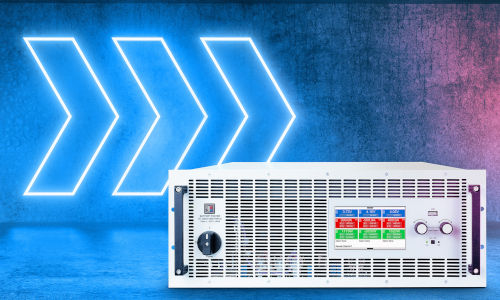
EA Elektro-Automatik GmbH & Co.KG presents the EA-BT 20000 Triple Battery Tester, the only battery tester with three channels and the highest voltage and current outputs.
The new instruments can simultaneously test up to three cells, modules, or battery packs with power capacities of 4 kW/channel, 6 kW/channel, and 10 kW/channel. Furthermore, for testing higher-capacity batteries, the channels can be connected in parallel to test battery packs of 12 kW, 18 kW, and 30 kW. The EA-BT 20000 Triple series comprises eight models with voltage outputs from 10 V to 920 V and current outputs/channels from 40 A to 600 A. Unlike other battery testers on the market, an EA-BT 20000 can continuously supply three 600 A channels or a single channel supplying 1800 A.
The EA-BT 20000 triple-output battery testers cover the entire battery lifecycle, from materials research and development to manufacturing, incoming inspection, and second-life battery recycling. The EA-BT 20000 can test individual cells, battery modules, and large battery packs for basic research and industries, including automotive, aerospace/defense, and consumer renewable energy systems.
The EA-BT 20000 battery testers offer complete functionality in a single instrument for charging and discharging high-power battery packs for battery testing, battery simulation, and battery recycling. The testers measure parameters such as state of health (SOH) and end of life (EOL). They also include controls for external circuit breakers and other safety features to monitor and protect the battery under test.
The EA-Power Control and EA-Battery Simulator software packages allow for automated tester control and the configuration and sequencing of tests without requiring a programming language.
To enable software development for custom systems, EA offers driver compatibility, including IVI and NI LabVIEW drivers. The EA-BT 20000 can also connect to a PC via SCPI commands or to a programmable logic controller (PLC) via Modbus commands. All models in the family share an identical programming interface to save development time when a system requires multiple models. Standard interfaces include USB, Gigabit Ethernet, EtherCAT, and CAN FD. With CAN FD, the battery tester can be conveniently connected to automotive test benches.
For system integrators, EA provides 3D models as step-by-step files to facilitate the design of complete battery testing systems. Furthermore, the compact 4U enclosure helps minimize the size of the test rack. With the support of application experts, system integrators can cost-effectively incorporate the EA-BT 20000 into battery test systems of any capacity.
Featuring three channels, the EA-BT 20000 battery testers can simultaneously test three batteries. Therefore, these instruments maximize throughput compared to single-output instruments, enabling manufacturers to reduce testing costs and save on capital expenditures for instrumentation.
Furthermore, the EA-BT 20000 processes commands and performs readings at the fastest control speed of 1 ms. Combined with the latest interface versions—EtherCAT, CAN FD, and Ethernet Gb/s—the EA-BT 20000 further optimizes performance.
For large battery systems, up to 64 battery testers with a capacity of 30 kW can test a system with a power output of up to 1.92 MW. A master-auxiliary bus creates a multi-instrument system that functions as a single instrument. The master instrument controls all other instruments and displays the total power, total current, and warnings and alarms for each instrument. A second bus, the Share-Bus, ensures that each instrument safely handles an equal share of the total load.
Other tester configurations can create a system capable of testing high-voltage battery packs with voltages up to 2000 V. The EA-BT 20000 systems offer the widest range of performance with the highest voltage and current available on the market.
When used as a load for battery testing or discharge, EA battery testers can return approximately 96% of the absorbed energy to the grid—the highest efficiency available. As a result, the EA-BT 20000 can save significant kilowatt-hours, allowing the instruments to pay for themselves. Furthermore, when supplying power, the battery testers feature active power factor correction, typically 0.99, and high-efficiency switched-mode power circuitry to optimize energy delivery efficiency.
EA Elektro-Automatik employs true automatic switching in its battery testers to provide wide input and output ranges for both voltage and current. This true automatic switching allows for full power input and output across the entire voltage output range. A single battery tester can test a wide range of battery voltage and current combinations, unlike other manufacturers who require two instruments or a more powerful instrument to cover the full output range of a battery.
The EA-BT 20000 Triple is a fully integrated battery tester. It boasts the highest power capacity for testing a wide range of cells, modules, and battery packs. The EA-BT 20000 is a complete solution for developing, testing, and recycling current and future battery technologies and capacities.
A single-channel version of the EA-BT 20000 is also available for applications requiring less capacity. This single-channel version offers all the safety and high-speed communication advantages of the triple-output instrument, but with an output of up to 2000 V and 1000 A.