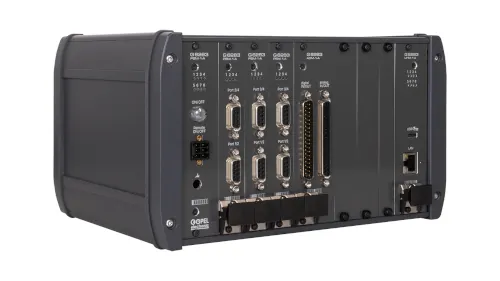
Unlike traditional interface cards or PC-dependent solutions, the GCAR 6283 test solution performs communication, diagnostic, and simulation functions directly on the hardware. This enables extensive residual bus simulations, as well as parallel testing of individual ECUs, high-performance flashing of multiple control units, or combined test tasks, all independent of the host system. This makes the GCAR 6283 particularly attractive for development environments, production, end-of-line (EOL), and run-in applications where a high level of parallelism is required.
The system is based on a new backplane concept that allows for flexible, customer-specific configuration. Plug-in modules enable the GCAR 6283 to be precisely adapted to the required bus systems and the desired number of interfaces. Among others, it supports CAN FD, LIN, and FlexRay, as well as Automotive Ethernet with 100BASE-T1, 1000BASE-T1, and 10BASE-T1S. Expansions for CAN XL and Multigigabit Automotive Ethernet are already planned, ensuring the platform's long-term scalability. Furthermore, it features a wide range of digital and analog I/O for simple testing tasks, trigger signals, PWM, and SENT.
Thanks to extensive integrated firmware features, such as E2E security (checksums and message counters), SecOC, network management, and transport and diagnostic protocols, computationally intensive and time-critical tasks are processed directly in the hardware. This creates stable, real-time conditions and enables demanding scenarios such as gateway simulations, parallel scheduling operations, or complex residual bus simulations on a single, self-contained system. For traceability tasks, the system can be expanded with an M.2 SSD (integrated slot).
For integration into customer-specific applications, GÖPEL electronic offers a comprehensive C-based programming interface (G-API) and a LabVIEW library. The GCAR 6283 connects to a PC via a separate pluggable host interface card (1 Gbit Ethernet and 5 Gbit USB). GÖPEL electronic's Net2Run software toolchain enables the configuration of residual bus simulations. Net2Run is used to derive AUTOSAR-compliant residual bus configurations from common data formats such as ARXML, FIBEX, or DBC. The generated configuration files are then loaded into the GCAR 6283 via the API and run directly on the system.
With its high density of interfaces, consistent real-time architecture, and modular backplane concept, the GCAR 6283 positions itself as a compact and scalable tester for modern ECU and vehicle network testing, far surpassing the functionality of classic communication hardware.