Measuring all forces and moments affecting the scale model is fundamental to any wind tunnel test. To achieve this, six force sensors and six torque sensors are integrated into a device located at the rear of the model. To provide accurate data, it is important that these sensors are calibrated frequently, and this is done in ETW's calibration chamber at temperatures ranging from cryogenic to ambient. Here, twelve PACE 5000 instruments—six for forces and six for torques—are used to generate precise pressures, which are then converted into forces and moments using pneumatic force generators. The model's sensor elements are subjected to these loads. The precisely known loads are compared with the sensor output readings to derive accurate calibration coefficients.
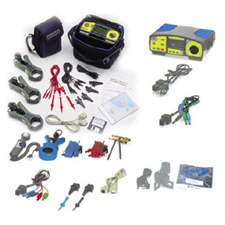
The PACE 5000 is based on the highly reliable and field-proven Druck 520 platform, which ETW has previously used for various calibration tasks. However, the PACE 5000 incorporates state-of-the-art piezoresistive devices and offers significant improvements in overall accuracy, long-term measurement stability, and control performance.