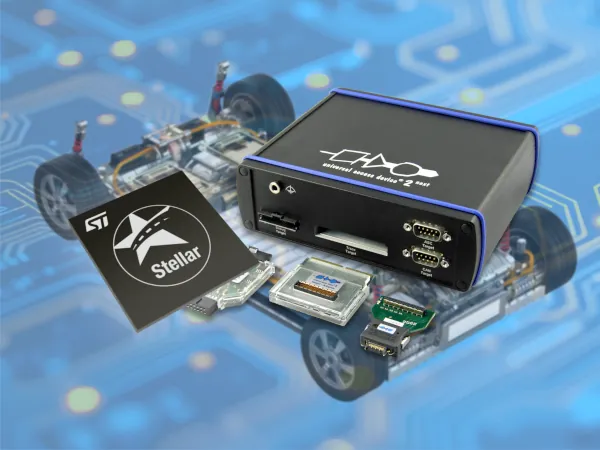
Thanks to the long-standing collaboration between PLS and ST through ST's "ST Partner Programs," key customers and early adopters are already benefiting from UDE's debugging, testing, tracing, and system analysis capabilities, which are optimized for Stellar P3E microcontrollers. Mass production of the chip is scheduled to begin in late 2026.
The Stellar P3E features a high-performance, multi-core cluster of Arm® Cortex®-R52+ CPUs and a neural processing unit (NPU). With this, ST aims to accelerate the development of highly integrated powertrain architectures and consolidate motor controllers, inverters, OBCs, and DC-DC converters into unified systems for hybrid and electric vehicles. In addition to its high computing power and AI acceleration capabilities, the MCU offers ample, expandable memory and intelligent power management features.
For the Stellar P3E, PLS has extended the Universal Debug Engine (UDE) debugging, tracing, and testing tool to enable developers to perform true multi-core debugging of the device's MCU. All cores in the Cortex-R52+ multi-core cluster are visible and controllable within a single, unified debugger instance. UDE's multi-core execution control ensures full synchronization of all cores during debugging at all times. Depending on the use case, cores can also be started and stopped individually. Multi-core breakpoints, which can be used in shared code, simplify the debugging of complex applications. Such a breakpoint is always effective and completely independent of which core is currently executing the corresponding code.
The UAD2pro, UAD2next, and UAD3+ devices from PLS's Universal Access Device family, along with the corresponding target adapter, complement the UDE debugging tool and ensure fast and reliable communication with Stellar P3E MCUs via JTAG or Serial Wire Debug (SWD). For development environments with demanding electrical requirements, galvanically isolated adapters are also available as an option, providing potential isolation up to 1000 volts.
For more comprehensive non-invasive debugging and runtime analysis, UDE utilizes trace data logged from the Stellar P3E. Among other things, it allows visualization of function or task executions over time, or profiling to uncover optimization potential. Large amounts of trace data can be logged on both the UAD2next and the UAD3+. The UAD2next has 512 MB of trace memory, while the UAD3+ has up to 8 GB. For fast download of trace data from the chip to UDE, the UAD2next and UAD3+ support the multi-Gbit/s high-speed serial trace interface based on the Aurora™ protocol. With the UAD3+ Serial Trace Pod 100G, a total trace bandwidth of up to 100 Gbit/s can be achieved.