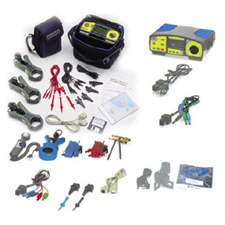
A key driver behind the development of new test equipment is how manufacturers work with customers to identify the challenges engineers face. While efforts continue to focus on improving measurement accuracy and bandwidth, many design changes are driven by how the instruments are used.
“The essential thing is the customers. We will design the products according to the way they will use them. It is crucial to make their work easier,” says Justin Sheard, Senior Engineer and Industrial Imaging Specialist at Fluke.
Bradley Odhner, Technical Marketing Manager for Tektronix and Keithley, agrees and points out that the company employs people whose primary role is to perform this type of customer work. "We dedicate a lot of time to talking to customers to find out what they need now, but especially what they will need in a few years."
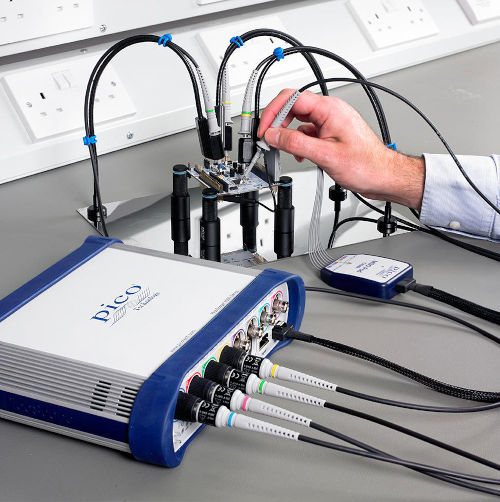 Customers inspire new features.
A customer-centric approach allows us to understand not only how engineers interact with tools, but also the types of features new instruments need to support. For example, energy efficiency is already a top priority for many engineering teams. The availability and environmental cost of resources used in manufactured products are increasingly important to society and, therefore, to product engineering teams. Kai Scharrmann, Head of Sales for Hioki Europe, highlights the work being done in battery design. "The cells being developed focus on packing more energy into the same space, or even less. That's not the only requirement. There's also a strong push to reduce the amount of polluting and hard-to-obtain elements, such as cobalt. The latest batteries are much more environmentally friendly, containing only a fraction of the cobalt used a decade ago."
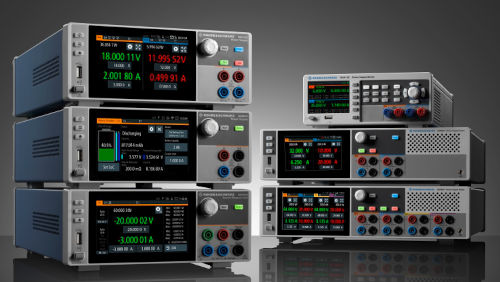 These market demands, in turn, drive the capabilities that manufacturers incorporate into their test equipment. Finding alternatives to cobalt has not been easy, as cobalt has frequently been shown to degrade over time. Repeated, automated measurements during stress testing will be crucial for identifying potential load control chemistries and algorithms, making them important features in test equipment.
The demand for new solutions can generate novel forms of instrumentation, says Sheard. "Our mission is to keep the world running. We create tools to put in the hands of those who keep operations going, and this applies to many different products." Sheard points to the example of maintaining industrial motors and machine tools. "Motors, bearings, and other mechanical components are subsystems that form the core of a factory, but their maintenance is costly.".
A major problem is that many conventional analysis techniques can only examine the surface of these moving parts. However, because they can penetrate the material, acoustic waves can reveal much more to maintenance technicians and engineers by showing the presence of faults inside bearings and motors. To bring acoustic imaging into production plants, Fluke has integrated acoustic imaging into its ii900 and ii910 handheld instruments. "Acoustic imaging is now doing what thermal imaging did 10, 15, or 20 years ago by revolutionizing manufacturing and preventative maintenance," explains Sheard.
Usability Improvements:
A focus on customer needs has led manufacturers like Tektronix to rethink the user interfaces of their instruments to help customers perform the measurements they need more quickly. "We've seen a trend among engineers to want to be able to do things faster and more easily," explains Odhner. The first step was to devise a novel interface designed from scratch, which customers responded to positively. "That new user interface became the current user interface for our 3, 4, 5, and 6 series oscilloscopes."
Thanks to the growing software instrumentation content, there's no need to wait for new hardware to take advantage of usability improvements. "Customers can simply download the latest software version and retroactively get all the added features," says Mike Purday, Manager of the EMEA region for Pico Technology. "We're currently working on a major new update that will benefit existing PicoScope owners free of charge.".
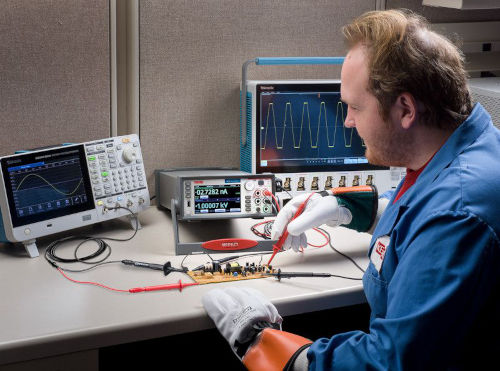 Advanced technology influences the development of lower-cost systems.
Some of the capabilities that will be incorporated into conventional instruments in the future are already available in specialized products today. As the cost of electronics decreases thanks to the product learning curve, development advances are incorporated into lower-cost systems. "It's the same situation as in Formula 1, where mainstream car companies invest in top-level racing teams. All the high-level equipment and technology that has been included in the race cars is eventually transferred to regular, mass-produced cars. We apply the same approach to the development of our products," says Scharrmann. "Today we manufacture specialized current sensors that can measure 800 A at 4 MHz. That technology, that know-how, and that experience are transferred to a standard meter, for example. This is one of the reasons why our clamp meters are so accurate."
Mike Hoffman, Manager of the EMEA region for Pico Technology, sees the same effect with oscilloscopes. "We've seen in the past when a 1 GHz oscilloscope was the Ferrari of oscilloscopes. Then, over time, as technology advances, what was needed to create a 1 GHz oscilloscope becomes cheaper to produce. Either that, or we invent new ways to build it and make it more affordable."
Manufacturers of testing equipment are keeping a close eye on research developments in even broader fields. This helps them identify technologies they can incorporate into cutting-edge instruments. "I spend a good portion of my time each month reading scientific articles in journals, not only to find out what the latest technology is, but also to see what tests scientists are using to evaluate their technologies," says Odhner, adding that these types of measurement circuits will be important for expanding the range of existing instruments and creating new types of products. "They start in early research and move into mass production until they eventually become widespread.".
 Setting New Standards for Innovation
Finally, standardization is an area that testing companies monitor and actively participate in. The Institute of Electrical and Electronics Engineers (IEEE) and similar organizations actively promote the capability and performance of PCIe, Ethernet, WiFi, and other communication standards. Test instrument manufacturers play an active role in many of these organizations. "In the case of PCIe, for example, we sit on those boards to try to define the standard and also to understand its future so we can start developing equipment that meets it," says Odhner.
Another aspect of participating in standards bodies, as well as interacting with academia, is the need to ensure that developed protocols can be effectively tested and to determine if alternative methods are needed. "When talking about low-level measurements, one of the first questions you want to be able to ask is: how low can I measure? There are fundamental limits," explains Odhner. "The universe doesn't allow us to measure certain stresses in certain strength materials because, in fact, you encounter the uncertainty principle. In our universe, there are physical limits to what can be measured."
Technology will continue to change, but test equipment manufacturers have embraced that reality by adapting to respond in a timely manner, ensuring that engineers have the testing solutions they need to drive innovation and complete their projects.
Author: Cliff Ortmeyer, Global Head of Technical Marketing at Farnell