Recent trends toward higher voltages in electric vehicles, railway inverters, new energy sources such as renewable solar power, and high-voltage commercial power lines such as 400 Vrms have demonstrated the need for oscilloscope probes capable of analyzing these high voltages.
Based on the proven 701927, the 701977 is designed for evaluating inverters, including 3.3 kV railway drive inverters, as well as measuring high-voltage surge noise waveforms.
The 701977 offers a maximum input voltage of 7,000 V peak at 50 MHz, with an attenuation ratio of 100:1/1000:1. High-voltage black and red alligator clips are supplied as standard.
A further development of the 701927, the 701978 meets the needs of renewable energy systems, specifically high-voltage photovoltaic systems. The 701978 offers a maximum differential voltage of 1,500 V at 150 MHz, with an attenuation ratio of 50:1/500:1. The new probe includes the same accessories as the existing 701927: a pincher tip (red, black), a 1 m extension cable, a 100 Ω resistor adapter, and a 150 Ω resistor adapter.
Both probes are powered from the power terminal of DLM oscilloscopes or from a separate external power supply and use BNC connectors.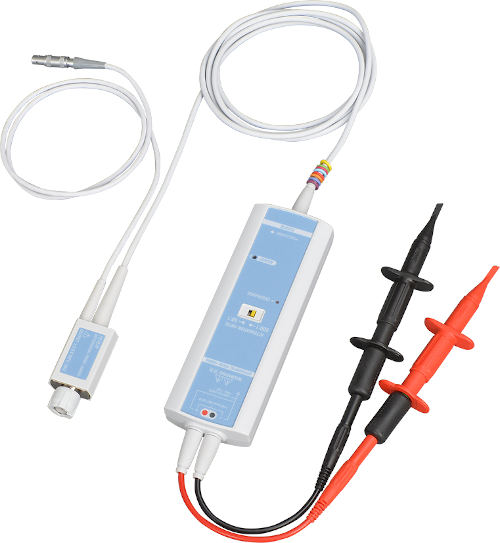
The 701925 is a new high-frequency differential probe. It offers a 500 MHz bandwidth and a wide input voltage range of +/- 35V, with a 50:1 attenuation ratio. This makes the probe ideal for measuring high-speed differential and floating signals such as CAN FD, enabling the accurate measurement of large surges—something existing differential probes may struggle to achieve.
Accessories supplied with the 701925 include 10 cm pair cables, 5 cm pair cables, red and black micro clamps, and a 6 cm ground extension cable. The 701925 is powered via the Yokogawa probe interface of DLM oscilloscopes.
Two new current probes are also being released, offering a wide range combined with high-sensitivity current measurement.
The 702915 and 702916 are three-range current probes designed for low-current measurement in consumer product development, IoT devices, and automotive systems. These new probes offer 10 times the sensitivity of conventional current probes, along with a higher signal-to-noise ratio (SNR) than existing products.
The 702915 has a bandwidth of DC to 50 MHz (-3 dB), while the 702916 has a bandwidth of DC to 120 MHz (-3 dB). With three ranges (0.5 A, 5 A, and 30 A), the probes allow a single instrument—an oscilloscope or a Yokogawa ScopeCorder—to analyze all current levels from standby to startup.
This makes the probes ideal for many current measurement applications, from measuring the quiescent current of household appliances, automotive components such as ECUs, and industrial equipment, to measuring current draw and quiescent current for low-power IoT devices, and control signal and starting currents in motors and industrial equipment.
For example, the combination of the Yokogawa DLM5000's high sensitivity and the new probes allows manufacturers to measure very low currents of less than one milliampere, providing analysis of the extremely low quiescent currents found in vehicle keyless entry systems.
“These new probes take our already excellent products to new levels,” says Terry Marrinan, Vice President of Test and Measurement for Yokogawa Europe and Africa. “Manufacturers who need accurate testing of high-frequency, high-voltage signals or precise monitoring of very low currents now have the features they need in convenient and easy-to-use probes. With these tools, manufacturers can easily test a wide range of products to meet the needs of new industries and consumers.”