Their efforts to improve the efficiency of their car led them to victory in a race that pitted the contestants against each other and against the harsh desert and mountainous environment of the North African country.
The basic design of all the cars in the race is similar: an aerodynamic wing shape covered with arrays of photovoltaic panels to convert sunlight into electrical energy, which is fed directly to a motor that drives the wheels.
To win a race like the Solar Challenge Morocco, a race car must generate as much solar energy as possible and convert that electricity into mechanical energy to the wheels as efficiently as possible.
At the same time, it must minimize energy losses: racing teams pay close attention to aerodynamic design to keep wind resistance to a minimum.
In the case of the RED E, the name of the Solar Team Twente race car, total wind resistance is equivalent to the rearview mirror of a conventional car. The driver must race as fast as possible, but not so fast that the car's battery runs out of power when it's not in sunlight.
A solar-powered race car has four main electrical systems: the array of solar panels; the battery and its management system; the inverter (motor drive), which converts the direct current output from the solar panels into three-phase alternating current supplied to the motor; and the motor itself. The team aimed for an efficiency of over 99% in the electrical power conversion circuits.
To prepare for the race, the team's engineers needed to improve the motor, battery, and power generation system if they wanted to outperform their rivals on the demanding African course. Even small improvements can make a significant difference. "If all the components are just 0.01% better than the competition's, then you already have an advantage before you even reach the starting line of a race," says Camiel Lemmens of the team. "So, precise measurement is a crucial element for our success."
Therefore, the team's electrical engineers are constantly working to further optimize the performance of the car's electrical systems. Among their achievements are increased energy generation from the photovoltaic cells and greater battery storage capacity. The team has even created a more robust and efficient inverter of their own design, replacing the standard commercial inverters used by competing teams.
The team had previous experience using the Yokogawa WT5000 precision power analyzer. This time, they had to perform four crucial tasks.
First, they had to analyze the efficiency of photovoltaic solar cells so that the team could select the cells with the best voltage and current output for a known photonic input.
Another task was to measure the energy capacity of the battery cells and select those that stored the most electrical energy.
They also had to validate the accuracy of the "fuel gauge," the car's onboard sensor that measures the battery's state of charge. This system measures the current entering the battery (from the solar panels) and the current leaving it (to the engine). By subtracting the input from the output, it can calculate the battery's remaining charge. This required continuous and highly precise measurement of the current flows.
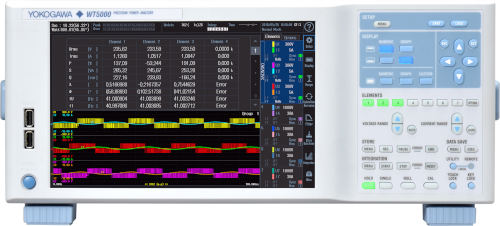 The fourth task involved measuring the output power of the motor system, including the inverter and the motor itself, across a range of input power values, so that the team could refine the design and gradually improve its efficiency. This required performing an extremely precise power analysis with a high sampling frequency.
Rob Krawinkel, from the team, states: "With the WT5000, we also discovered that the fuel gauge circuit's current sensors had a drift, which made the car's state-of-charge measurements inherently inaccurate. By compensating for the drift, we were able to safely provide the driver with an additional 1 or 2 km of battery range at a given speed."
The modular and expandable WT5000 is Yokogawa's most accurate power analyzer, with a specified measurement accuracy of ±0.03%.
Its measurement bandwidth is 10 MHz for voltage and 5 MHz for current, and its maximum sampling rate of 10 million samples/units exceeds the data refresh rate required to validate the RED E fuel metering system. Featuring exceptional isolation, noise immunity, and advanced filtering capabilities, the WT5000 allows users to perform simultaneous measurements on up to seven inputs and view them on its high-resolution 10.1" touchscreen.
"The WT5000 is a very pleasant instrument to use; it's intuitive and easy to navigate the controls," says Rob.
"It's also easy to adjust the display to show exactly the measurement results you're interested in, such as when it clearly showed that our new inverter design outperformed the equivalent commercial model by a significant margin."
The team's development of their own custom powertrain and components – a feat that relied heavily on the accuracy and precision of the WT5000 – proved decisive for the victory, and the team hopes to continue its successes at the upcoming 2023 World Solar Challenge.