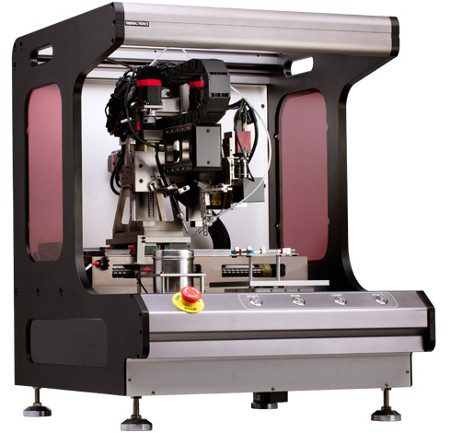

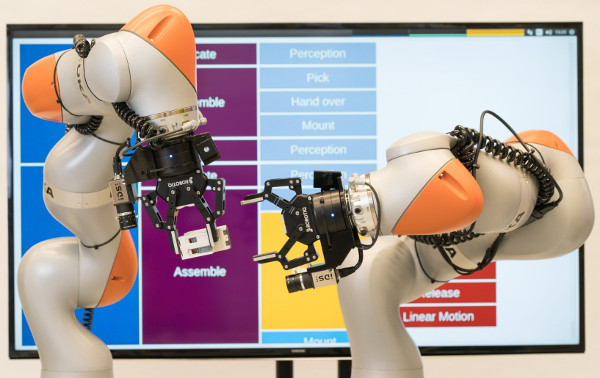
As it springs into action, a click is heard when a hand places a piece in its correct position in the assembly. The hand then withdraws, picks up another piece, and passes it to the other arm for maximum precision, so that both limbs coordinate their movements to assemble a section of the control station.
The collaborative activity of a two-armed robot's hands has been tested at Siemens Corporate Technology in Munich, the company's global research unit. There, it was confirmed that the robotic system is a crucial element for the future of manufacturing, a future in which factories will be self-regulating.
The ability to perform tasks autonomously, rather than automatically, is what small-batch producers and those who produce different versions of the same product need to meet the growing demand for customized products. Conventional automation is not yet cost-effective at this level, which is known as "batch size 1.".
A Siemens Corporate Technology team led by Kai Wurm and Georg von Wichert, which has been responsible for researching autonomous systems within the company, has solved this problem. "Our intelligent two-arm prototype shows that cost-effective production for smaller, single-batch sizes is possible," says Wurm. "In the future, robots will no longer need to be programmed so expensively and slowly with pages of code that provide a customized procedure for assembling parts. We will only need to describe the task, and the system will translate these specifications into a program."
Transition to Semantic Information
: “We simply tell the robot to insert a specific item into the assembly line,” says Wurm. “And that’s exactly what it does.” On a small scale, this task is equivalent to Batch 1 size. That involves manufacturing or assembling a product containing different parts in various versions, for which the robot obtains information on how to manufacture a product from an associated software model. While this CAD/CAM (Computer-Aided Design and Manufacturing) model is incomprehensible to conventional robots, the new prototype can understand such models. In a sense, it’s as if the robot could understand different languages, thus eliminating the need to program its movements and processes.
To achieve this, the prototype breaks down the software's build plan tasks, such as the general "assemble" command, into actions like "pick up" and "deliver," until it moves an arm or opens its grippers. The robot also decides which task each arm should perform. To make this possible, the developers have enabled the prototype to augment the product development software's information at a semantic level.
"Product components and process information are semantically transformed into ontologies and knowledge graphs," Wurm states. "This makes implicit information explicit. Until now, some processes that people perform intuitively due to experience have had to be taught to robots through code. However, our prototype analyzes the problem on its own and finds the corresponding solution.".
In the case of the Siemens prototype, this process can be easily observed on a monitor located to the right of the robot's arms. The monitor displays two rows of colored tiles, each containing words such as "assemble" (left column) and "select" (right column). These tiles gradually move upward, similar to scrolling on a web page. The tiles represent each step of the assembly process. On the left-hand monitor, the demonstrator displays the information received by the robot's arms at the start of a production process. This information consists of a 3D representation of the surrounding area and the objects within it. Above the demonstrator are two more screens that show what the robot's arms are currently viewing through their integrated cameras.
Towards Self-Correcting Systems
: Siemens Corporate Technology's prototype system can also correct errors without requiring prior detection. For example, if a part becomes misplaced, one of its arms will locate it as long as it remains within the camera's field of view. The arm will pick up the part and adjust all subsequent movements to install it correctly. If the part needs to be positioned on the opposite side of the assembly, the arm will transfer the component to the other arm. These innovative developments are part of the company's Core Technology (CCT) Future of Automation program. CCT enables Siemens to focus on crucial areas of innovation such as digital twins, artificial intelligence, and additive manufacturing.


 Asparagus picking-1-w.jpg)