

The sum of small improvements tends to multiply. Two 10% improvements can result in a 21% benefit, and the range of improvements is vast. People mistakenly believe that a Tesla achieves record-breaking range with a better battery, but equally important is that the battery operates safely near its limit, eliminating thousands of parts and other details. Range is even more desirable in small aircraft because it's a safety factor, so pilots also aim for a drag factor of 0.2, eliminating a kilometer of wiring, hundreds of parts, and inefficient motors and power electronics.
Faced with reality, detractors of small electric aircraft are now focusing on the impossibility of larger electric planes and vertical takeoff. They have a point, as we are in a "silly season" where many reckless proposals attract a flood of money from blind investors waiting for the next Tesla. Theorists were right to point out that a design with a propeller at each wingtip and nothing in between would plummet to the sky if one failed. They are right to warn that, with currently available parts, many multirotor VTOLs fall from the sky within 60 minutes of takeoff: there is no gliding and not even parachute deployment at that altitude. The economics of urban air taxis are rightly questioned by IDTechEx in their report "Air Taxis: Electric Vertical Take-Off and Landing Aircraft 2021-2041." However, after doing the calculations, benchmarking, and interviews, IDTechEx is certainly not negative about battery-powered VTOLs in general.
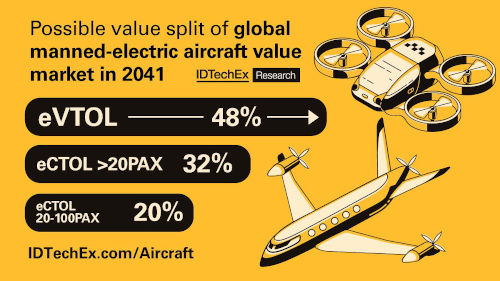 As IDTechEx advises, many are pivoting to fixed-wing VTOLs, so they can fly like conventional airplanes most of the time, have longer flight times, and, in some cases, glide in emergencies. One example is the British startup Vertical Aerospace, which is valued at $2.2 billion after Virgin Atlantic and American Airlines placed orders for 1,000 of its fixed-wing VTOLs—several billion dollars, even though nothing is airborne yet.
However, helicopters are inherently more efficient in vertical flight, but without redundant propellers or wind stability. They help lift tall buildings, hovering for up to an hour. No battery-powered VTOL can do that: they must address minimal commercial hovering scenarios.
Returning to conventional takeoff and landing fixed-wing aircraft, some calculations suggest that none of the eight- to one-hundred-seat versions planned for 2026-2030 are likely to fly. These calculations use the wrong equations because two of them rely on the very different principle of ground effect, and many others use the new distributed thrust (DT) principle, which involves multiple propellers along the wing. DT means eliminating flaps and significantly reducing weight, space, material costs, drag, and runway length. Calculations and experiments by NASA and the DLR support this.
Critics are also mistaken because they ignore the "every little bit helps" approach for larger aircraft. For example, today's polluting regional jets have 30 km of wiring and a poor drag factor, but a born-electric aircraft is like a Tesla. The Tesla's range comes largely from regenerative braking, and the equivalent in airplanes is propellers that reverse during descent and wheels that regenerate during landing. In fact, motorized wheels can make taxiing and takeoff for electric aircraft more efficient.
Let's look at an example. Bye Aerospace has over 720 orders—worth more than $250 million, with deliveries about to begin—from flight schools and air taxi operators for its two- and four-seat battery-electric airplanes, which are available for testing today. It recently announced an eight-passenger battery-electric airplane with a similar "lower total cost of ownership" argument, but the 500-mile (fully charged) range was touted as dependent on a partnership with Oxis Energy for a new battery. Detractors laughed when Oxis quickly went bankrupt. However, the giant LGChem has a similar timeline for supplying a comparable battery, and, like Tesla, Bye has never relied on a single battery supplier. They do the dirty work on all the small improvements. The following aspects of the specification reveal some of this, as well as the numerous safety features beyond even its long glide, automatic emergency landing system, and aircraft parachute.
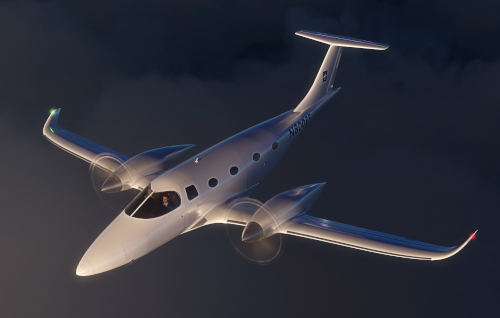 The eFlyer 800's design is completely new, from nose to tail. Its aerodynamic efficiency is twice that of a typical legacy turboprop aircraft of similar size. The propulsion system boasts high overall efficiency, with a highly efficient motor and low cooling resistance. Two wing-mounted electric motors, each with redundant motor windings and quad redundant battery packs, provide a modest increase in range. Optional supplemental solar cells (likely the satellite-grade cells they tested, which produce twice the electricity of current solar cars and aircraft) and electric in-wheel taxiing offer a modest boost in range.
In fact, Jet It and JetClub, sister companies with fractional ownership in North America and Europe respectively, have signed a multi-million dollar purchase agreement for a fleet of eFlyer 800 aircraft. Furthermore, L3Harris Technologies and Bye Aerospace have signed an agreement to develop a fully electric, multi-mission variant that will provide intelligence, surveillance, and reconnaissance (ISR) capabilities.
For now, Bye Aerospace isn't exactly building a groundbreaking aircraft with a new flight principle, but it can add distributed propulsion whenever it wants. Meanwhile, all battery-electric planes climb faster than their polluting, propeller-driven counterparts, just as Teslas accelerate faster. Just be careful about saying that no battery-powered commercial or regional airliner can fly. There's a groundbreaking aircraft smiling down on you from above.