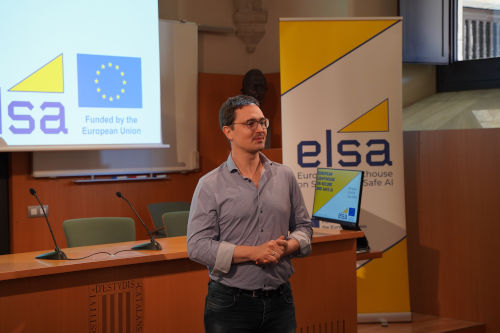
The aim of the meeting of the 26 initial partners was to make progress on the pressing security and safety challenges of artificial intelligence and machine learning. ELSA is based at the European Laboratory for Learning and Intelligent Systems (ELLIS), an internationally recognized AI network of excellence.
The consortium discussed the activities planned for the next three years. As Dr. Mario Fritz, ELSA project coordinator and professor at CISPA, explained: “We want to develop reliable artificial intelligence. This means that, in the future, we want AI to be used legally, ethically, and safely within Europe. Designing these technologies is our responsibility, as is developing their positive impact on society.”.
On the second day, the researchers participated in a hands-on workshop focused on defining the six use cases that will be studied in more detail throughout the ELSA project. The selected use cases relate to key applications of AI and ML that will serve as a benchmark for measuring progress in secure AI techniques and models.
The use cases focus on:
HEALTHCARE.
Healthcare is a sensitive area with the highest privacy requirements. The ELSA project focuses on medical data and how AI can be trained on it while respecting privacy in different institutions.
AUTONOMOUS DRIVING
Autonomous vehicles are safety-critical systems. They must not only perform excellently, but also respond appropriately to the unexpected. This could include, for example, adverse handling, extreme weather conditions, or accidents. The ELSA project aims to develop test environments to evaluate the safety of these methods.
ROBOTICS - LEARNING THROUGH HUMAN INTERACTION
One of the goals of robotics is to enable machines to learn continuously and perform tasks independently, with or even without human assistance. To achieve this goal, the machine learning models underlying intelligent machines must be trained on vast amounts of data. The purpose of the ELSA project is to ensure that data can be used effectively for the learning process without violating people's privacy.
MEDIA ANALYSIS: THE FIGHT AGAINST DISINFORMATION
Thanks to the power of modern techniques, deepfakes are more easily enabled and subsequently disseminated in the media. A deepfake is an image or video created using artificial intelligence that appears authentic when it is not. While in previous years, AI-generated images contained clues to the forgery, current results are much less recognizable. This use case explores new ways to understand and detect false information.
CYBERSECURITY - MALWARE DETECTION
Securing end-user devices is a difficult and challenging task. Many anti-malware solutions rely on machine learning and data-driven AI algorithms to combat malware. Unfortunately, attackers can bypass these protections by targeting the AI itself. The ELSA project aims to overcome this problem by making AI-based malware detection systems more resilient to these attacks or eliminating some of them entirely.
DOCUMENT INTELLIGENCE
Automated information extraction from documents is a crucial aspect of AI solutions for businesses and is used for process automation. Analyzing document information leads to AI decision-making processes that can have a direct impact on humans. At the same time, documents often contain private information, which limits access to them. The ELSA project aims to develop methods for training large-scale ML models on private and widely distributed data while protecting human privacy.
On Wednesday, the closing day of the launch event, participants had the opportunity to learn about each other's research in a poster session. ELSA partners presented scientific posters on artificial intelligence and machine learning. In a final discussion, the results of the past few days were summarized, and the vision of ELSA – European Lighthouse on Secure and Safe AI – was consolidated.
Prof. Dr. Mario Fritz concluded: "It has been a great start for the ELSA project in Barcelona. We are highly motivated to continue building the virtual center of excellence for secure AI in Europe."