

Other battery storage technologies, such as redox flow batteries, Na-ion batteries, and metal-air batteries, have remained emerging technologies with a limited volume of deployments in recent years.
The growth of the lithium-ion battery energy storage system (BESS) market has been facilitated by the rapid reduction in technology costs and the improvement of its performance characteristics through continuous development. BESS manufacturers have continued to develop systems that promise better safety properties and higher energy densities. These performance characteristics are important to BESS customers and will often be considered when procuring BESS for grid-scale projects, along with, of course, other crucial metrics such as cost, cycle life, storage duration, and C-rate. The launch of "zero-degradation" BESS technologies, such as CATL's TENER technology, has also generated interest in the industry. Continued technological innovation will help facilitate the dominance of lithium-ion BESS in the stationary battery storage market in the coming years. The IDTechEx report "Batteries for Stationary Energy Storage 2025-2035: Markets, Forecasts, Players, and Technologies" suggests that the lithium-ion BESS market will reach a value of $109 billion by 2035.
The change and dominance of LFP chemistry
Over the past decade, NMC and LFP chemistries have been the most widely used for lithium-ion BESS. LFP chemistry is less expensive due to the absence of cobalt and nickel in the cathode, has a longer lifecycle, and generally presents a lower risk of thermal runaway (and is therefore considered potentially safer). Consequently, the chemical composition of deployed lithium-ion BESS has gradually shifted toward a more dominant LFP share due to these advantages. Although most LFP cell production is concentrated in China, more gigafactory plans are being announced, which will lead to the manufacturing and supply of LFP cells for BESS becoming more localized across different countries over the next decade.
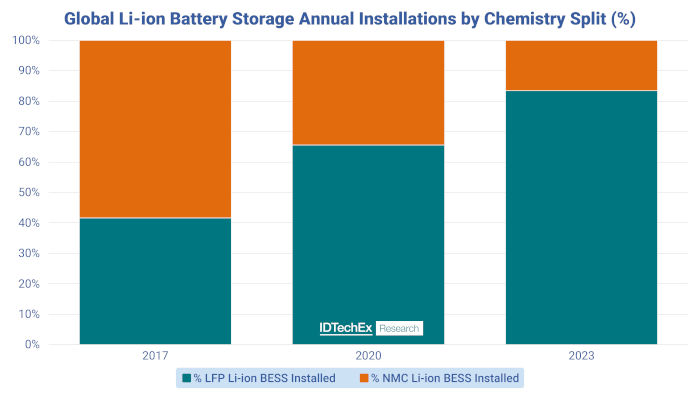
Annual global installations of lithium-ion battery storage by chemical composition (%). Source: IDTechEx
Evolution of BESS Energy Density
Despite these advantages, LFP cells have a lower energy density than NMC cells. Energy density is an important parameter in the high-performance electric vehicle (EV) sector, as EV battery packs with higher energy density facilitate greater driving range. However, energy density has historically been a less crucial factor for stationary energy storage applications. Nevertheless, more and more BESS manufacturers and integrators are switching to LFP, so the performance differences between the technologies of different players are becoming less extreme. Therefore, optimizing energy density at the system level is becoming increasingly important to differentiate and position oneself in an increasingly competitive market. This has been achieved through the use of LFP cells with larger form factors. Larger form factors cells have higher energy storage capacity. However, and more importantly, the use of cells with larger form factors has allowed more BESS container volume to be dedicated to the cells themselves, rather than to dead space, thermal management, or power conversion systems (PCS), thus increasing system-level energy density. This saves space for customers with more space-constrained projects. Furthermore, since fewer containerized systems would be needed for a given project capacity (MWh), this could result in cost savings for customers at the project level due to reduced installation times.
Narada Power announced the use of 320 Ah cells, with a volumetric energy density of 390 Wh/L, for a 5.11 MWh 20-foot containerized BESS. CATL also announced its new 6.25 MWh 20-foot containerized BESS, called TENER, which uses cells with an energy density of 430 Wh/L. While this represents an approximately 25% increase in system-level energy density compared to many of the 5 MWh BESSs launched by Chinese manufacturers in the past year, CATL also stated that the technology exhibits zero degradation in the first five years of use.
Claims about zero degradation of BESS
CATL reported the development of biomimetic SEIs and self-assembling electrolytes as enablers of "zero degradation" performance. Biomimetic typically refers to structures, processes, or production methods that copy or are inspired by biological structures or processes. As explained in the IDTechEx report, the "zero degradation" claim is likely a combination of factors that extend beyond the SEI and electrolyte design to include the use of prelithiation additives during battery manufacturing. Furthermore, the operation of the battery management system (BMS) can be altered throughout the battery's lifespan to give the customer the perception of "zero degradation" when, in reality, the cells will continue to undergo some degradation. The IDTechEx report delves deeper into the analysis of CATL's "zero degradation" in BESS batteries and how it can be achieved or perceived.
Perspectives on lithium-ion battery storage technology
Lithium-ion batteries will remain the dominant BESS technology in the medium term. The technology is well-established and has been successfully demonstrated in grid-scale projects reaching GWh. Annual deployments of lithium-ion BESS have grown significantly worldwide, exceeding 90 GWh in 2023. The ongoing development of technologies by cell and BESS manufacturers to improve performance characteristics will help lithium-ion technologies maintain their market dominance. Continuous innovation will also be key for any player to remain competitive, especially given the increasing number of players adopting LFP chemistry. In the past, the performance and cost differences of lithium-ion BESS were more pronounced between technologies using LFP cells and those using NMC cells. This allowed companies selling these systems to more easily highlight the advantages of their technology. In the current market, BESS manufacturers have launched lithium-ion BESSs with higher system-level energy densities to enhance their market position, while also delivering potential cost reductions for customers at the project level. This has been achieved by using cells with larger form factors, and this key trend is expected to continue, with a growing number of players adopting this strategy.