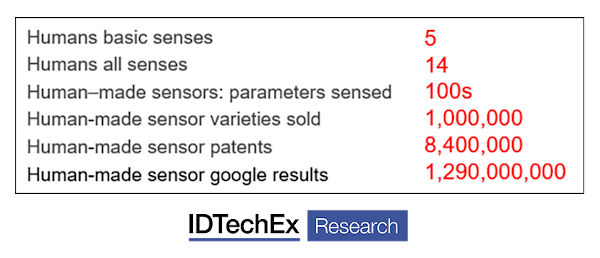
For example, your body has primitive sensors like your eyes and fingers, but it processes data in a combined way, so the whole is greater than the sum of its parts. This is called "sensor fusion," something increasingly seen in the automotive, healthcare, and robotics industries.
Sensors for the Internet of Things:
The Internet of Things (IoT) promised billions of nodes per year, each containing a transceiver, a microprocessor, and several sensors, all at an affordable price of a few dollars each or less. These devices were supposed to collaborate with each other for the benefit of humankind, but without human intervention. Each node was to be directly connected to the internet, unlike anti-theft tags, RFID, and LPWAN nodes. Unfortunately, in those terms, the IoT is deploying only a thousandth of the promised number because they are rarely suitable and affordable.
Another system may come to the rescue in 2030. 6G communications will, for the first time, merge communications, sensing, positioning, and other aspects into a single system to replace 5G. 6G will serve nodes and devices with little or no power, solving that IoT problem. It's important to note that 6G communications breaks with tradition by encompassing sensors, positioning, imaging, and edge computing as well as communications. Its proponents say it can eliminate all those expensive LIDAR and RADAR systems in self-driving vehicles, so there's no need to lower their price after all. That may be true, but Tesla is developing vehicles that navigate without connectivity so they can go anywhere.
Huge Needs for New Sensors:
The enormous need for new sensors is part of the sensor melodrama. For example, there will soon be 500 million people with diabetes worldwide, and they may appreciate a wearable, non-intrusive blood glucose meter. So, what's the outlook? Sensors will always be in things rather than people. However, they will often be biomimetic, meaning they will usefully copy nature.
 Leading countries in sensors
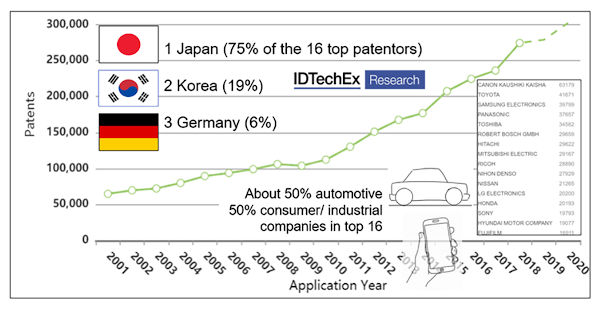
Patents must be treated with great caution because, for example, the Chinese tend to patent the sensor system, not the sensor itself. Japan, China, and Korea develop sensors more intensively than most other countries.
Recession-proof
Patent trends, along with other indicators, show us where research is headed and, potentially, where sales value is headed. Sensor patents are extremely strong and relatively unaffected by recessions or COVID-19. This is partly because they are a key technology that enables increasingly more tasks to be performed on increasingly more types of equipment and in increasingly more locations.
Sensors for smart cities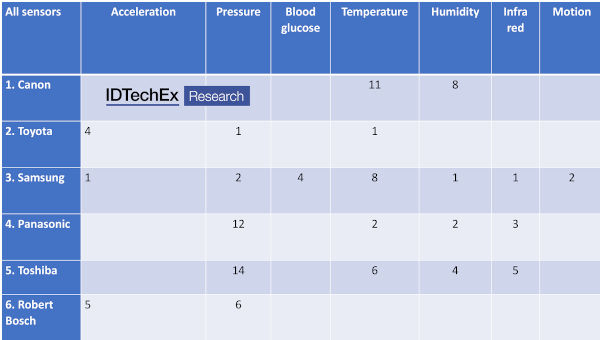
Smart cities receive massive investment regardless of recessions. NEOM in Saudi Arabia has a budget of $500 billion, and its high-security, zero-emission robotics approach requires a vast number of sensors. Its first smart city, "The Line," will accommodate one million people without the need to commute. It is being reclaimed from the desert, so water production and conservation alone require many sophisticated sensors. The Forest City being reclaimed from the sea in Malaysia has similar needs and a usable budget of $100 billion to meet them.
 Where are the leaders headed?
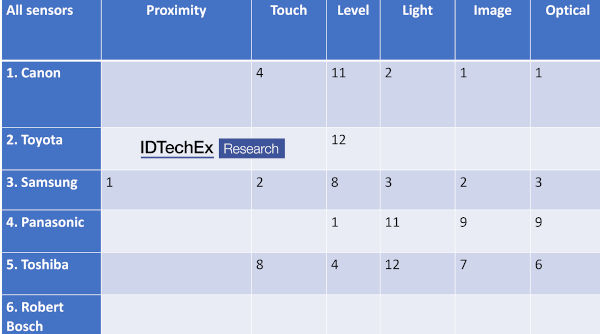
Let's take a closer look at the leading patent holders. In which areas do they excel? Below are their rankings by measured parameter. For example, Samsung is the company that registers the most patents worldwide for accelerometers/acceleration measurement. One interesting initial observation is that many of the leaders are patenting sensors to protect the equipment in which they place those sensors, not because they want to sell individual sensors.
Canon focuses heavily on light/image and related topics such as touch. Toyota's activity may be consistent with its stated determination to keep combustion engines in vehicles longer than much of its competition. Its sales forecasts for battery electric vehicles in the future lag far behind those of leading developers like Tesla and Volkswagen. However, Tesla has few patents, yet its market value dwarfs that of all other automakers, demonstrating that patents are only part of the story.
Who pursues the hot topics?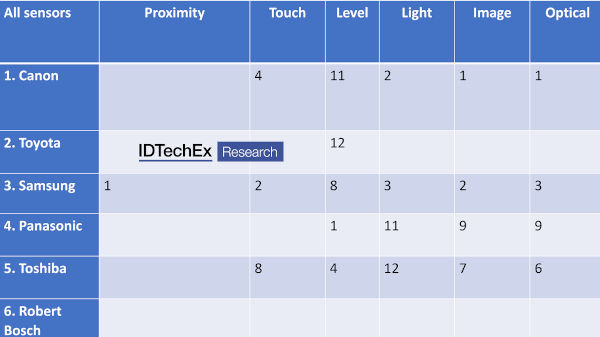
How are these major patent holders behaving in three booming types of sensors: vehicle radar, LiDAR, and biosensors? There are two definitions of a biosensor, and here we use the one relating to the use of biological mechanisms for detection. We are not referring to any parameter measured in a living organism.
Toyota is very active in RADAR and LIDAR robotic vehicle technologies. Its multi-purpose e-Palette robotic shuttle is the foundation of Toyota's planned Woven City at the base of Mount Fuji. Samsung is clearly expanding rapidly in the healthcare sector, as the principle of biosensors is particularly favored in the medical industry. Of course, part of this involves the mobile phone becoming a medical device. Samsung intends to remain a leader in mobile telephony.
Uninteresting topics
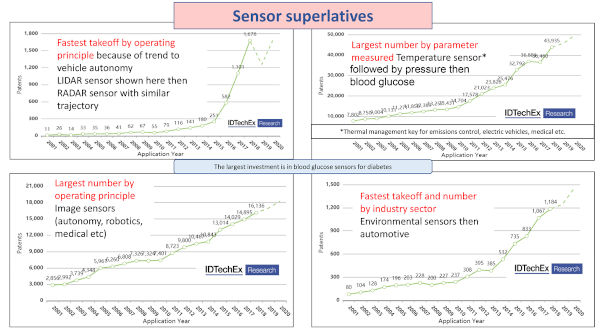
Here's a surprise. Which parameters were first detected long ago, leading one to believe that these sensors are mature and no longer under investigation? Temperature? Pressure? In fact, these "less exciting" topics are the basis of a large and growing number of patents. It's possible that 50,000 patents will be filed in 2021 for temperature sensors alone. The reason appears to be the increasing variety of specifications required for these "less exciting" sensors and the need to continually reduce costs through redesign.
 Sensor superlatives
Finally, let's look at some of the superlatives of sensors. These become clear when we consider that imaging is key to personal electronics, entertainment, healthcare, and robotics. Temperature detection is vital, from battery-electric vehicles to industry, the military, healthcare, the environment, and other sectors. Cleaning up the environment and keeping it that way is one of the new megatrends.