
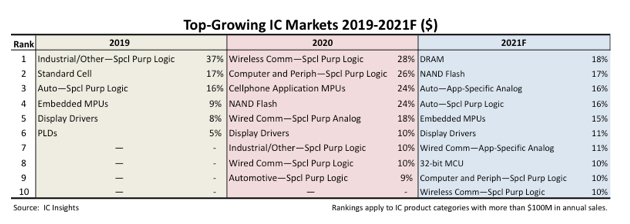
Each of the 10 fastest-growing IC product categories is expected to see double-digit sales growth, but only the top five segments will grow faster than the overall IC market, which IC Insights predicts will increase by 12% this year.
DRAM and NAND flash are expected to be the two fastest-growing product segments in 2021, with projected sales growth of 18% and 17%, respectively. Claiming to be the fastest-growing IC product segment is familiar territory for the DRAM market. DRAM was also ranked as the fastest-growing IC segment in 2013, 2014, 2017, and 2018. On the other hand, due to its extreme cyclicality, DRAM has also been among the worst-performing categories. The price collapse caused the DRAM market to decline by 37% in 2019, placing its growth rate last among the 33 IC product categories that year.
The surge in sales of laptops, tablets, and server systems boosted NAND revenue by 24% in 2020, as the COVID-19 pandemic forced a transformation in how consumers, schools, businesses, and governments communicated and conducted their activities. The transition to 5G technology within many of these same computing applications and smartphones is expected to drive NAND revenue growth by 17% in 2021.
Two automotive-specific IC product categories, Automotive-Application-Specific Analog and Automotive-Special Purpose Logic, are projected to be among the fastest-growing segments in 2021. New car sales took a hit during the COVID-19-plagued year of 2020, negatively impacting sales of automotive integrated circuits. But car demand rebounded in early 2021, leading to shortages of many automotive IC products. Additional electronic systems/features, onboard connectivity, advancements in autonomous driving, and the expansion of electric vehicle sales worldwide are expected to help increase the average semiconductor content per new vehicle to over $550 in 2021.
With smartphone growth slowing in recent years, many system-on-a-chip (SOC) MPU vendors, such as Qualcomm, Samsung, and MediaTek, have shifted their focus to 64-bit embedded processors that integrate security features and machine learning AI acceleration, along with graphics and video capabilities for automated vehicles, drones, and IoT applications. Several system trends are driving the growth of embedded processors, including increased automation in vehicles, industrial equipment, and home products. Internet connectivity is also becoming ubiquitous in systems. In a growing number of applications, embedded processors handle machine learning AI capabilities for autonomous operations without the need for human intervention or control.
The 32-bit MCU market has expanded rapidly due to the growing demand for higher levels of precision in embedded systems and the rush to connect sensors, along with virtually everything else, to the Internet of Things. Many new 32-bit MCU designs support wireless connections and Internet Protocol (IP) communications. In automobiles, the demand for 32-bit MCUs is driven by "intelligent" onboard systems and the increasing functionality of real-time sensors that support a growing number of automated safety functions, such as electronic stability control (ESC) and collision avoidance. Meanwhile, a rising tide of 32-bit microcontrollers is being used in a wide range of industrial and consumer equipment applications, as IC vendors introduce powerful MCU designs that cost about the same as 8- and 16-bit devices in consumer electronics and other high-volume systems.