“I owe a huge debt of gratitude to the team for the dedication and excellence they all brought to this effort. It is clear proof of the importance of the COM-HPC specification. We are now well-positioned to address current and future technology requirements.”
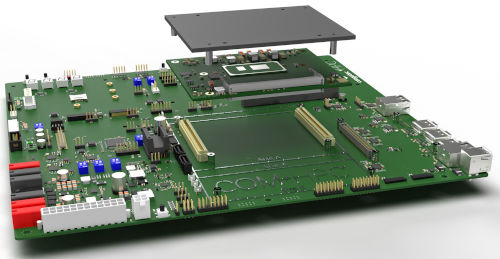
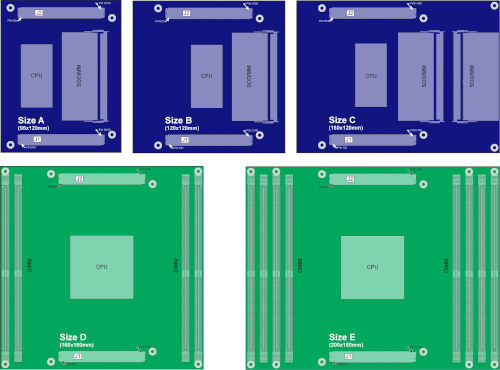
COM-HPC defines five module sizes to deliver edge server performance for small, resilient data centers. The specification addresses the emerging requirements of the embedded and edge computing market. The base specification will be accompanied later this year by a platform management interface specification, COM-HPC EEEP, and a motherboard design guide. “
 The PICMG organization is proud of the collaboration among industry leaders that has led to the completion of the COM-HPC base specification,” said Jess Isquith, president of PICMG. “The new open standard will enable multiple applications, including AI and Industry 4.0, by bringing computing to the edge server level.” Adopting the specification provides a necessary standard to reduce time to market and stabilize costs for hundreds of solution providers.
It is important to note that the specification covers two classes of modules.
The COM-HPC client module is designed for use in high-end embedded client products that require one or more displays, a full suite of low, medium, and extremely high-bandwidth I/O, powerful CPUs, and a modest footprint. Typical applications include medical equipment, high-end instrumentation, industrial equipment, casino gaming equipment, ruggedized field PCs, transportation and defense systems, and many others.
The COM-HPC server type is used in high-end, undisplayed embedded servers that require intensive CPU power, large memory capacity, and high-bandwidth I/O, including multiple 10 Gbps or 25 Gbps Ethernet ports and up to 65 PCIe lanes at speeds up to PCIe Gen 5. Typical uses include ruggedized embedded server systems for field environments and applications such as autonomous vehicles, cell tower base stations, geophysical field equipment, medical equipment, defense systems, and more. Both client and server modules feature a dedicated platform management interface, the first of its kind in a COM standard to include remote administration.
This new specification does not replace COM Express, which will continue to play a crucial role in the COM market for many years to come.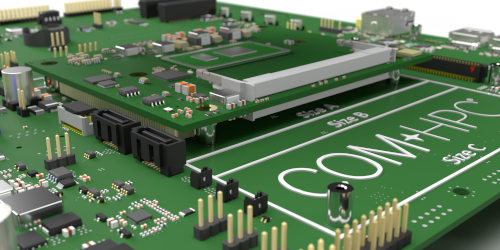
The specification documents are available for download from the PICMG website, picmg.org/open standards/com-hpc/. A preview document and additional resources are also available to learn more about the specification.
Technical Features:
Two high-performance 400-pin BGA connectors.
Platform Management Interface.
Not limited to x86 processors.
Supports x86 and RISC processors, FPGAs, and GPGPUs.
COM-HPC Client Modules:
Up to 48 + 1 PCI Express Gen4/5 lanes.
Up to 4x USB4.
Up to 4 video interfaces.
Up to 2 x 25Gb Ethernet interfaces.
Module sizes:
Size A: 95 x 120 mm.
Size B: 120 x 120 mm.
Size C: 160 x 120 mm.
COM-HPC Server Modules:
Up to 64 + 1 PCI Express Gen4/5 lanes.
Up to 2x USB4.
Up to 4 graphics/headless interfaces.
Up to 8 x 25Gb Ethernet interfaces.
Module sizes:
Size D: 160 x 160 mm.
Size E: 200 x 160 mm.
The members of the PICMG COM-HPC committee are: Bielefeld University, Acromag, ADLINK, Advantech, Amphenol, AMI, Avnet Integrated (MSC Technologies), Comtel, Duagon (MEN Mikro Elektronik), congatec, Elma Electronic, ept, Eurotech, Fastwel, GE Automation, HEITEC, ICC Intelligent Platforms, Intel, Kontron, NAT, nVent, Samtec, SECO, Supermicro, TE Connectivity, Trenz Electronic, and VersaLogic. ADLINK, congatec, and Kontron are the committee sponsors. Christian Eder, marketing director at congatec, is the chair of the COM-HPC committee. He previously drafted the current COM Express standard. Stefan Milnor of Kontron and Dylan Lang of Samtec support Christian Eder in their respective roles as editor and secretary of the PICMG COM-HPC committee.