But if they can be made faster and more agile, drones could be used in time-critical operations beyond the racetrack, for example to search for survivors in a natural disaster.
Now, aerospace engineers at MIT have devised an algorithm that helps drones find the fastest route around obstacles without crashing. The new algorithm combines simulations of a drone flying through a virtual obstacle course with data from experiments of a real drone flying the same course in a physical space.
The researchers discovered that a drone trained with their algorithm flew through a simple obstacle course up to 20 percent faster than a drone trained with conventional planning algorithms. Interestingly, the new algorithm didn't always keep the drone ahead of its competitor throughout the entire course. In some cases, it chose to slow a drone down to tackle a tricky turn, or conserve its energy to accelerate and ultimately overtake its rival.
"At high speeds, there's intricate aerodynamics that's difficult to simulate, so we use real-world experiments to fill in those gaps and discover, for example, that it might be better to slow down first to be faster later," says Ezra Tal, a graduate student in MIT's Department of Aeronautics and Astronautics. "It's this holistic approach that we use to see how we can make an overall trajectory as fast as possible.".
"These types of algorithms are a very valuable step toward enabling future drones to navigate complex environments very quickly," adds Sertac Karaman, associate professor of aeronautics and astronautics and director of the Information and Decision Systems Laboratory at MIT. "We really hope to push the boundaries so they can travel as fast as their physical limits allow.".
Tal, Karaman and MIT graduate student Gilhyun Ryou have published their results in the International Journal of Robotics Research.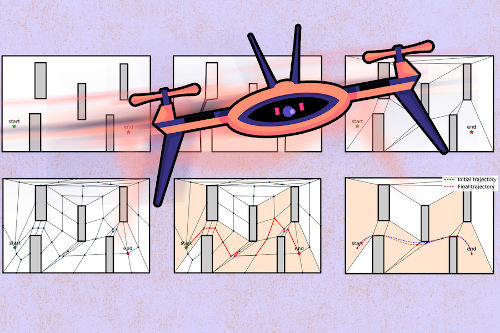
Fast effects
Training drones to fly around obstacles is relatively straightforward if they are intended to fly slowly. This is because aerodynamic effects, such as drag, are not usually a factor at low speeds and can be ignored in any modeling of a drone's behavior. But at high speeds, these effects are much more pronounced, and it becomes much more difficult to predict how the vehicles will behave.
"When you're flying fast, it's difficult to estimate your position," Ryou says. "There can be delays in sending a signal to an engine, or a sudden voltage drop that could cause other dynamic problems. These effects can't be modeled with traditional planning approaches.".
To understand how high-speed aerodynamics affects drones in flight, researchers have to conduct many experiments in the lab, putting drones at different speeds and trajectories to see which ones fly fast without crashing—an expensive training process that often results in accidents.
In contrast, the MIT team has developed a high-speed flight planning algorithm that combines simulations and experiments, minimizing the number of experiments needed to identify fast and safe flight paths.
The researchers began with a physics-based flight planning model, which they developed to simulate how a drone is likely to behave while flying through a virtual obstacle course. They simulated thousands of race scenarios, each with a different flight path and speed pattern. They then calculated whether each scenario was feasible (safe) or unfeasible (resulting in a crash). From this graph, they were able to quickly select a handful of the most promising scenarios, or race paths, to test in the lab.
"We can do this low-fidelity simulation cheaply and quickly to see interesting trajectories that could be fast and feasible. Then we fly these trajectories in experiments to see which ones are actually feasible in the real world," says Tal. "Ultimately, we converge to the optimal trajectory that gives us the shortest feasible time.".
Going slowly to going fast
To demonstrate their new approach, the researchers simulated a drone flying through a simple course with five large, square obstacles arranged in a staggered configuration. They set up this same configuration in a physical training space and programmed a drone to fly the course at the speeds and trajectories they had previously selected in their simulations. They also ran the same course with a drone trained using a more conventional algorithm that does not incorporate experiments into its planning.
Overall, the drone trained with the new algorithm "won" every race, completing the course in less time than the conventionally trained drone. In some cases, the winning drone finished the course 20 percent faster than its competitor, even though it took a slower trajectory from the start, for example, taking slightly longer to navigate a curve. The conventionally trained drone did not make these kinds of subtle adjustments, likely because its trajectories, based solely on simulations, could not fully account for the aerodynamic effects that the team's real-world experiments revealed.
The researchers plan to conduct more experiments, at higher speeds and in more complex environments, to further improve their algorithm. They may also incorporate flight data from human pilots who remotely operate the drones, whose decisions and maneuvers could help define even faster and more feasible flight plans.
“If a human pilot slows down or speeds up, that could inform what our algorithm does,” says Tal. “We can also use the human pilot’s trajectory as a starting point and improve upon it, to see what humans don’t do that our algorithm can figure out to fly faster.” These are some of the future ideas we’re considering.
This investigation was supported in part by the Office of Naval Research.
###
Written by Jennifer Chu, MIT News Office