





Tesla vehicles boast "full self-driving" (FSD), but current regulations do not allow fully autonomous vehicles to be on the road. What's going on?
The term autonomous vehicle (AV) conjures up images of cars driving themselves, without human intervention. But this is not yet the reality of the automotive industry. The Society of Automotive Engineers has agreed on six levels of automation, and the barrier to entry is surprisingly low.
Level 1 vehicles only need to automate one part of the driving process, such as maintaining a set speed, which can be achieved with cruise control. Level 2 vehicles must be able to assist in two aspects of driving, which is typically achieved with adaptive cruise control and lane-keeping assist systems.
It's not until level 4 that the science fiction fantasy of the self-driving car is achieved. So, where does Tesla stand on this scale? Level 3? Level 4? In fact, Tesla's Autopilot is a level 2 system. In other words, it's not a self-driving car, and a human must always pay attention to the road.
This doesn't mean Tesla's Autopilot is a bad system. In fact, according to Consumer Reports, it's the second-best Advanced Driver Assistance System (ADAS) on the market, with GM's SuperCruise taking first place.
This is reflected in videos of Tesla's system in action: it controls traffic superbly and can follow satellite navigation. But it doesn't drive the vehicle; the driver is human. In videos where the driver is asleep or has left the driver's seat, it is abusing the system and breaking the law.
ADAS is a much better description of the autonomous vehicles currently on the market. No vehicle currently for sale has anything more than driver assistance features; the driver is always in control.
The problem for Tesla is that its system has been catastrophically overmarketed and oversold. The problem ranges from the 'Full Self Driving' labeling to the exaggerated language CEO Elon Musk uses when describing the system.
Musk has been talking about the 'Full Self Driving' upgrade in Tesla vehicles since 2018, and with multiple revisions, updates, and hype cycles since then: some confused customers will think they have bought a self-driving autonomous vehicle when they have not.
 Camera-only system: Is Tesla wrong?
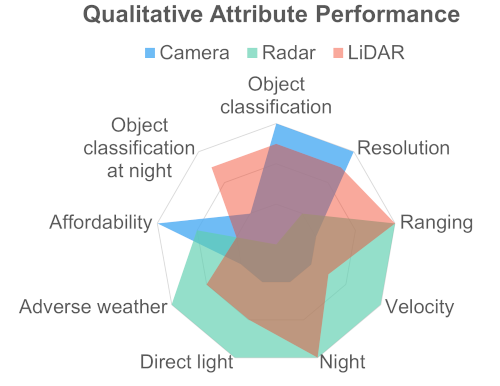
Another part of the problem lies in Tesla's sensor suite, which only includes cameras. While other manufacturers rely heavily on cameras, radar, and LiDAR, Tesla opts for a camera-only system and has even gone so far as to eliminate radar from Model 3 and Model Y vehicles (starting in May 2021).
The rationale is that humans can drive with their eyes: the same information that a set of cameras can capture. Therefore, a car could drive itself using only the cameras. A set of cameras also has better potential than a human driver, as it provides a wider perspective around the vehicle, and thermal cameras can perform better at night.
The problem is that cameras don't have the same capabilities as radar. While cameras can infer range and speed using AI, radar can measure this information intrinsically and is almost completely unaffected by bad weather, darkness, and direct sunlight, which are challenges for cameras.
Undoubtedly, Tesla can outperform human driving with a suite of cameras, but IDTechEx believes it has limited its potential by omitting radar, putting itself at a competitive disadvantage. Other manufacturers will also incorporate LiDAR into their ADAS sensor suites, which has some advantages over radar, but also some drawbacks.
Radar and LiDAR can be very important at night, when camera systems perform well below their maximum potential. This is crucial for ADAS systems, since most pedestrian fatalities occur at night. The NHTSA also noted that most of the incidents they are investigating involving Tesla's Autopilot systems occurred in dark conditions.
It may be time for Tesla to reconsider removing its radar systems, especially with the emergence of more sophisticated radars, such as those from Continental, Arbe, and Metawave. These next-generation radars could resolve the issues Tesla has faced with radar in the past. This would allow Tesla to achieve superior nighttime performance while supporting its camera system during the day. This would also help Tesla be prepared for when regulations change and Level 3 activities are permitted, as in Japan.
Tesla's Autopilot and FSD are not bad systems. They are among the best ADAS systems on the market. It is unlikely that the U.S. government and the NHTSA will find anything adverse or dangerous in these systems. The problem lies entirely in a dangerous misinterpretation of the system's capabilities. Until a clear message is conveyed that these are not fully self-driving vehicles, and that the driver is ultimately responsible for operating the vehicle, these incidents currently under investigation will continue to damage the perception of automated vehicles and, in the worst-case scenario, cost lives.













