




There are numerous reasons for this, including a lack of models and a challenging economic environment, but better, cheaper batteries and higher-performing EVs remain crucial to convincing consumers to buy them. Longer range, faster charging times, and stable performance in colder climates could be key to accelerating the prospects for BEVs, and lithium-ion batteries with silicon anodes offer a way to achieve this.
Higher silicon performance
The current iteration of lithium-ion batteries is beginning to reach its performance limits. Changes in electrode materials and cell designs are needed to move beyond the energy densities of around 600–700 Wh/L, which are achieved by the latest generation of cells based on graphite anodes and high-nickel NMC/NCA cathodes. Since the nickel content in NMC/NCA cathodes is already approaching 90%, gains in cathode capacity and energy density will be limited. Similarly, cell designs are relatively well optimized, and while further improvements are possible, significant performance gains from cell design innovations are unlikely. At the cell level, this leaves the choice of anode material as a key lever for improving battery performance, with silicon emerging as a leading alternative to the graphite currently used in most lithium-ion batteries.
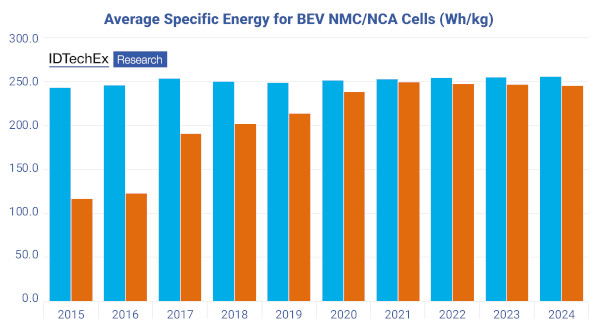
The energy density of lithium-ion batteries based on graphite anodes and high-nickel NMC/NCA cathodes has begun to stabilize. Source: IDTechEx
Silicon has a theoretical capacity of 3590 mAh/g, compared to 372 mAh/g for graphite. This high capacity allows silicon-based anodes to be thinner and less dense, resulting in higher energy densities and contributing to improved fast-charging capabilities. Anode compositions with even modest amounts of silicon can significantly improve energy density, while anodes with high or predominantly silicon content could allow for energy density improvements of 30-50%, with values exceeding 1000 Wh/l.
Fast charging capability can also be improved through the use of silicon, an increasingly important feature for battery manufacturers and automotive OEMs. Many silicon anode developers are highlighting improvements in this area. For example, Daejoo Electronic Materials plans to commercialize a material in 2025/26 that will enable charging times of 15–18 minutes. Group14 Technologies has supplied Molicel with material for 265 Wh/kg and 714 Wh/l cells that can operate in repeated cycles at a 5C charging rate (12 minutes of charging). Storedot has focused on charging capacity, developing batteries that add 160 km of range to an electric vehicle after a 5-minute charge, while many other developers are reporting improvements in battery charging speed made possible by their silicon anode technologies.
Multiple pathways to silicon adoption
Despite the promising advantages of using silicon, its large volumetric expansion, up to 300%, causes numerous problems, from electrolyte and lithium consumption to the loss of electrical and ionic conductivity, ultimately resulting in a short cycle life. Therefore, when silicon has been used, it has been as an additive to graphite in low weight percentages. Numerous technologies and solutions are being developed to allow the use of silicon above 10% of the anode and towards compositions in which silicon constitutes most, if not 100%, of the anode's active material. Among the materials and technologies under development are silicon-carbon compounds, silicon-graphite compounds, silicon oxides, pure silicon materials, and silicon nanostructures. All of this is combined with the use of various cladding materials, electrolyte additives, and other techniques designed to improve cycle life and overall lifespan.
The various solutions being developed may offer different advantages and disadvantages. For example, silicon-carbon composites have generated considerable interest, with materials typically incorporating silicon into porous carbon structures through a chemical vapor deposition (CVD) process. The porous carbon structure provides space for the volumetric expansion of the silicon while also offering electrical conductivity, but controlling the deposition process can be challenging and production can be expensive. Similarly, direct deposition of silicon structures onto a conductive sheet, while offering the potential for the most significant performance gains, is also likely to remain expensive and would require a major change in the cell manufacturing process.
Cost could still be a barrier
As previously noted, cost may remain a barrier to the large-scale adoption of more advanced silicon anode solutions. The price of silicon anode material is higher than that of graphite in terms of USD/kg and USD/kWh. The high degree of engineering involved in silicon anode materials, the use of silane gas in some cases, and the relatively early stage of the silicon anode market are likely to limit the potential for cost reductions in the short term. However, silicon's greater capacity allows for the use of less material, while the widespread availability of silicon and increasing production capacity and competition offer hope for cost-competitive solutions in the future. In the short term, the deployment of the next generation of higher-silicon anode materials is likely to first reach the high-end electric vehicle segment, as well as other less price-sensitive applications such as smartphones and drones.
Silicon anodes could play a significant role in accelerating the deployment of electric vehicles by delivering potentially substantial improvements in the energy density and charging times of lithium-ion batteries. For more information on the range of silicon anode technologies being developed, commercialized, and manufactured, including Si-C and Si-Gr compounds, silicon oxides, and pure silicon materials, please refer to the IDTechEx report, "Silicon Anode Battery Technologies and Markets 2025-2035: Players, Technologies, Applications, Markets, and Forecasts.".













