IDTechEx reports, "Future Automotive Technologies 2024-2034: Applications, Megatrends, Forecasts" and "Connected and Software-Defined Vehicles 2024-2034: Markets, Forecasts, Technologies," found that connected and software-defined vehicles have the greatest growth potential in the automotive space. The reports found that these technologies will grow at a compound annual growth rate of 21.1% between 2024 and 2034, reaching a value of $700 billion. That's between $400 and $500 per vehicle on the road. So, where will all that revenue come from?
At this year's CES, IDTechEx identified some of the sources of this revenue. First and foremost will be in-car AI assistants. This was a major focus for players like Mercedes, Amazon Web Services (AWS), and Qualcomm. Early functionality will enable more natural interaction with the car's systems. Voice commands in cars are nothing new, having evolved from a largely unusable gimmick over the years to something some readers might now think, "Oh yeah, my car has voice commands." Even the best current systems are somewhat clunky and require the user to memorize specific terminology and ways of phrasing requests.
In recent years, the world has witnessed the rapid growth of AI, and GPT chat demonstrates that machines can replicate normal human conversation. At CES, IDTechEx showcased how this can contribute to the in-vehicle experience. Both Qualcomm and AWS had demo interfaces trained on the vehicle owner's manual. This is an ideal first application, as customers can inquire about vehicle functions and receive a clear explanation from the AI assistant. For example, a driver could ask the assistant, "Why does the engine shut off when the car is stopped?" and the assistant could explain that it's designed to conserve fuel and let the driver know how to turn it off if desired. Another application simply involves interacting with vehicle settings. Many cars already have voice control systems that can change climate control settings, but AI assistants offer a much more natural way to do so. Drivers won't need to refine their commands or use specific words; They can say "I'm cold", "turn up the heat", "set the temperature to 20 degrees" or "temperature to 70 degrees" and the car will change accordingly.
However, AI assistants are likely to come as a subscription service, especially since they tend to rely on connectivity. AWS's AI assistant for cars is a cloud service that connects to AWS servers to run AI functionality. The latest Qualcomm chips incorporate built-in AI accelerators, allowing the vehicle to offer some AI features even when offline. However, it will likely require some connection for regular updates and requests that need to access data not stored in the vehicle, such as calendar information or Wikipedia articles. Either way, AI assistants will probably be a premium service, perhaps with the first year free, to attract customers and demonstrate value.
The AI examples discussed focused on vehicle interactions, but combined with connectivity and third-party app stores, the potential applications of AI assistants are limitless. One basic application is scheduling car maintenance. When a vehicle is nearing its service interval, the AI assistant can access the dealership's service center availability, then offer the driver available slots for servicing their vehicle, inform them of the cost of different packages, and even schedule and pay for the appointment.
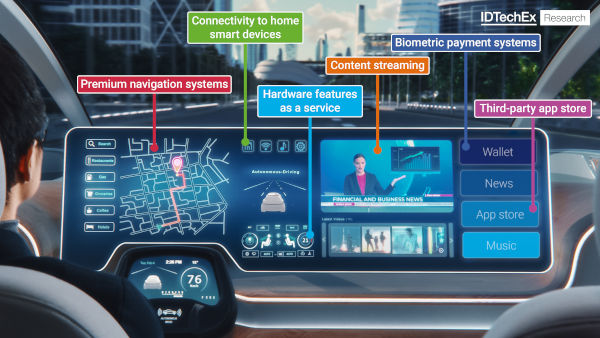
In-vehicle payments will be another game-changing technology in the automotive market. These systems can use biometric security, powered by infrared and standard in-cabin cameras, to authorize payments. IDTechEx saw a live demonstration of this at CES 2024. At one of the demo booths, an exhibitor pressed a button to purchase a mock-up of an infotainment system; the camera displayed their face for verification, and then the bank transaction could be seen on a separate screen. This wasn't a fake example or a hoax, but real money moving between accounts, processed by what appeared to be a car.
The example IDTechEx saw at CES demonstrated how a user could pay for an upgrade to access additional features—the feature-as-a-service model. This currently exists in companies like Tesla, BMW, and others that install hardware in their vehicles with all its functionality locked behind a paywall. Currently, the driver must pay to access these features through a smartphone app or online. With AI assistants, connectivity, and in-car payments, the game changes. A driver might say, "I'm cold," and the AI assistant could recommend subscribing to a package that includes heated seats. Connectivity and AI payments are then processed, and the purchase is completed. This is how AI, connectivity, software-defined vehicles, features-as-a-service, and in-car payments are coming together to generate hundreds of dollars in new revenue per vehicle by 2034.
Author: Dr. James Jeffs, Senior Technology Analyst at IDTechEx