The study conducted by IDTechEx in "Automotive Radar 2024-2044: Forecasts, Technologies, Applications" shows that, on average, 70% of new cars sold in 2022 had a front radar, while 30% had side radar. However, with increasingly sophisticated ADAS systems and Level 3 autonomous driving systems entering the market for the first time, radar technology needs to improve to meet the new performance demands of these systems. Therefore, the industry is seeing the first generations of "4D imaging" radars arrive on the market and be installed in vehicles. With this in mind, IDTechEx analyzes what a 4D imaging radar is, why it is necessary, and what new technologies it utilizes.
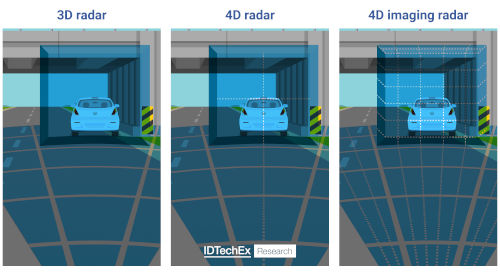
IDTechEx illustrates the differences between 3D, 4D, and 4D imaging radars. Source: IDTechEx
What is a 4D imaging radar?
First, a 4D radar is not automatically an imaging radar. Sometimes the two terms may seem interchangeable; however, IDTechEx believes it is important to distinguish between them. In the past, most radars were limited to three dimensions: azimuth (horizontal angle), range, and speed. A 4D radar simply means the addition of some resolution capability in the elevation direction.
A classic example of the need for this fourth dimension is the detection of a car parked at the entrance to a tunnel. A 3D radar will return the same results whether there is a car at the entrance or not. Typically, the vehicle will assume that the large reflection is a tunnel, and the adaptive cruise control system will continue to operate. This behavior is perfectly acceptable if there is a human driver who can override the ACC system accordingly, but it becomes a problem for vehicles operating at SAE Level 3 and above, which has become a real-world reality in the last two years.
In theory, a 4D radar overcomes this problem. The addition of vertical resolution means the radar should be able to distinguish a stationary vehicle at ground level from the tunnel a few meters above the roof. However, if the vertical resolution is so poor that the tunnel and the car remain in the same "pixel," then the situation hasn't improved. This is where the distinction between 4D radar and 4D imaging radar comes into play. Imaging radar must have sufficient angular resolution to distinguish the tunnel and the vehicle even at very long distances. In fact, IDTechEx believes that imaging radar should have sufficient resolution to distinguish much smaller obstacles at long distances—for example, a person on the road 100 meters away. But what resolution is needed for this? Assuming the person is between 1.5 and 1.8 meters tall, a resolution of approximately 1° would be needed to distinguish them from the road. In this scenario, the system would have enough time to activate the brakes and stop the vehicle, avoiding a collision, even at highway speeds.
However, detecting a person is one thing, but correctly identifying them using only radar data is another. That's why radar is often paired with front-facing cameras for applications like automatic emergency braking. At night, in fog, or in heavy rain, the camera may also be unable to see clearly. In these situations, there are several options: adding short- or long-wave infrared detection to the vehicle, which provides similar resolution to the camera and is more robust in poor visibility; adding LiDAR to the vehicle, which has similar range capabilities to radar but at a high cost; or further improving the radar's resolution.
Achieving a Resolution of 1° and Beyond:
Radar has a natural physical limit to its resolving capability known as the Rayleigh criterion, which is inversely proportional to the frequency multiplied by the aperture size (1/fd). In short, a typical car radar operating at 77 GHz with a 10 cm wide antenna array should be able to achieve a resolution of 2.8°. For example, a normal human eye has a resolution of between 0.005 and 0.01°, sufficient to see a 1 cm object at 100 meters. To improve radar resolution, its operating frequency could be increased; after all, humans use visible light, which is in the hundreds of terahertz range. However, radar frequency is limited by regulations and is not something that can be easily changed.
The next option is to increase the size of the diaphragm. While technically possible, this is complicated in practice. To go from 2.8° to 1°, the aperture must increase from 10 cm to 28 cm. To achieve this resolution in both azimuth and elevation, the radar now measures 28 cm x 28 cm, which will be difficult to integrate into the front bumper. It will likely cause airflow problems to the radiator, could be difficult to protect from damage, and will cause some headaches for OEM aesthetics teams. IDTechEx has seen increasingly larger radars, with examples such as the Continental ARS540, the Bosch FR5+, and the Arbe Phoenix, all over 10 cm, but the largest of these, the Phoenix, is still only 12.7 cm x 14.3 cm.
Another problem when creating larger radars is filling them with channels. Creating a 28 cm x 28 cm radar without the supporting semiconductor technology would be like building a $10,000 DSLR camera lens and pairing it with a 1 MP camera phone sensor from 2001. In this case, the analogue to pixels is virtual channels, which are multiples of a radar's transmit and receive (Tx and Rx) channels. In the past, a 3D radar might have one transmit channel and three receive channels (1Tx/3Rx). A basic 4D radar would likely use a radar transceiver with a 3Tx/4Rx arrangement, while some cutting-edge radars combine four of these chips to achieve a 12Tx/16Rx arrangement with 192 virtual channels. Arbe has developed a chipset that scales to 48Tx/48Rx in a single radar, providing 2,304 virtual channels. In this way, Arbe achieves a resolution of 1˚ in azimuth and 1.7˚ in elevation.
One way to overcome the challenges of building a very large radar is to distribute its power. IDTechEx has identified a couple of approaches to this. One, from Zendar, involves using two lower-power radars positioned at opposite ends of the bumper and operating in tandem. However, the aperture size has increased from less than 10 cm to 1.5–2 m. Consequently, the resolution of these two radars working together is just over 0.1° in azimuth. The other approach IDTechEx has observed is to construct separate antenna plates for each channel (in a 3Tx/4Rx radar) and position them along the bumper. This is the development path being explored by Plastic Omnium and Greener Wave.
Software is another key aspect of this discussion, and almost all the companies mentioned here will use some form of super-resolution software to enhance their performance. Returning to the camera analogy, modern DSLR cameras come with powerful processors that can extract maximum performance from an image, while modern phone cameras have benefited from years of software development to produce the sharpest and most natural-looking results. In radar, there are a few examples of startups creating exemplary algorithms to improve radar resolution without making any physical changes. Zadar Labs uses technologies such as machine learning, AI, and encoded transmission signals to improve radar performance. Spartan, meanwhile, uses an algorithm based on research for F-18 and F-35 fighter jet applications. Super-resolution software can quadruple angular resolution, reducing a standard radar with a 2.8° angular resolution to 0.5–1°, or even less if it already employs one of the other techniques discussed here.
Scanning is another promising option for radar. Metawave's metamaterial antenna uses beamforming and steering technologies to concentrate the radar's performance into a narrow fan. This fan is then scanned across the desired elevation field of view, providing improved resolution performance in both elevation and azimuth. Another advantage of this technology is that the emitted energy is distributed over a much smaller area than a flash-type focus, meaning it can achieve greater ranges than a non-scanning equivalent.
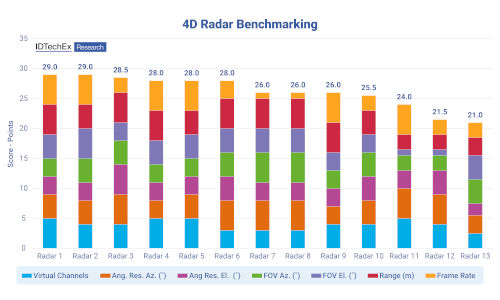
With all these options for building the next generation of radars, how do you know which one is best? The IDTechEx report "Automotive Radar 2024-2044: Forecasts, Technologies, Applications" goes into more detail about how these technologies work and improve radar performance. The report also presents a comparative analysis to compare these technologies against each other in relation to key performance indicators such as angular resolution, range, field of view, and frame rate, identifying which technology produces the best overall package—with some unexpected results.
Author: Dr James Jeffs, Senior Technology Analyst at IDTechEx