This shift is an essential step toward reducing emissions in heavy industries, such as oil refining, and transport sectors like maritime shipping. Governments and companies worldwide are setting ambitious targets to increase green hydrogen production, highlighting its potential to improve energy security and unlock new market opportunities.
Continuous innovation in electrolyzer technology is key to the rise of green hydrogen. Electrolyzers, the devices responsible for splitting water into hydrogen and oxygen, rely heavily on advanced materials for their electrodes, membranes, and catalysts. These components are critical for optimizing efficiency, durability, and overall performance. Innovations in materials science, such as the development of more robust membranes or more efficient catalysts, play a vital role in reducing costs, increasing lifespan, and minimizing the use of rare and expensive materials. As demand for green hydrogen grows, advances in materials technology become increasingly crucial. However, it's not just about creating more efficient electrolyzers. It's also about ensuring that these systems are sustainable, scalable, and affordable to pave the way for a truly green hydrogen economy.
The new IDTechEx report, "Materials for Green Hydrogen Production 2024-2034: Technologies, Players, Forecasts," delves into the current and future materials and components used in the four main water electrolyzer technologies. It also covers production methods, commercial activities, key industry players, and major innovations across all electrolyzer stack components.
Alkaline Water Electrolyzer (AWE): Innovation with Widely Available Materials.
Alkaline water electrolyzers, a proven and robust technology, operate using a liquid alkaline solution, typically KOH, and a porous diaphragm to separate the half-cell chambers. This trend is expected to continue thanks to the use of readily available materials such as nickel and stainless steel. Currently, AWE systems are classified into finite-gap and zero-gap configurations. This preference is due to the inclusion of porous transport layers (PTLs), which significantly increase efficiency and gas transport properties.
Innovation remains a driving force in the field of AWE systems, with manufacturers exploring new frontiers in electrode coatings and catalysts. The aim of these advancements is to improve the efficiency and effectiveness of this established technology. Furthermore, increasing attention is being paid to refining fuel cell designs to facilitate the evolution of more sensitive gases. These innovations are crucial for enabling better integration with renewable energy sources and optimizing environmentally friendly hydrogen production. Although many companies have begun producing fuel cells in-house, they still rely on external suppliers for various components. This interdependence presents opportunities for further innovation, particularly in advancing catalysts and evolving fuel cell configurations to enhance the capabilities of AWE systems.
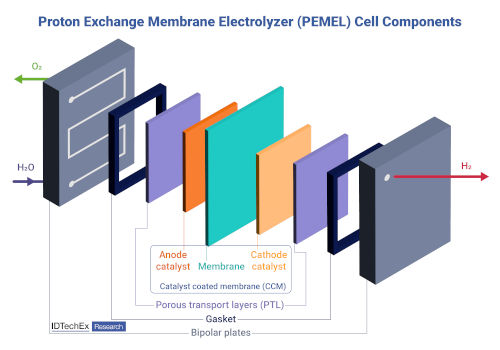
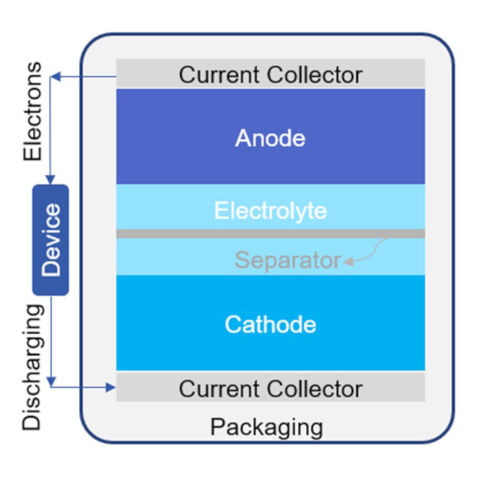
Components of proton exchange membrane electrolyzer (PEMEL) cells. Source: IDTechEx
Proton exchange membrane electrolysers (PEMELs): Greater efficiency with less use of precious metals
Proton exchange membrane electrolysers (PEMELs) are gaining popularity due to their high efficiency, compact design, and adaptability to fluctuating renewable energy sources. While there is a movement toward standardizing PEMEL fuel cell materials, innovation is far from stagnant, particularly in the development of anode catalysts. Recent advances include catalysts that maintain high catalytic activity while significantly reducing iridium usage, thus lowering the material cost per kilowatt (kW) and improving overall affordability. Crucially, the adoption of these innovations is critical to the success of PEMELs, as there are many concerns that their potential will be limited by future iridium supplies.
Other innovations in PEMEL technology are diverse and impactful. For example, advances in thinning proton exchange membranes contribute to improved efficiency, while innovative coatings for titanium bipolar plates increase durability and reduce reliance on precious metals. These advances, along with advanced commercial PEMEL designs, highlight the potential for significant battery performance improvements. New coatings and manufacturing methods, particularly for the catalyst-coated membrane (CCM), are at the forefront of these improvements and promise a new era of cost-effective and efficient PEMEL technology.
Anion exchange membrane electrolyzers (AEMEL): Combining the advantages of AWE and PEMEL
The anion exchange membrane electrolyzer (AEMEL) is a rapidly expanding technology that aims to combine the best features of alkaline and PEM technologies. AEMEL seeks to combine the abundant material of AWE with the high efficiency characteristic of PEMEL. This technology is experiencing rapid growth and innovation, exemplified by companies like Enapter, which are pioneering commercial megawatt-scale systems.
As a relatively young technology, AEMEL's materials are not as standardized as in AWE and PEMEL. Therefore, there is significant potential for innovation with AEMEL, and academic and commercial research is focused on advancing the membranes and catalysts for this technology. This not only fuels its innovation potential but also positions AEMEL strategically to potentially revolutionize the electrolyzer technology landscape thanks to its unique combination of material stability, efficiency, and accessibility.
Solid oxide electrolyzing cells (SOEC): High-temperature ceramic innovation
Solid oxide electrolyte cells (SOECs) represent a relatively nascent technology in the electrolysis landscape, with a smaller market presence compared to AWE and PEMEL. However, SOECs are gaining significant momentum thanks to innovations shared with the solid oxide fuel cell (SOFC) sector. Interchangeability between SOFCs and SOECs, particularly in their use of similar materials, is a key advantage. Although some ceramic components are already established in the technology, the development of new electrode-electrolyte assemblies in SOECs remains a dynamic area of innovation. This includes considerable variations in cell design and material usage among different cell manufacturers. These range from metallic to electrode-electrolyte types, each with its own advantages and incorporating various ceramic materials.
One of the main challenges in SOEC is the thermal compatibility of the various materials. This has led to advancements in other battery components, such as interconnects and sealants. New materials and coatings improve thermal compatibility and reduce the degradation of battery components. Overall, a wide range of materials are used in SOEC batteries, highlighting not only the diversity of the technology but also the potential for material innovation in these high-temperature electrolyzers. The evolving SOEC landscape presents exciting opportunities for advancing electrolysis technology through new ceramic materials and innovative battery configurations.
Market outlook and strategic perspectives
IDTechEx forecasts that the electrolyzer components market will reach an impressive $31.7 billion by 2034. This growth is primarily driven by the rapid evolution of the green hydrogen industry, in which electrolyzers play a crucial role. The new IDTechEx report, "Materials for Green Hydrogen Production 2024-2034: Technologies, Players, Forecasts," presents a comprehensive analysis of current and future materials and components used in the four main water electrolyzer technologies: alkaline water electrolyzer (AWE), proton exchange membrane electrolyzer (PEMEL), anion exchange membrane electrolyzer (AEMEL), and solid oxide electrolyzer (SOEC).
The report provides a detailed breakdown of battery costs by component, focusing on AWE, PEMEL, and SOEC batteries. Comprehensive lists of electrolyzer battery suppliers, components, and materials are included, along with case studies of key business innovations in the sector. Furthermore, it offers granular 10-year market forecasts, quantifying the demand for materials and components in tons, square meters (m2), and millions of dollars annually. This report provides an in-depth view of current electrolyzer market trends and prospects, highlighting key opportunities and the direction of industry growth.