




As a result of the collaboration between the Higher Technical School of Aeronautical and Space Engineering (ETSIAE), of the Polytechnic University of Madrid (UPM), and the National Institute of Aerospace Technology of the Ministry of Defense (INTA), the work developed has resulted in a “bio-inspired micro drone” with deformable wing geometry in which the moving mechanical elements have been replaced by deformable aerodynamic surfaces by means of intelligent materials in one wing, which entails an impact on the improvement of the performance of the device.
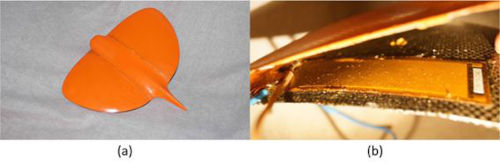
Details of the prototype: general view of the vehicle (a) and detail of the piezoelectric actuator installed on the wing (b). Source: UPM.
The research work has consisted of integrating composite materials into a wing, so that the modification of the geometry would be based on adaptive wing geometry, that is, without mechanical elements, since these have a lower temporal response.
Smart composite materials known as MFCs (macro fiber composites) have been bonded to the inner part of the wing. By precisely controlling their voltage, the wing's geometry is modified, and consequently, the aerodynamic characteristics and performance are clearly altered and controlled according to the vehicle's maneuvers. In this way, considering the system's electronic control, this controlled modification of the wing's curvature allows for an immediate and efficient adjustment of its geometry, modifying its aerodynamic characteristics and adapting them to the flight profile.
“We’re talking about how an increase in curvature leads to modifications in the drone’s aerodynamic characteristics. For example, an increase in the maximum lift coefficient allows the aerial vehicle to fly at lower speeds, accommodating different payload requirements (cameras, video cameras, atmospheric sensors, etc.), or shortening takeoff and landing times,” the researchers explain. This increased versatility allows the vehicle to adapt to different mission scenarios, making it a valuable asset in various applications. Thus, its capabilities for potential missions will be significantly expanded.
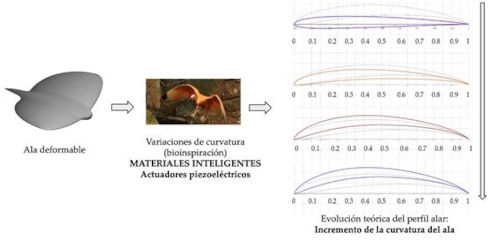
Concept for the design of a bio-inspired micro aerial vehicle based on smart materials. Author: Ángel A. Rodríguez Sevillano (ETSIAE-UPM).
The research results demonstrate that vehicle control and maneuverability are clearly achievable using these systems based on smart composite materials. Their integration opens new avenues for research in aerospace engineering, specifically in the field of flight mechanics, with new elements for improving aerodynamic characteristics and performance. According to the researchers involved in the study, "smart composite materials will be the first step towards developing innovative strategies for adaptive control laws."













