




This trend highlights the potential of mobile robots to automate various logistics operations, such as material handling, picking, long-distance distribution, and last-mile delivery. By 2023, some applications, such as material handling using automated guided vehicles (AGVs), will have reached maturity and will generate billions of dollars in annual revenue. However, other applications, such as drone delivery, are still emerging and are not expected to become widespread until later this decade due to regulatory constraints and specific technological challenges.
Despite varying levels of market readiness, each segment is experiencing rapid growth, with tech giants acquiring startups. Recent notable examples include United Robotics Group's acquisition of Robotnik, Amazon's acquisition of iRobot, and the merger of Mobile Industrial Robots (MiR, a Teradyne company) with AutoGuide Mobile Robots.
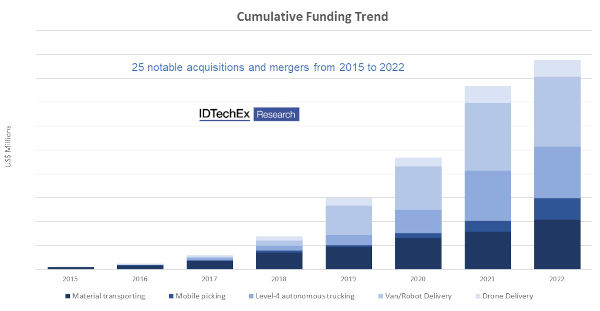
Cumulative funding trend from 2015 to 2022. Source: IDTechEx - "Mobile Robotics in Logistics, Warehousing and Delivery 2024-2044"
The IDTechEx report, "Mobile Robotics in Logistics, Warehousing, and Delivery 2024-2044," examines key products used in various logistics operations, including AGVs (e.g., tow tractors, forklift AGVs, unit load carts, network-based "goods-to-person" AGVs, etc.), autonomous mobile robots (AMRs), case-picking robots, mobile manipulators, heavy-duty autonomous mobile vehicles (AMVs), and last-mile delivery robots (vans, curbside robots, and drones). The report highlights recent technological advancements and business transitions, such as Amazon's first fully autonomous mobile robot, Proteus, which is expected to drive AMR adoption in warehouses.
On the technology front, IDTechEx analyzed the detachable components of several mobile robots to provide an in-depth technological analysis of the emerging technologies underpinning the growth of mobile robots. These technologies range from sensors such as LiDAR, ultrasonic sensors, and cameras to software such as computer vision, simultaneous localization and mapping (SLAM), and other navigation and sensing technologies. IDTechEx interviewed a range of industry players, from leading companies like Omron, MiR, and ForwardX Robotics to mid-sized and startup companies, to discuss the unique value propositions of their technologies, how they can help address pain points, and the latest business information, including regulatory approvals, funding status, and the latest flagship products.
One of the transitions identified by IDTechEx is the shift from AGVs to AMRs. AGVs have been widely adopted in many warehouses. Unlike AMRs, AGVs rely on infrastructure such as magnetic strips, QR codes, and markers for navigation. While this provides high navigation accuracy, it increases the overall cost of infrastructure development and limits AGV flexibility. With emerging SLAM technology and a growing number of companies demanding flexible operation, IDTechEx has observed the use of some AGVs in factories and warehouses, such as Amazon's Proteus. The IDTechEx report analyzes both AGVs and AMRs and offers an independent analysis of scenarios in which these two types of robots would be advantageous for users.
The report also provides 20-year market forecasts for the future of mobile robotics in the logistics industry, including granular breakdowns by application area and product category. According to IDTechEx research, the annual market size for mobile robots (L4 forklifts only) will reach approximately $150 billion, representing significant opportunities for component suppliers, robot manufacturers, and end users.
Author: Yulin Wang, Technology Analyst at IDTechEx













